
How can you make your meetings, workshops, or events more engaging and memorable? How can you achieve a higher level of communication, understanding, and engagement from all meeting participants? If this has seemed unattainable to you until now, we guarantee that after reading the content below, you’ll change your mind and see new horizons of possibilities. In this exploration, we will uncover the role of graphic recording in transforming passive listeners into active co-creators.
Imagine this: the meeting is in full bloom. Ideas are flying, voices overlap, and the energy in the room is almost tangible. Some participants are taking notes, others are scrolling through slides, but something else is happening in the background. An activity that often remains unnoticed at first. We’re talking about the presence of a graphic recorder and their intensive work during the meeting…
We’ll dare to say this: during discussions, the graphic recorder is the most alert person in the room. They capture every spoken word, turning facts and feelings into images, diagrams, and visual metaphors. Those visuals quickly fill a canvas or screen, transforming abstract concepts into clear, concrete elements. It’s not about drawing for drawing’s sake. Nothing of the sort! It’s about ensuring no insight is lost and no promising idea slips through the cracks. At that instant, the role of graphic recording becomes a catalyst, channeling collective energy into shared clarity.
Why do leading companies and event organisers trust this approach? Because visual thinking brings people together. It helps everyone see the bigger picture, literally and figuratively. Graphic recording isn’t just a trend (though it’s undoubtedly at the top!). It’s a way to make every voice count, to turn fleeting moments into lasting understanding, and to give your meetings and conferences an edge that traditional methods simply cannot match.
Curious how it works in practice and what technologies make it possible today? Let’s dive in.
What does graphic recording mean today?
Let’s abandon the old image of someone quietly sketching in the corner. Today, graphic recording is no longer just visual note-taking. We view it as an effective, increasingly popular tool for communication and problem-solving. It also unites people around complex ideas. In modern facilitation circles, the role of graphic recording bridges abstract thinking and shared understanding.
Picture yourself as a participant in a meeting where every brilliant idea, every spark of creativity, and every important point is captured in real time, not just as words, but as a living visual story. Do you think this graphic record would be useful to you? Would you use it in your further activities and work? Certainly yes!
Modern graphic recorders draw, listen actively, synthesise ideas instantly, and use visuals, icons, and lettering to craft engaging presentations. This is exactly how they build a visual narrative that everyone in the room (and beyond) can follow. It’s a combination of visual thinking, strategic facilitation, and technology that transforms the way we communicate and collaborate. Today, graphic recording occurs on paper or digital screens, adapting seamlessly to in-person, hybrid, and virtual events.
Paper and markers – an outdated method or an unbeatable communication tool?
Want to know how we see it, as experts? Our world overflows with information and sensory stimuli. Traditional visual storytelling cuts through the noise, helping people perceive connections between concepts they might otherwise overlook.

After all, it’s about creating visual aids that help teams share complex ideas, retain information, and turn discussion into action. Drawing on a large board suits this perfectly, and we believe this communication method will never die.
Benefits of working with graphic recorders
There’s something almost electric that happens when a professional graphic recorder is in the room. Suddenly, meetings and workshops stop being a blur of words and slides; they become living visual stories everyone remembers. But the real value goes far beyond colourful drawings on a page.
Let’s start with the science!
Studies show that people remember up to 80% of what they see, compared to only 10% of what they hear.
That’s why visual note-taking is such a powerful tool for boosting retention and comprehension. When a graphic recorder turns complex ideas into clear, real-time visuals, key messages stay with your team long afterward. Put simply, the role of graphic recording is turning fleeting talk into vivid mental snapshots audiences recall instantly. Does every line and every shape in this whole process have to be perfect? That’s absolutely not what it’s about! It’s not about perfection; it’s about helping people grasp and remember information, though aesthetics and talent support that.
But the benefits don’t stop there…
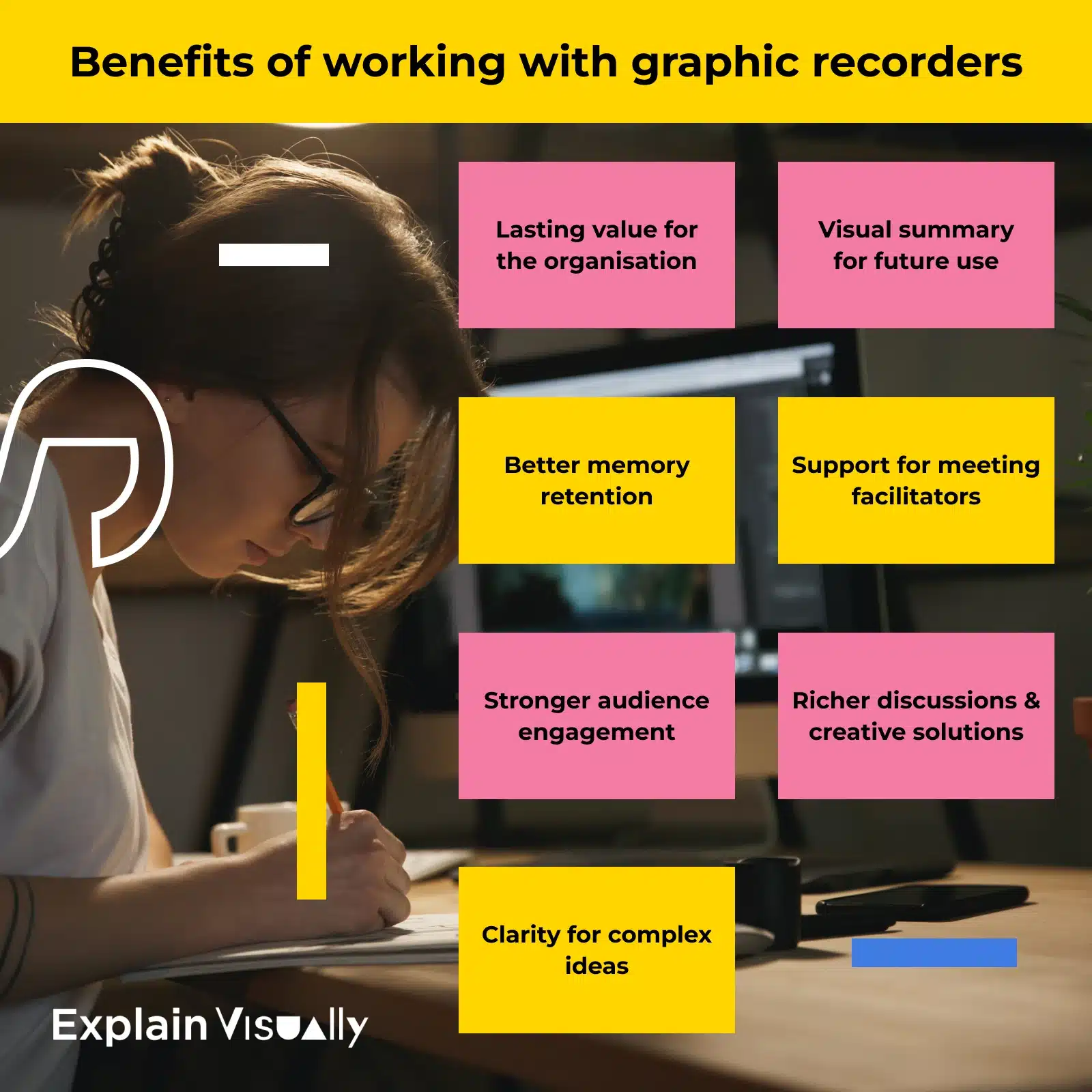
Graphic recording naturally increases engagement.
When participants watch their ideas and contributions come to life on a large sheet or digital screen, they feel heard and valued. This encourages more active participation, sparks new ideas, and leads to richer, more creative conversations. The visual narrative keeps everyone on the same page (literally!) and helps move discussions forward.
Working with a skilled graphic recorder also brings clarity to even the most complex ideas.
Visual metaphors, diagrams, and images reveal patterns and connections that might otherwise get lost in a sea of words. This visual thinking approach helps groups spot gaps, identify opportunities, and solve problems faster. The graphic facilitator’s work becomes a visual aid that supports decision-making and keeps meetings focused and productive.
And here’s something many people overlook:
The value of visual documentation doesn’t end when the event is over!
The visuals created during a graphic recording session become a lasting resource perfect for sharing across teams, using in follow-up workshops, or even posting on social media (see the example below) to amplify your message. These visual recording turn fleeting conversations into assets that can be revisited, shared, and built upon, making your investment in graphic recording truly pay off.
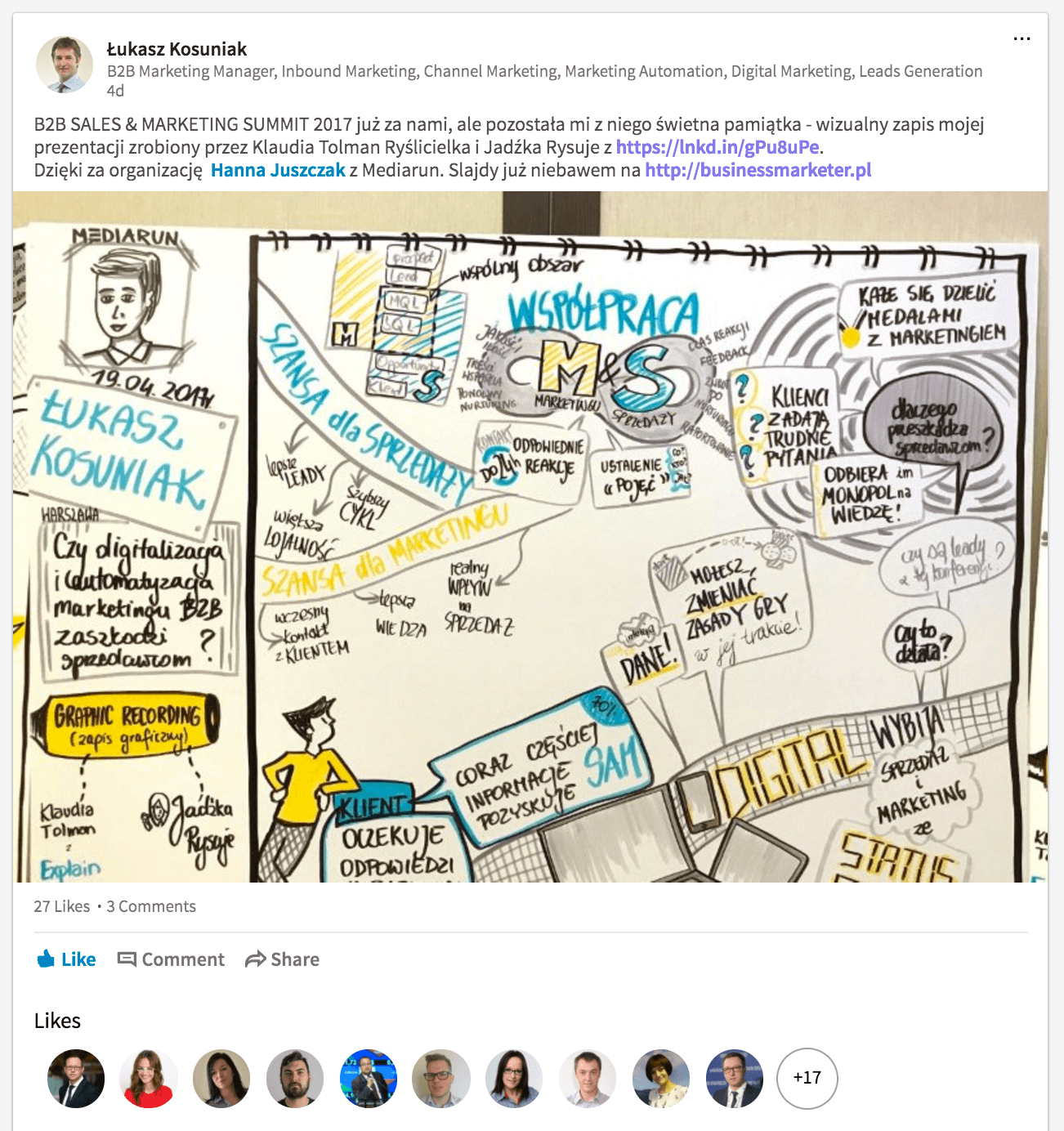
GR shared by Łukasz Kosuniak, Marketing Manager at Samsung and author of the blog businessmarketer.pl
The role of a graphic recorder
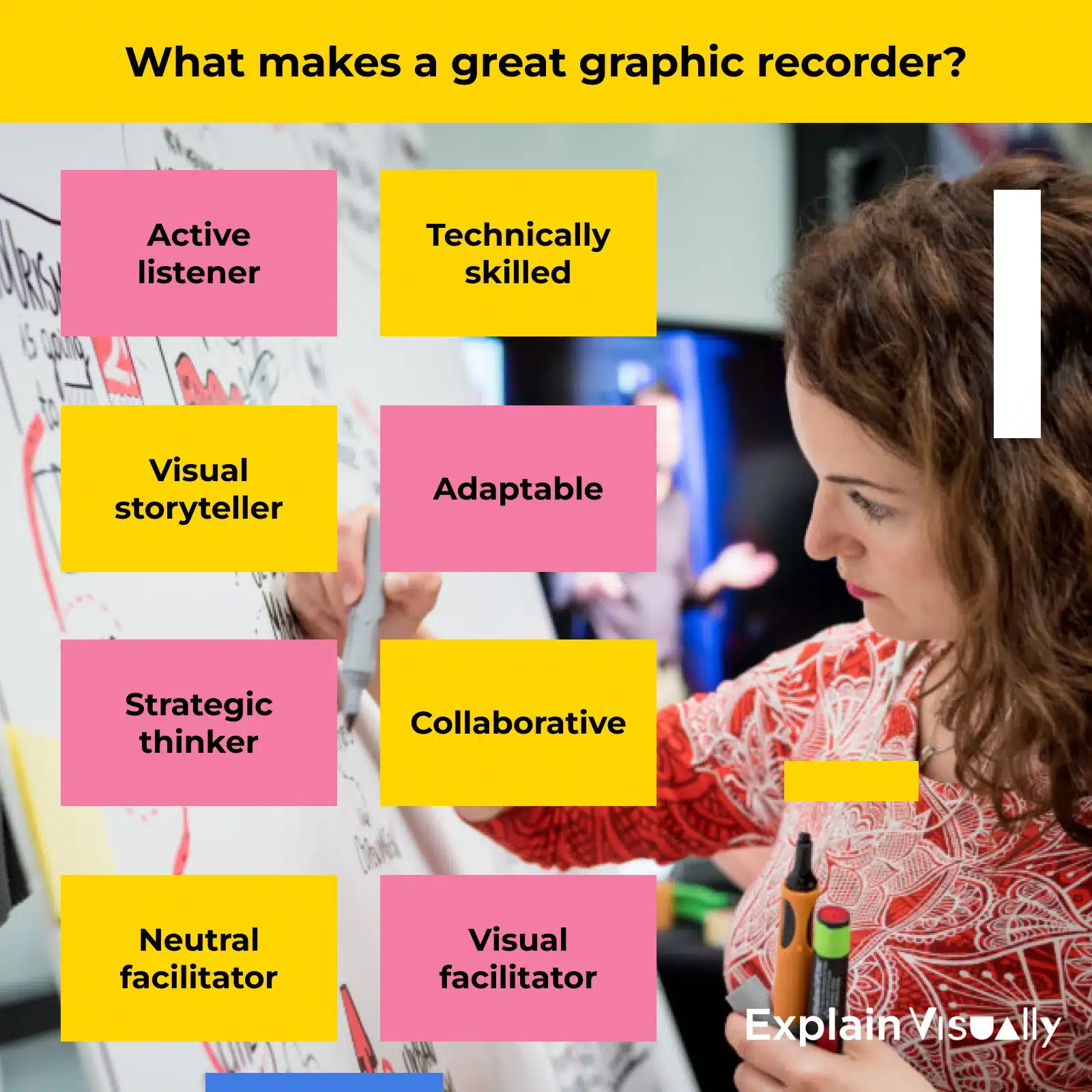
Think of a professional graphic recorder as much more than someone who sketches in the background. In reality, he is a sharp listener, a strategic thinker, and a visual storyteller all at once. His job is to tune in to every conversation, filter out the noise, and capture key ideas. Seen this way, the role of graphic recording is to turn attentive listening into instantly shareable, visual knowledge.
A graphic recorder is the bridge between spoken words and shared understanding, making every meeting more visual, memorable, and effective.
The real magic lies in his ability to combine active listening with rapid synthesis deciding on the spot:
- what matters most,
- how to visualise it,
- when to step in to clarify or confirm what’s being said.
This means he’s constantly making decisions which concepts deserve a visual metaphor, which moments need highlighting, and how to ensure the visual narrative truly reflects the group’s thinking.
A skilled graphic facilitator knows how to walk the fine line between being present and being invisible.
He’s there to support, not distract capturing the session’s essence while letting the conversation flow naturally. To do this well, he needs to understand the context and objectives of every meeting, remain neutral, and translate different perspectives fairly. This calls for empathy, cultural awareness, and the ability to work with diverse teams and communication styles.
Technical skills are just as important as artistic ones.
A great graphic recorder is comfortable working on large sheets of paper or switching to digital tools like the iPad Pro and drawing apps for virtual or hybrid events. He adapts his approach to suit the audience, the space, and the technology available always making sure the visuals are clear, accessible, and impactful.
And there’s a bonus, too…
Today’s graphic recorders often step into the role of visual facilitators!
They don’t just record events; they guide discussions by visualising patterns, sparking ideas, and steering groups toward consensus. Thus, they become active communicators, ensuring every voice is both seen and heard through shared visuals.
Visual facilitation is currently a highly sought-after skill and a valuable asset for any graphic recorder.
Graphic recordings in action
If you think graphic recording is just for creative workshops, think again. Its versatility shines across industries and settings.

In the tech world, graphic recorders are often found at the heart of product development sessions or innovation sprints. Here, visual note-taking looks impressive and helps cross-functional teams make sense of technical details, spot connections, and keep track of ideas. Visual storytelling transforms dense discussions into accessible visuals, making it easier for everyone to stay aligned and move projects forward. For agile squads racing toward tight release deadlines, the role of graphic recording is to act as a living blueprint that anyone can consult at a glance.
Corporate mergers and acquisitions represent one of the most challenging contexts where graphic recording proves invaluable. When two organizations join forces, they face complex integration challenges that extend far beyond financial considerations. Visual communication becomes essential during these critical periods, helping to bridge cultural differences and align diverse stakeholders around a unified vision.
Graphic recording helps employees understand organizational changes, new structures, and their role in the combined entity. The visual documentation serves as a lasting record that supports ongoing communication and decision-making throughout the integration process.
Healthcare organisations are also turning to graphic recording to capture the complexity of patient experience workshops and strategic planning sessions . By creating visual narratives, graphic recorders help diverse stakeholders (from clinicians to administrators to patients) see the bigger picture and tackle challenges together .
Academic and educational institutions have embraced graphic recording at research conferences and symposiums. When participants come from different disciplines, visual documentation acts as a bridge, helping them find common ground and spot opportunities for collaboration.
Government agencies and non-profits use graphic recording for public consultations and stakeholder engagement . Here, the value goes beyond documentation: visual summaries make policy discussions more transparent and accessible, ensuring that community voices are captured and shared with wider audiences . It’s a practical way to support democratic processes and build trust .
At international conferences and multi-day events, graphic recording is both an engagement tool and a method of documentation . As the visual story unfolds, participants can track key themes across sessions, revisit important points, and share highlights with colleagues who couldn’t attend . The result? Greater impact, better retention, and a visual record that extends the life and value of the event far beyond its closing session .
A lot to take in? And just think these are only a few examples 😁.
No matter the context (be it business mergers, healthcare transformation, education, or public service) graphic recording brings clarity, connection, and creativity to the table . It’s proof that when you combine technology, visual skills, and active listening, you can communicate complex ideas in a way that truly makes a difference .
Read also: Enhancing engagement. How graphic recording can enhance virtual workshops?
Visual thinking in modern business
Visual thinking is now a critical competency for business leaders navigating complex challenges and communicating across diverse audiences. Conceptualising problems and solutions visually helps executives spot patterns, relationships, and opportunities traditional analysis might miss. This cognitive shift towards visual problem-solving is driving increased adoption of graphic recording and related visual communication methods. In these contexts, the role of graphic recording is to distill insights into a shared visual language speeding strategic decisions.
Organisations that embrace visual thinking report improved innovation outcomes and faster problem-solving cycles. When teams can externalise their thinking through visual means, they’re able to build on each other’s big ideas more effectively and identify creative solutions that emerge from the intersection of different perspectives. This collaborative advantage becomes particularly important when dealing with complex challenges that require input from multiple disciplines or departments.
The integration of visual thinking into business processes also improves stakeholder communication and buy-in for strategic initiatives. Complex strategies and change programmes are more accessible when visuals reveal the big picture and individual roles. This clarity reduces resistance to change while improving implementation success rates.
Training programmes that incorporate visual thinking elements consistently demonstrate better learning outcomes and higher participant satisfaction scores. The combination of visual and verbal learning approaches accommodates different learning styles whilst creating more memorable and actionable learning experiences that translate into improved on-the-job performance.
Best practice for hiring a graphic recorder
We’ve saved the most interesting part for last:
How to choose the right person and company to show up at your event and do it well?
We’ll modestly suggest that you’ve already found the best ones, but to make your decision easier (or rather, to confirm it😉), here are a few key guidelines:
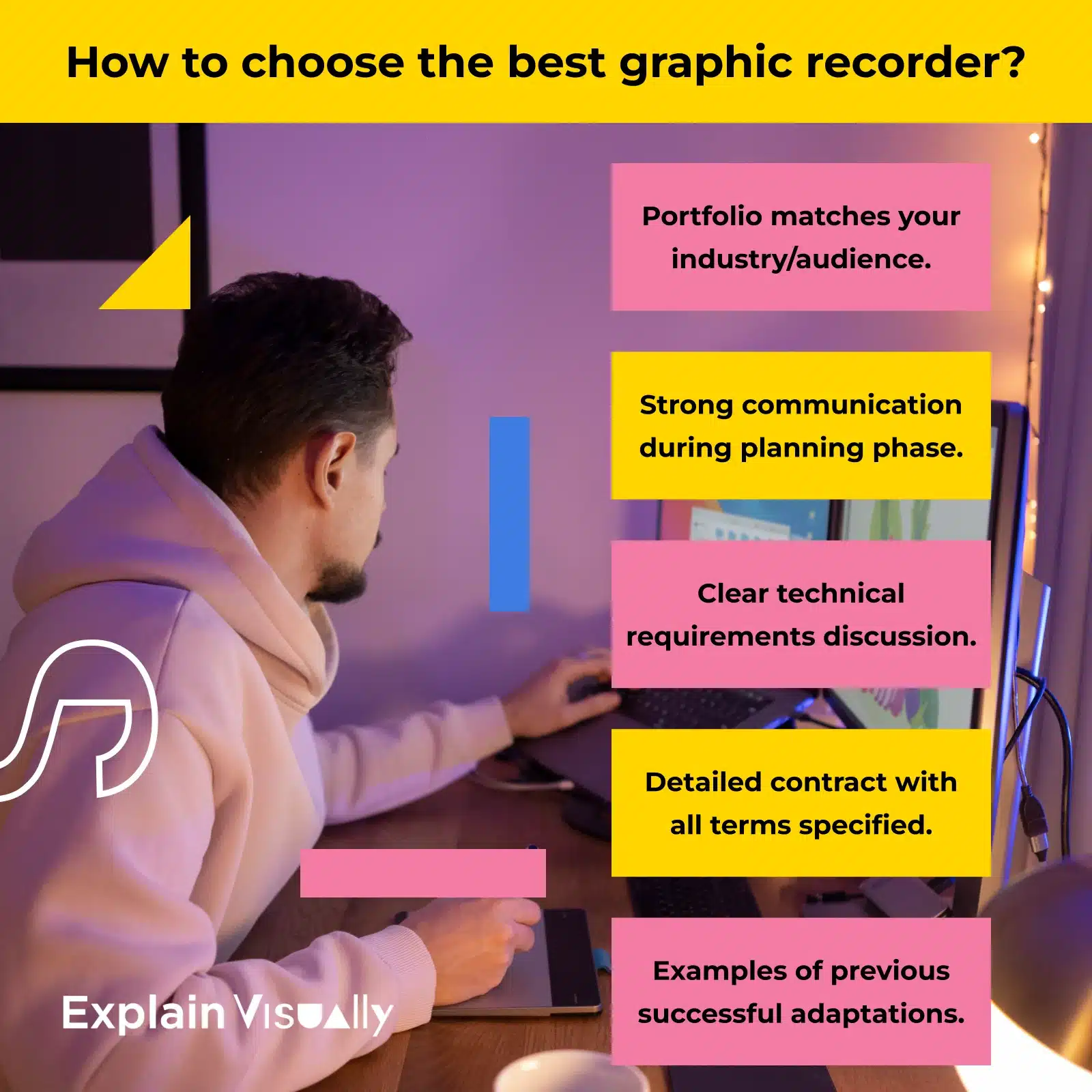
Selecting a graphic recorder demands assessing technical skills and cultural fit with your organisation and audience. Effective practitioners blend artistic talent, interpersonal agility, and insight into group dynamics. Choose professionals experienced with similar audiences; such background keeps their visuals relevant. Remember, the role of graphic recording reaches beyond drawing — it offers strategic facilitation in lines and colour.
Preparation and communication processes are equally important as technical skills when evaluating potential graphic recorders. The best practitioners will want to understand your objectives, audience characteristics, and content themes well before the event. They should be able to articulate how their approach will support your specific goals and provide examples of how they’ve adapted their methods for similar situations.
Technical requirements and setup logistics require detailed discussion to ensure successful outcomes. Whether working with traditional or digital formats, graphic recorders need appropriate space, lighting, and equipment to perform effectively. Recognising these needs early in planning helps avoid last-minute issues that could harm visual documentation quality.
Contract terms should clearly specify deliverables, usage rights, and cancellation policies to protect both parties and ensure clear expectations. Professional graphic recorders provide detailed proposals listing included services and possible extra costs, such as travel or post-event edits.