Most animations in YouTube Ads boost metrics, but not sales. See which motion patterns actually increase engagement that translates into revenue and when being visually impressive starts to hurt.
Most video animations for youtube Ads look dynamic. They have movement, pace, typography in motion. And then you look at the data and notice something uncomfortable. The views are there, the clicks are decent, but sales are flat. Interestingly, the problem rarely lies in the budget. More often, it’s that the animation is doing a different job than it should. If you want to increase engagement, you first need to decide which type of engagement actually matters on YouTube.
The “engagement” that actually matters on YouTube Ads (and how animation influences it)
If you optimize your campaign for “engagement” and mainly look at view rate, you are only seeing part of the picture. A view is a technical threshold. Revenue is influenced by different signals.
There are three areas that truly matter: view quality, intent signals, and post-click behavior. These are the three levels where animation can either strengthen performance or, simply put, seriously weaken it.
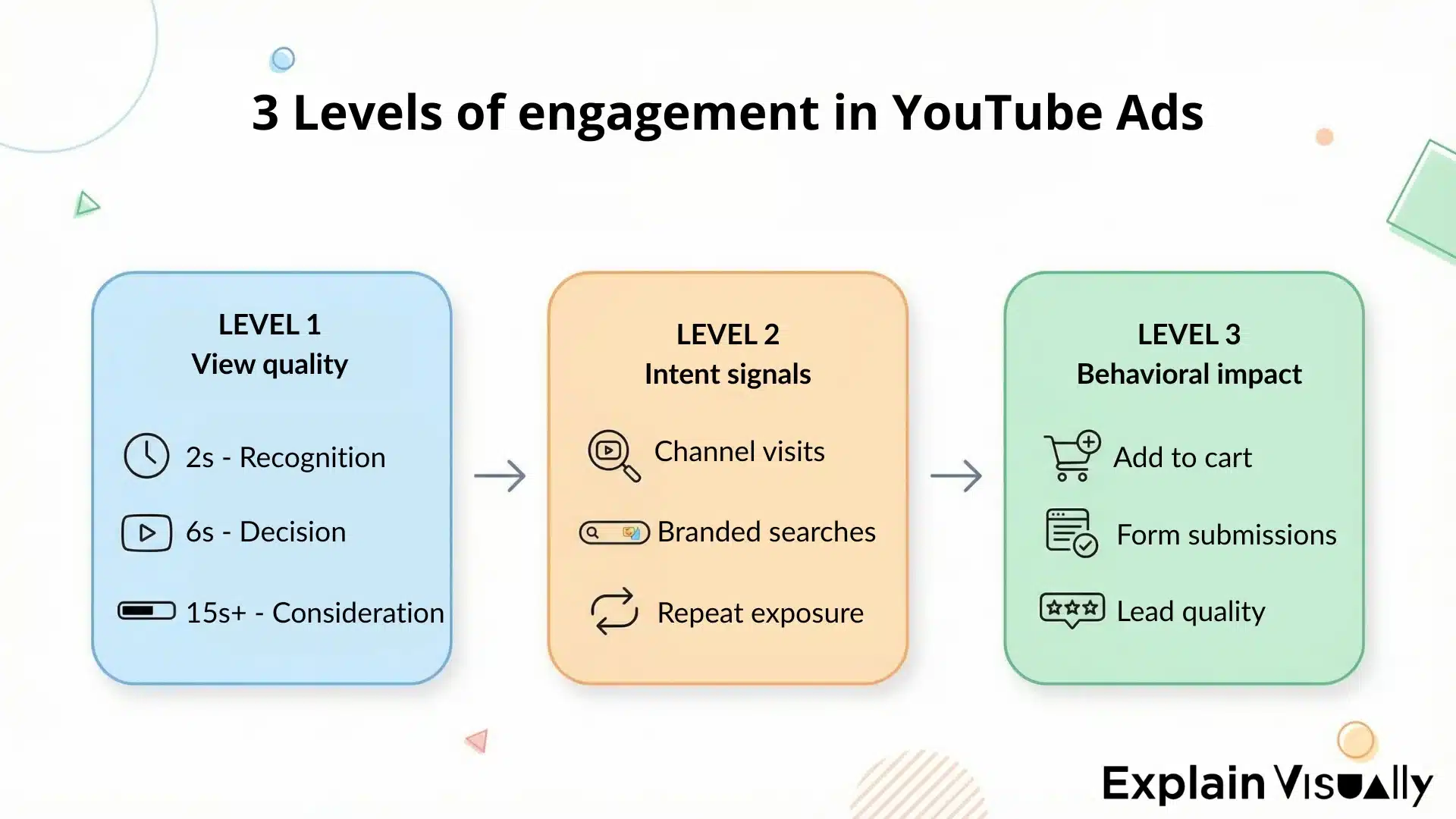
1. View quality
2 seconds… 6 seconds… 15 seconds and more.
These are three completely different cognitive situations.
Two seconds is a first impression test. The opening frame and the first movement must immediately answer the question: “what is this?”. If the animation is too abstract, overloaded, or aesthetic at the expense of clarity, you lose the viewer.
Six seconds is a decision point. The viewer gives you a credit of attention. Now the animation has to guide the eye and build tension. If you fail to outline the promised outcome within that time, attention fades and you most likely will not get a second chance.
Fifteen seconds and more is the consideration stage. Structure becomes critical. Movement should organize information. But be careful. Too much energy at this point lowers trust.
These three moments require a completely different approach to motion and pacing. Yet in many ads, everything is animated with the same intensity.
2. Intent signals
YouTube captures more intent signals than most teams account for. Channel visits, increases in branded searches, repeated exposures without rising irritation. Animation influences this subtly, but over time.
If you have a consistent motion language, viewers recognize you faster during the next exposure. Recognition shortens the decision process because the brain does not have to start from zero. If you change style, tempo, and tone every time, you create confusion. The campaign may look fresh, but brand memory suffers.
Scaling budget without a consistent motion logic rarely ends well.
3. Behavioral impact
This is where animation stops being decoration and starts being accountable. And it makes sense. A click and a moment of attention are only the beginning, a small success. What truly matters is what happens next. Add to cart, form submission, lead quality. That is what every seller of products or services is waiting for.
Animation sets expectations about the product. If you present it as instant, extremely simple, and effortless, the website has to confirm that promise. If it does not, the user will feel a disconnect. Sometimes it is better to show an authentic interface with a natural pace than a polished vision without friction. Motion can increase confidence, but it can also undermine it. That’s often the difference between interesting and profitable.
The hidden trade-off. Winning the skip moment vs building consideration
Not every campaign needs the same temperature of motion. On YouTube, the first battle is usually the skip moment in in-stream placements, or the thumb pause in Shorts and in-feed. In those situations, strong contrast, a fast entrance, and a clear rhythm make sense. For launches, short-term promotions, or remarketing to a warm audience, intensity reinforces impulse.
But when the viewer is just getting to know the category or has to make a larger financial decision, too many stimuli start to get in the way. A pace that is too fast makes information harder to process. And when something is hard to process, skepticism increases.
Calmer animation creates space for understanding. One dominant source of movement. Clear hierarchy. A moment of pause at an important message.
Before you decide on a style, answer one question: does your audience need a stimulus right now, or certainty?
Choose your animation based on the ad’s job, not the style
The same type of animation can work flawlessly in one campaign and completely miss the mark in another. The difference usually lies in the job that the creative is supposed to do. The truth is, the most common mistake happens very early. The team debates whether to use 2D, 3D, kinetic typography, or UI-based motion instead of answering a simpler question: what is this ad actually supposed to accomplish?
Before you start thinking about form, define the role of the ad within the larger system. Is it meant to attract new audiences? Clarify the value? Ease doubts? Drive action?
Four ad jobs (and the animation behaviors that serve each)
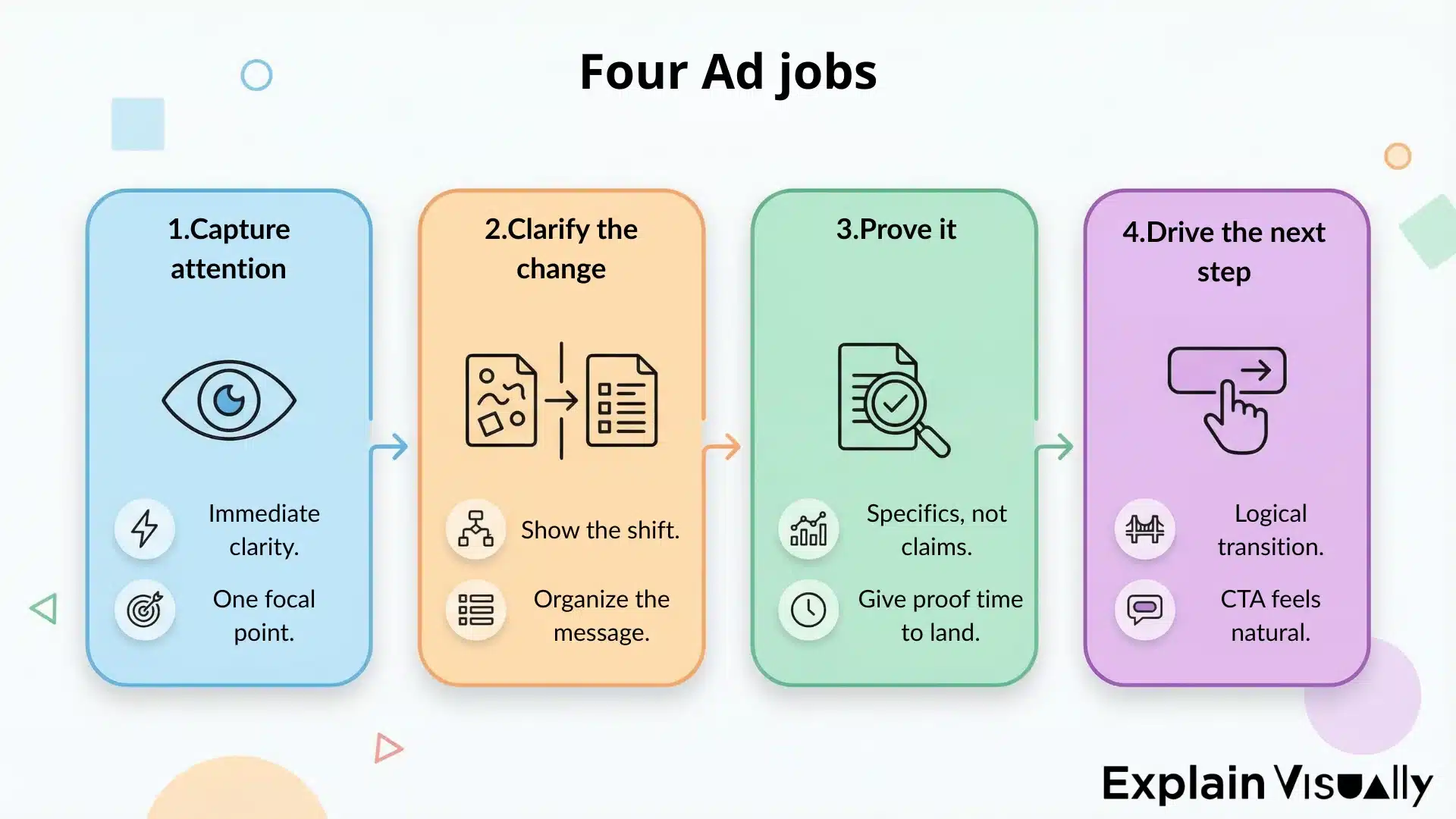
1. Capture a new viewer’s attention
In campaigns aimed at cold audiences, immediate clarity of the situation is critical. The viewer has to quickly recognize the context and decide whether it concerns them. Movement should be decisive and unambiguous. One dominant element. A clear focal point.
2. Clarify what it changes
When the audience already recognizes the brand or the problem, there is room to refine the message. Here, animation organizes the narrative. It shows relationships, change, outcome. The pace can be calmer because the goal is understanding, not just stopping attention.
3. Make the promise credible
There is a saying in legal circles that without evidence, everything falls apart. The same applies to animation. This is where specifics should appear. A fragment of the interface, a concrete number, a result, a process shown without shortcuts. This moment has to be clear and given space.
Many ads speed up at this point. That is a major mistake. Evidence needs a moment to be processed. If you rush through it at the same tempo as everything before, the viewer has no time to register it.
4. Lead to the next step
Make the next step easy. The CTA should not feel detached from the rest. If you have already shown change and evidence, the transition to action should follow the logic of the narrative. Animation can subtly guide the eye toward the button, simplify the message, and present the next step as a natural consequence.
A sudden increase in pace and an aggressive call to action often ruins the effect built over the previous seconds.
If you want to go deeper into execution, read our breakdown of animation techniques that support clarity, proof, and performance: Top 15 animation techniques You should master for stunning visuals.
Top 15 animation techniques You should master for stunning visuals
The engagement-first animation patterns that consistently perform in YouTube Ads
You don’t need trends. You need patterns that survive testing cycles. What matters are motion patterns that consistently deliver results, provided they are used in the right context.
Each of these patterns works for a specific reason. Each can also hurt performance if you use it without understanding the situation.
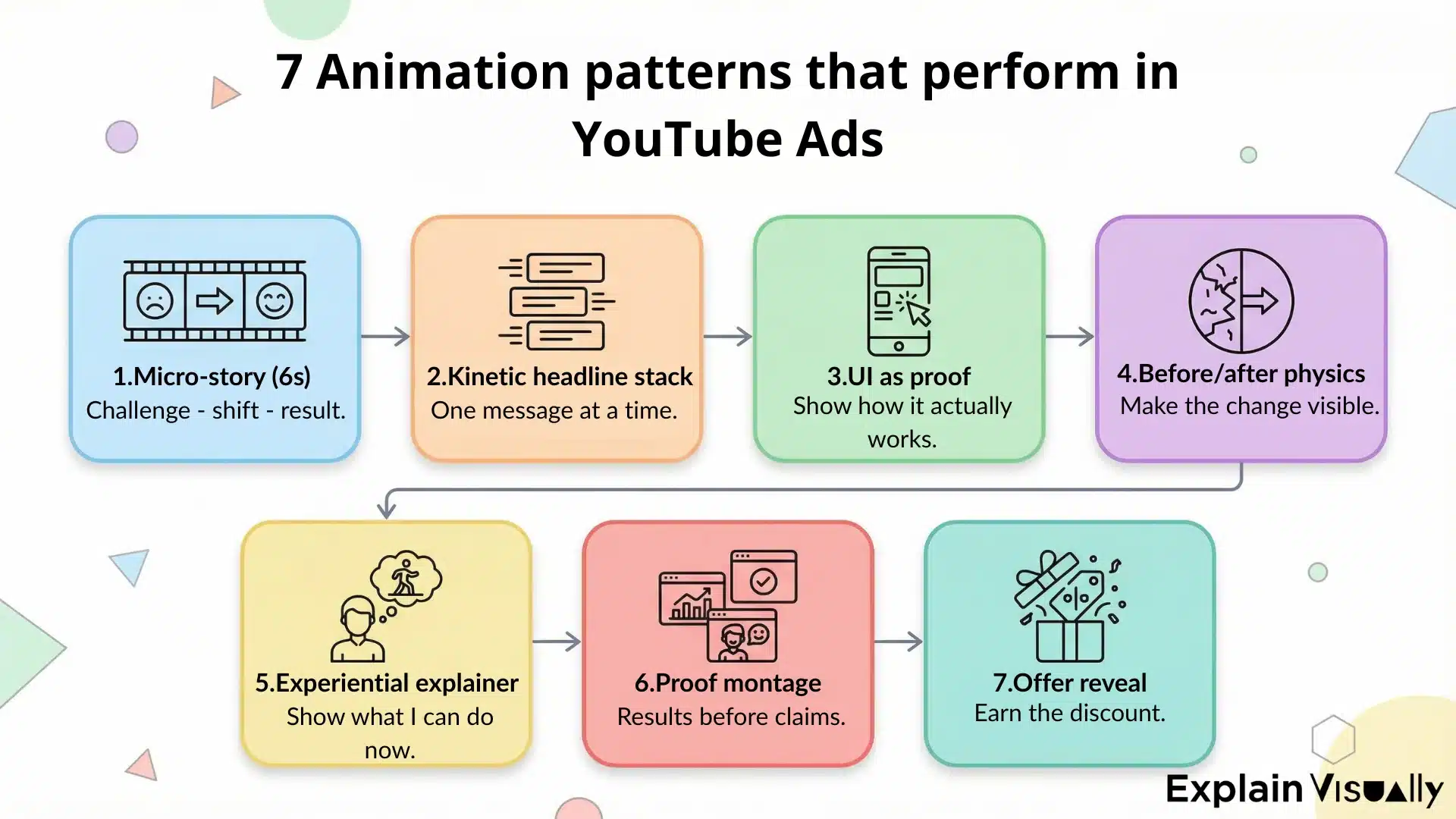
Pattern 1: The “Micro-story in 6 seconds”
This is one of the strongest formats for short placements. In six seconds, you can show tension and its resolution. Your task is not to tell a story, but to show a change. It works especially well when the product is easy to visualize. Instead of explaining a feature, you present the starting situation, the turning point, and the outcome.
-
In a 6-second bumper, this micro-narrative has to be extremely condensed. One problem. One movement of change. One effect.
-
In 15 seconds, you can add minimal context.
-
In 30 seconds, you can introduce an element of credibility.
This pattern fails when you try to fit too much into one sequence. Two transformations in six seconds create chaos. The key is one tension and one visible difference.
Pattern 2: The “Kinetic headline stack”
Moving typography can stop attention faster than imagery. A word in motion is harder to ignore than a static frame. The problem begins when everything moves at once.
This pattern works when the text carries the main promise and animation gives it hierarchy. One headline enters first. The second refines it. The third completes the meaning. Movement should guide the eye in a controlled way. It cannot simulate energy just for the sake of energy.
What is the most common mistake we see? Several animated lines at the same time, different entry directions, no pause between messages. The viewer does not read. They simply register chaos.
A simple rule applies: at any given moment, only one element should move. The rest supports it. Contrast in size, light, and pacing builds structure. If every word has the same visual weight, none of them stays in memory.
This pattern works well in campaigns where the message is strong and clear. For products that require explanation, typography alone is not enough. It needs support from imagery or interface.
Pattern 3: The “UI-as-proof” animation
In the case of digital products, the interface itself is often the strongest asset. Instead of building visual decoration around the product, show how it actually works. A real flow, a specific action, a visible result. This reduces uncertainty faster than even the most polished transitions.
This pattern works especially well for SaaS, fintech, or apps where the viewer wonders whether they will manage. Details matter: clear steps, a visible completion of an action, a natural pace. Movement that is too fast or overly polished makes the interface look like a mockup.
Do not show everything. One process is enough. UI in an ad does not have to impress with aesthetics. Its main task is to build the belief that it is real and usable.
Pattern 4: The “Before/After physics”
This framework works because the brain processes difference faster than description. Instead of saying something is faster, cheaper, or simpler, you show friction and then its disappearance.
It can be shortened time, fewer steps, a simplified screen, fewer elements on an axis. Movement should visualize reduced effort or a shift from chaos to order. A well-executed before/after does not shout. It shows the difference and lets the viewer judge it.
The most common mistake is exaggeration. A transformation that is too theatrical looks like a special effect, not a real improvement. Interestingly, the more expensive or complex the product, the more subtle the change should be.
Pattern 5: The “Explainer that doesn’t feel like an explainer”
A classic mistake: “let’s show how it works” and suddenly it turns into a mini training session. Too many steps, too many arrows, too much narration. A better approach? Show what you can do right now.
Instead of explaining the entire mechanism, choose one use case. One situation. One effect. The animation should guide through the experience.
This pattern works when the product is new or requires a change in behavior. It fails when you try to fit the entire system logic into a few seconds. Remember: one concept per moment. One visual shortcut per idea. Everything else only blurs the message.
Pattern 6: The “Proof montage”
Numbers and testimonials can persuade faster than the best narrative. The problem is that they are often presented too aggressively. Large percentages, loud animations, fast transitions. This builds pressure and has nothing to do with credibility.
A good proof montage has rhythm. First the result. Then brief context. Sometimes a limitation. Who it works for. That order makes your message sound realistic.
Animation should emphasize specifics. A subtle movement on a number, a clean entrance of a quote, a visible source. If everything pulses and pops, the viewer stops believing.
Pattern 7: The “Offer reveal”
A promotion can quickly improve results, but presented poorly it lowers perceived value. If you communicate a discount like a clearance banner, the entire earlier narrative loses weight.
Offer reveal means building tension before showing the concrete offer. First context and argument, then the discount or bonus. Movement should guide the eye and gradually narrow focus instead of immediately throwing the discount onto the screen.
For premium brands, this is especially important. The offer should feel justified. It is not a desperate message.
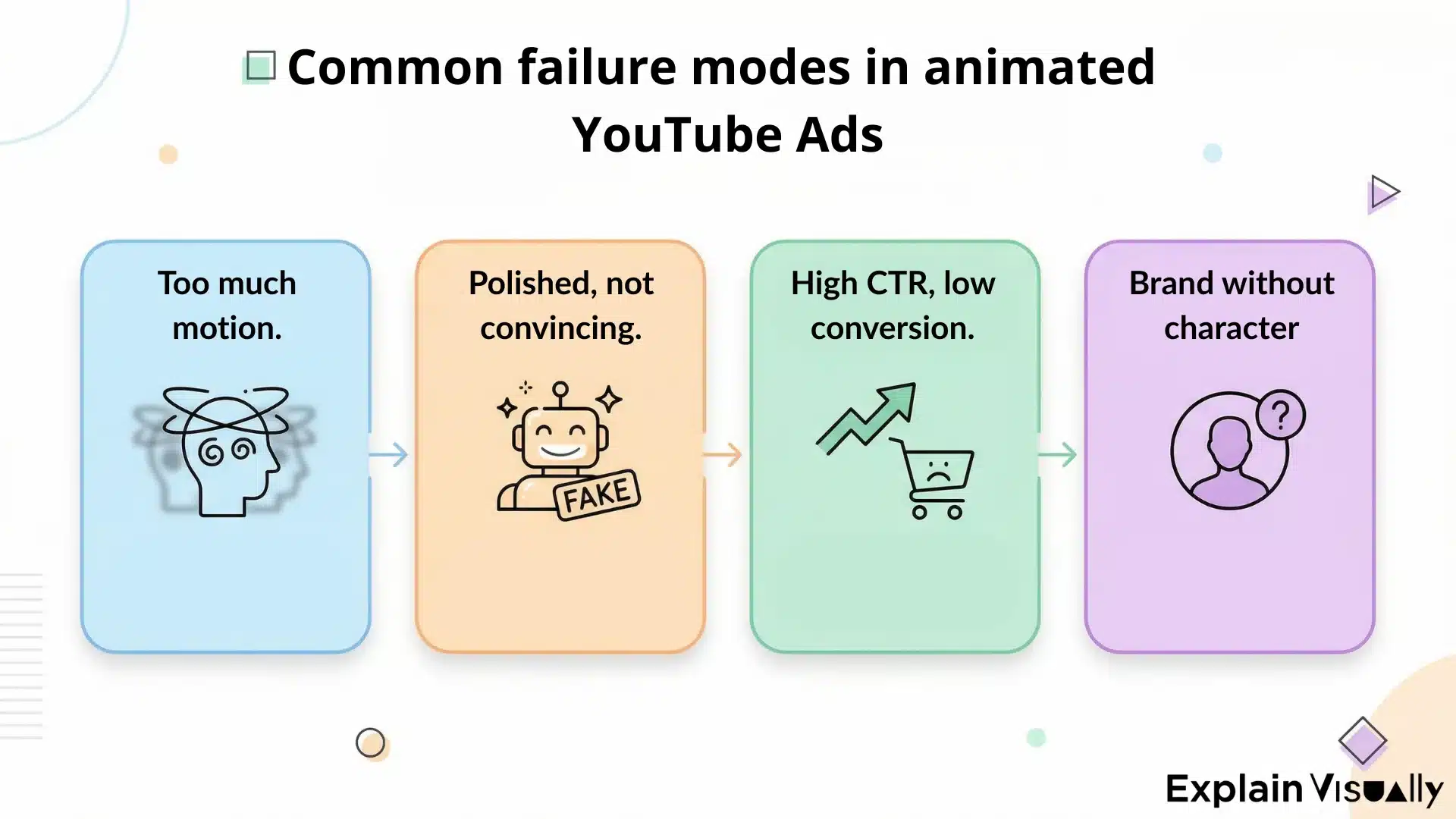
Common failure modes and the fixes that protect business outcomes
-
Too much motion, too little meaning.
This is one of the most common problems. Everything moves. Background, text, icons, transitions. The result? The viewer does not know where to focus. Movement is supposed to direct attention, not scatter it. If every element fights for priority, none of them wins. In practice, one element should dominate at any given moment. The rest should support it.
If your ad looks impressive but is hard to summarize in one sentence, the animation is probably covering up the message.
-
Polished, but… not convincing.
Refined aesthetics will never replace substance. Gradients and smooth transitions do not build credibility on their own. If there is no proof in the ad, no number, no result, no fragment of a real process, no testimonial, the viewer is left with an impression. Arguments are missing.
Ask yourself a simple question: is there anything in this animation that can be verified? If not, it is difficult to expect a decision.
-
High CTR, low conversion.
This is the point where many teams start increasing the budget or changing the landing page. Yet the problem often begins earlier.
The animation may have promised something different from what the user sees after clicking. Pace, simplicity, scope of possibilities. All of this builds expectation. If the experience does not match it, disappointment appears. The ad cannot present a better version of reality that does not align with the truth.
-
A brand without character.
Many animations could belong to any company in the category. The same transitions. The same icons. Similar dynamics. After a few exposures, it is hard to tell who is actually speaking.
Movement leaves a trace in memory. If it looks different every time, recognition is difficult. If it looks like everything else, it fades into the background. You need to find the balance. Sometimes a repeatable way of introducing text, consistent pacing, or a specific use of space is enough. At the next exposure, the viewer will connect the dots faster.
The simplest way to decide which animation will be best for your YouTube Ads
After so many patterns, rules, and mistakes, it is easy to ask another question: which option should you choose now?
The simplest answer is this: choose the animation that reduces your audience’s uncertainty the fastest.
-
If someone does not know you, the uncertainty is about whether this is even for them.
-
If they know the category, they wonder whether this solution actually changes anything.
-
If they are close to making a decision, they want to be sure they are not making a mistake.
Animation should shorten the path to that certainty. Sometimes it will do that with a strong opening. Sometimes with a clear presentation of the process. Sometimes with a calm and precise display of proof. Before you choose a style, answer one question: what doubt dominates in my audience’s mind at this moment?
If motion helps resolve it, you are close to the right decision.
Selecting the right animation partner or approach
Many studios start with style. Moodboards. References. Inspiration. It is an enjoyable part of the process, but not the most important one. In our view, the key issue is whether someone can translate a campaign goal into a concrete creative hypothesis. More specifically:
– Do they understand at which stage of the funnel the ad operates?
– Do they know exactly what should change after someone watches it?
– Do they think about test variants before the final version is produced?
In practice, the best projects happen when animation is treated as a system. With opening variants, different proof blocks, and the ability to quickly swap messages without rebuilding everything.
This approach requires experience in both motion design and performance campaigns. It is at the intersection of these two worlds that creatives are built which look good and, just as importantly, maintain results when the budget scales.
If you are choosing a partner, look for a team that can talk about data as comfortably as they talk about motion.
At Explain Visually, this is how we work. We start with the campaign goal and the stage of decision, and only then design movement. Every animation is treated as part of a system that can be tested, shortened, expanded, and adjusted based on results.
If you want a practical next step, audit one of your current YouTube Ads against three questions:
– What doubt does it resolve?
– Where is proof given time to land?
– Does the landing experience match the promise created by the motion?
If you’d like, we can run that audit with you and propose 3–5 testable hook and proof variants.
Frequently Asked Questions
What are video animations for YouTube Ads and how are they different from regular video?
Video animations for YouTube Ads are built for one specific job: performance inside youtube placements. That changes everything. The pacing, the opening frame, the sound effects, the way the message lands.
An animated video for awareness and an animation video built for paid distribution are not the same thing. In ads, every second has a role. The first few seconds determine whether viewers watch or skip. The structure must explain fast, deliver proof, and lead somewhere measurable. This is closer to performance engineering than pure content creation.
Do small businesses really need animated video for ads?
Small businesses often assume animation is only for large brands. In reality, animation can simplify production and reduce cost compared to live-action promo videos.
You can create business videos without filming, locations, or actors. That gives smaller teams more control over the message, the style, and the process. What matters is not budget size, but clarity of strategy. Animation helps explain complex services in just minutes, which is often critical when targeting new customers.
Can we use animated video templates or an animation maker instead of hiring a studio?
Animated video templates and animation maker tools are useful if you need something fast. For internal social media posts, simple promotional videos, or quick experiments, they can work.
But templates come with limits. The animation styles are fixed. Transitions, fonts, elements, and music are pre-set. You can customize colors and images, maybe fine tune a few clips, but the structure is usually generic. If the goal is performance in youtube ads, a template rarely addresses the specific doubt your audience has. It helps you create. It does not always help you convert.
How do I know which animation style is right for my business?
Animation styles should follow the stage of the decision, not personal taste. If you are launching to cold viewers, clarity and contrast matter more than complexity. If you are targeting warm customers, proof and pacing matter more than spectacle.
Before you browse a gallery of stunning animations, ask: what uncertainty needs to be resolved? The wrong style can distract from the message. The right one reduces friction in the mind of the audience.
How long does it take to create animations for YouTube Ads?
With the right process, you can start making structured animated video assets within weeks, not months. The timeline depends on scope, feedback cycles, and how quickly decisions are made.
If you rely on templates, you can generate something in just a few clicks. But speed alone is not the goal. The question is whether the final video delivers clarity, proof, and alignment with your website or app experience.
Can animation work without strong storytelling?
Animation without storytelling is just motion. And motion without direction often feels impressive but empty.
Even short promo videos need a story. A simple shift. A before and after. A change in state. Good storytelling explains why something matters in real life. That applies whether you post on facebook, instagram, or your own channel.
What role do sound effects and music play in animated ads?
Sound effects and music amplify moments, but they cannot fix a weak structure. Many viewers watch in browser with low volume or muted autoplay. The animation must still explain visually.
When sound works, it supports emphasis. A click, a subtle drop in music before a key proof point, a rhythm that matches transitions. Used carefully, audio increases perceived quality. Used aggressively, it feels manipulative.
Is AI replacing professional animation services?
AI tools can generate ideas, images, and even short clips. They can help teams brainstorm, load references, or edit content faster. They are becoming part of modern tools.
But AI does not understand your funnel, your customers, or the psychology behind why viewers hesitate. Professional video services are not just about generating media. They are about choosing what to animate, what to leave out, and how to explain details without overwhelming the audience.
What makes an animated video engaging rather than just visually stunning?
Stunning videos can attract attention. Engaging animation keeps it and directs it. The difference is structure.
If viewers watch but do not act, something is missing. Maybe the proof was rushed. Maybe the message was unclear. Maybe the landing experience did not match the promise. Engagement is not about visual power. It is about reducing doubt step by step.
What should I prepare before starting an animation project?
Clarity beats inspiration. Before you upload a brief or start a conversation, define the core idea. Who is the audience? What stage are they in? What action should they take after they watch?
Bring examples if you have them. Screens from your website. Details about your services. Past business videos. Performance data from previous ads. The better the input, the easier it is to explain, animate, and deliver something aligned with your brand and business goals.