

Animations generated with the help of generative AI are developing rapidly, but it’s the collaboration between humans and algorithms that delivers the best results in the animation industry. Not fully convinced yet? By the end of this article, you won’t have any doubts. We’ll explore how animations in generative AI results can speed up production without sacrificing the human intention, taste and storytelling that make animation truly memorable.
If you open TikTok, LinkedIn or pretty much any technology newsletter today, you’ll see the same thing: examples of innovative tools that can create animation in a matter of seconds, automatically generate characters, clean up backgrounds, smooth movement and generally perform small miracles. Meanwhile, somewhere in a studio, an animator is sketching a character’s face by hand, searching for the right gesture and adjusting a line of dialogue because something just feels off.
And that’s where the question comes in, the one that keeps appearing more and more often in the industry:
Will animations created with the support of generative AI replace humans, or will they simply become another tool in the animator’s toolbox?
Exactly…
It’s not a new question. It emerges every time technology accelerates faster than the industry is ready for. It appeared when Disney introduced rotoscoping. When the first computer animations were created. When motion capture began to resemble the movement of a real actor rather than a rubber puppet.
Every time, some people said: “This is the end of hand-drawn animation.” And every time, it turned out not to be the end. Just the beginning of another chapter.
From pencil to algorithm
Animation has always been a hybrid of two things: technique and vision.
This footage comes from a 1938 short film titled “How Walt Disney Cartoons Are Made.
Once, it was pencils, paper, a desk lamp and endless in-between frames. Animators spent whole days perfecting details that the viewer could only perceive subconsciously, yet without them, a scene lost its rhythm, energy and natural flow. Then came graphic tablets, digital drawing software, storyboards built in programmes instead of on cardboard, animacja 3D, and later tools powered by machine learning and generative models.
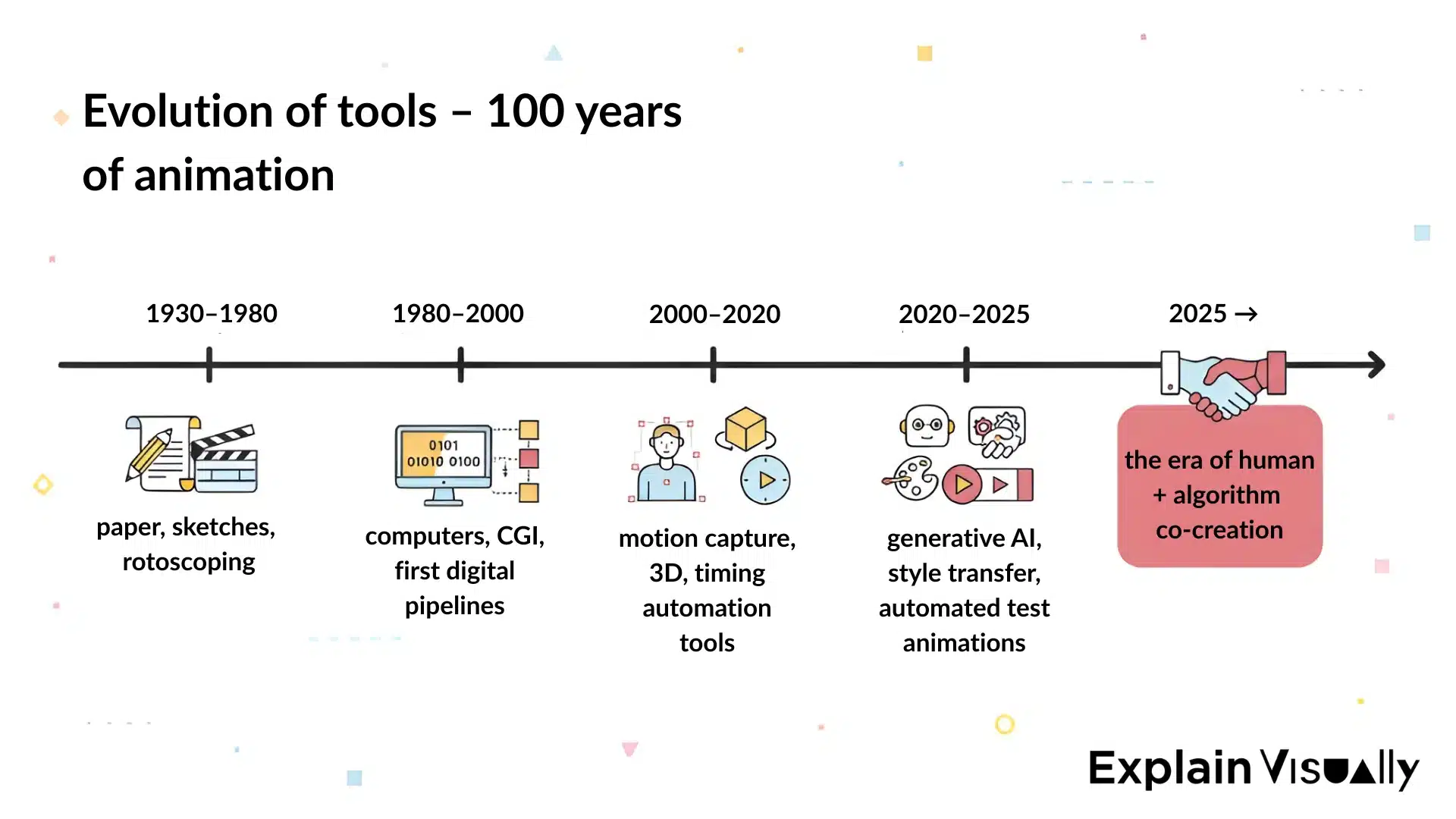
Each time, the animation process changed, and funnily enough, each time the industry was divided. Some said that this time it was finally, undeniably the end of the craft and from now on it would be only technology. Others calmly replied that we’ve always used tools – and a pencil is also a technology. We’ve always been (and still are) in that second group, because in our view, the truth tends to sit somewhere in the middle. Today, we see a similar split when discussing how animations in generative AI results should complement, rather than replace, human creativity.
In one interview, Tomm Moore (co-creator of “The Secret of Kells”) said a sentence that fits today’s discussion perfectly:
“Technology helps us draw faster, but it will never teach us why we draw the way we do.”
And that’s probably the heart of it. You can create realistic movement, perfectly match lighting angles and smooth out every contour of a character. But if there is no intention underneath, the animation becomes like a beautifully sketched map of a city where no one actually lives.
New tools aren’t new enemies
If we look at the history of animation further back than a single decade, a clear pattern appears. Every generation of creators had its own technological fear. For example:
– Rotoscoping was supposed to kill frame-by-frame hand-drawn animation.
– CGI was meant to make traditional drawing unnecessary.
– Motion capture was expected to replace character animators.
– Automatic tweening was believed to push timing and movement specialists out of the industry.
And yet none of that happened. No disaster, no extinction event. All these technologies eventually became just another part of the craft. And no one is surprised anymore that an animation may start as a sketch, move through motion capture and end up as cel-shaded 2D with an anime aesthetic or as a minimalist web animation style. In the same way, we expect that animations in generative AI results will simply become another flexible stage in this creative pipeline, rather than a radical break from everything that came before.
Today, generative AI enters as yet another tool in the kit. It suggests character designs, generates alternative visual styles, and allows ideas to be tested before entering full production. You could say AI handles the parts that animators simply don’t want to repeat for the hundredth time 😆.
There is still one area algorithms don’t touch: they don’t know why animation works.
They can make movement realistic. They can create a style. They can replicate the stiffness of armour, the softness of fur, or the weight of a clown walking through a rainy street. But they cannot sense what makes a viewer smile, go quiet, cry, or think about a scene a week later. For now (and likely for a long time), AI can process data but it has no creative intuition, lived experience, or emotional filter.
Want to expand your perspective? Have a look at: What is 2D animation? Your introduction to the basics.
What does generative AI do brilliantly?
Let’s start with the positives, because there are genuinely many of them. Ignoring them just because they sound a bit too technical would be unfair to what modern algorithms are already capable of.
Generative AI has a knack for doing the things that were necessary in animation for years, but never truly enjoyable. It can shorten production time, especially during the testing or concept phase. It can suggest a character design, generate several background style variations, improve movement smoothness or even propose realistic facial expressions, before the creator finishes their coffee.
And we know perfectly well that if you’ve never worked directly in animation, it’s difficult to feel what that really means. But trust us: animators know exactly which parts of the process drain all creative energy – adjusting the angle of a hand, endlessly matching mouth shapes to dialogue, or retouching details that will appear on screen for barely a second.
So what does AI-assisted animation do in those moments? We like to joke that it behaves like a young (but clever and obedient!) intern who knows every keyboard shortcut, doesn’t complain and never asks if it’s time to go home. It can handle part of the work automatically, give a sensible starting point for others, and simply speed up the rest. It doesn’t make artistic decisions, but it removes the burden of mechanical tasks from the creator.
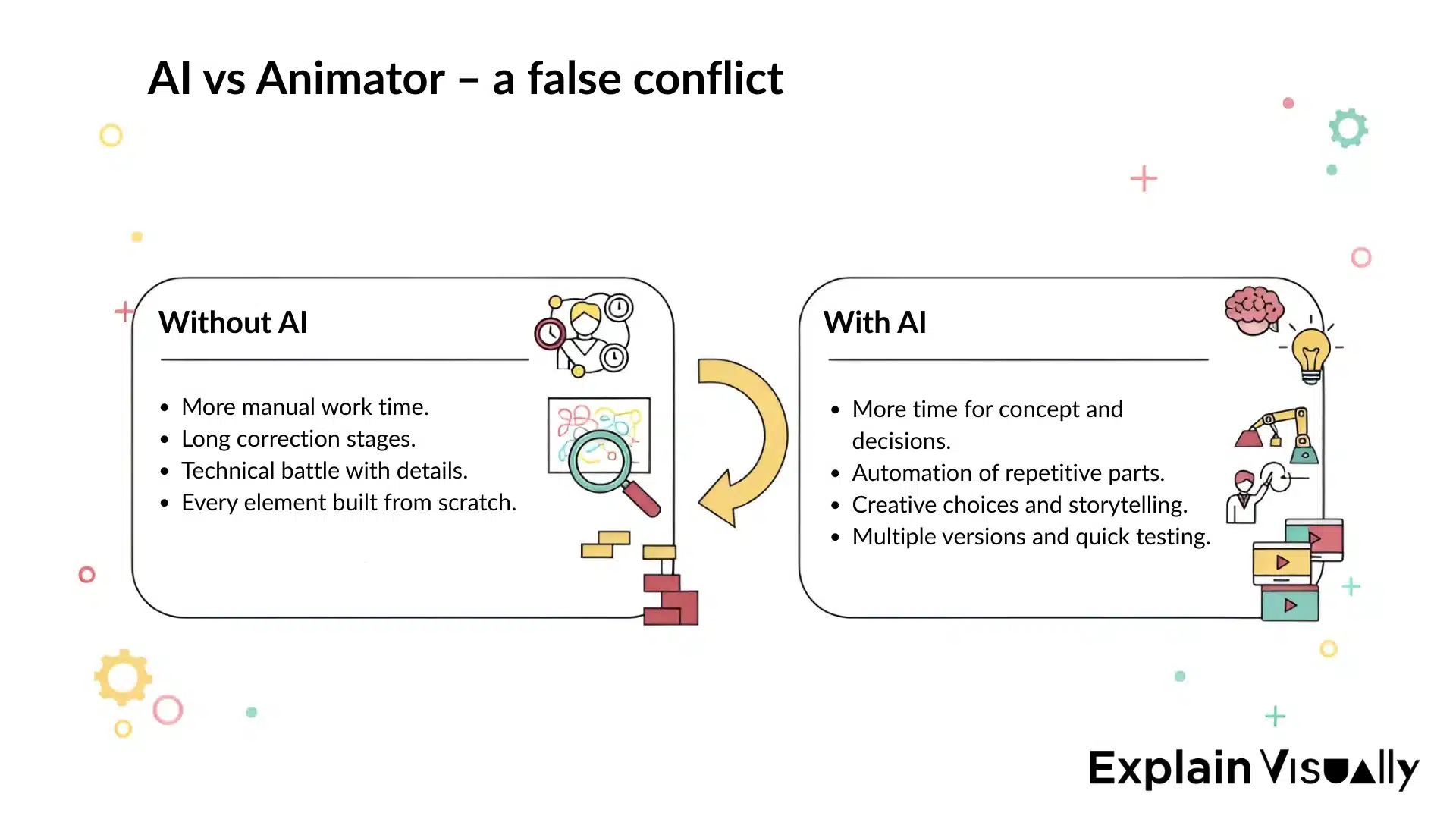
The greatest value of AI is that it gives animators time back. Time that has always been missing for experimenting, testing style, and searching for the tone of a story, instead of endlessly perfecting technical details. By offloading repetitive tasks, animations in generative AI results can act like rapid prototypes that free artists to focus on nuance, storytelling, and emotional impact.
Generative tools move aside the bits that don’t require talent, only patience.
And that’s the golden thought worth remembering.
What do AI technologies still not see – yet?
And here’s where the second part of the story begins. AI can create realistic character movement. It can generate backgrounds of absurdly high quality. It can produce a style inspired by virtually anything. But…
Does AI understand why “Shrek” doesn’t look like “The Lion King”? Or why a character can “speak with their eyes” even if their face consists of only three simple shapes? Those things can’t be calculated with a formula. They come from sensitivity, culture, experience, observation and humour, all the things that live inside the mind of a designer, an animator, a director.
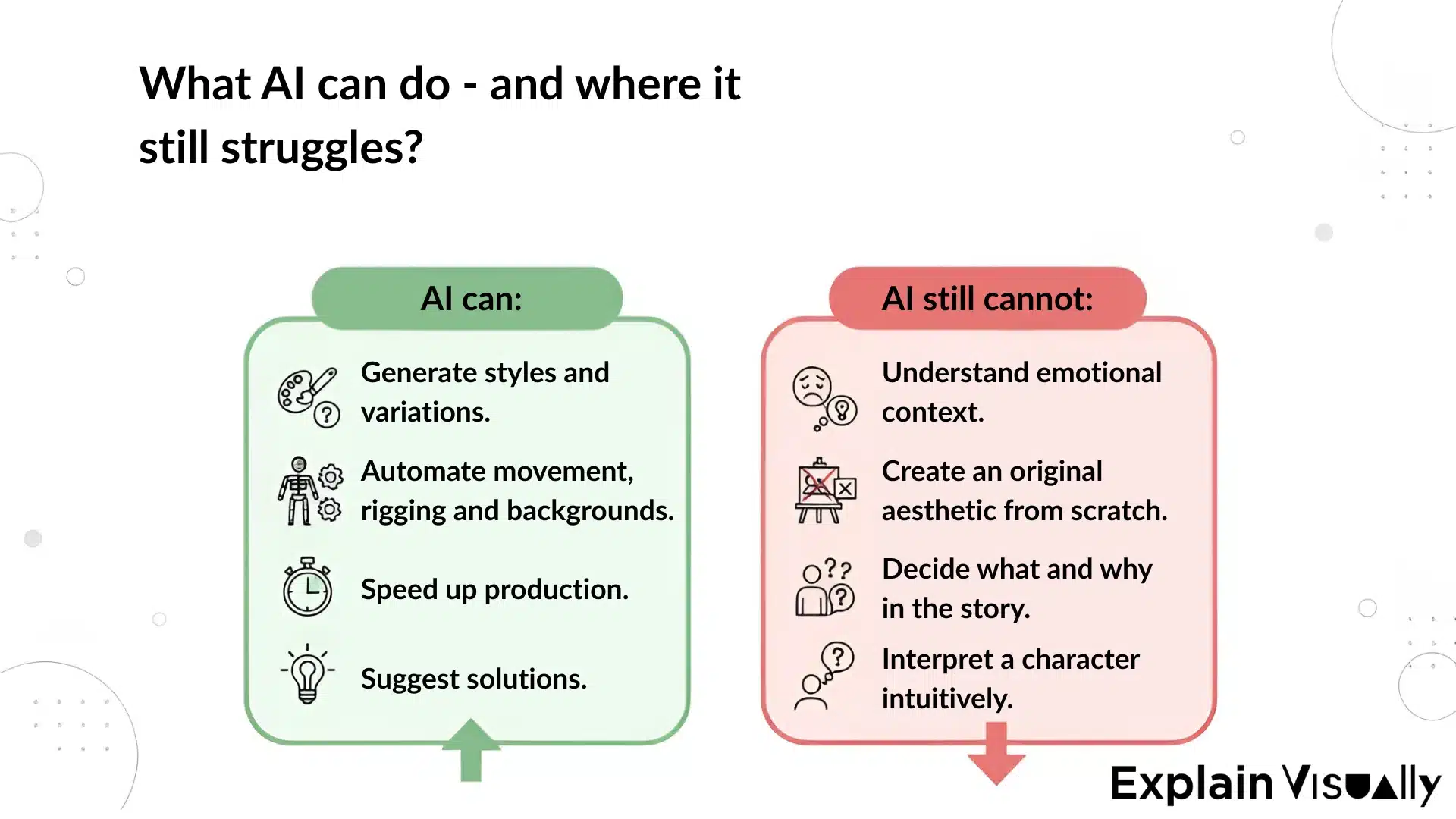
As you can see, algorithms can process aesthetics, but they don’t feel emotional intention.
And that’s exactly why the best animations still have small imperfections. A slightly uneven line. A gesture that’s just a bit exaggerated. A timing that isn’t mathematically perfect. It’s not a mistake or a lack of polish. It’s simply the creator’s signature.
2025 – the year the animation industry openly debated and protested against AI
In June 2025, during the Annecy Festival, the topic of generative AI moved from theoretical discussion into a real conflict. International unions of animators, voice actors, screenwriters and storyboard artists announced a protest. It wasn’t a rejection of the technology itself, but rather of how quickly it was being adopted without clear ethical standards or reflection on the consequences for the job market. For many of the protesters, it was crucial that the use of animations in generative AI results be transparent, fairly compensated, and grounded in respect for human authorship.

Placards you’d normally expect to see at political demonstrations suddenly appeared at an industry event that had always been a celebration of animation, not a battleground over who would tell the stories of the future: humans or algorithms?
What’s interesting (and, in our view, a little amusing) is that at the very same time, just a few dozen metres away, technology companies were giving presentations. There, AI was portrayed as something that could free creators from repetitive production work and reduce months of effort to just a handful of days. The word “revolution” was used constantly. The word “replacement” was never said directly, but we heard it was definitely hanging in the air. The clash between the two narratives had never been clearer: some warned of threats to creative jobs, while others spoke about a future that was already unfolding. In essence, both sides were really arguing about whether animations in generative AI results would become tools for empowerment or instruments of displacement.
Producing animation with artificial intelligence – what does it actually look like in practice?
The workflow with AI in animation isn’t as different from the classic production pipeline as it might seem. It still begins with an idea, a rough story outline and a defined visual style. The difference is that now, at certain points, the animator can ask AI tools to generate a few background variations or character styles before anything even reaches the storyboard stage. During the actual production phase, AI acts as technical support (remember the intern analogy?). It checks proportions, automates minor movement adjustments, smooths frames and accelerates character reactions. But it is still (and consistently) the animator who sets the tone and decides what is final and what is merely an algorithmic suggestion.
In practice, it works like this: AI provides quick samples, visual answers and alternatives (sometimes surprisingly good, sometimes completely off) and the animator selects what aligns with the intended vision and emotional tone of the scene. The final result is created at the intersection of intuition and algorithm. The machine proposes; the human chooses and refines the details that shape the character’s personality, the rhythm of the movement and the overall storytelling quality.
What about the legal and ethical side of things?
This is the part of the conversation that simply cannot be skipped.
One of the biggest issues is what generative models are trained on. It’s no secret that most of them use existing styles, artworks or films. And unfortunately, the truth is that much of this happens without clear consent from the original creators. No wonder it raises questions about intellectual property, authorship and the boundaries of inspiration. When is the output of an algorithm truly new and when is it a copy or borrowed work? No one has a definite answer yet…
The second area concerns fairness in the creative process. If AI generates part of an animation, should all creators be credited? Or only those who made the artistic decisions? Discussions around this are only just beginning to take shape. Studios, animation schools and legal experts are now trying to establish guidelines that can separate human creativity from automated processing. And this matters (a lot!) because animation, even when supported by AI, should still have the face of someone who knows what they want to say.
What will the animation process of tomorrow look like?- is it time for co-creation?
Looking at how the tools are evolving, it’s reasonable to assume that the future of animation won’t be fully digital or entirely hand-crafted. A more likely scenario is a collaborative model where creators and machines work together. How? AI suggests, animates and optimises, and the human gives meaning, direction and emotion. Studios may work faster and at lower cost, while gaining more artistic freedom.
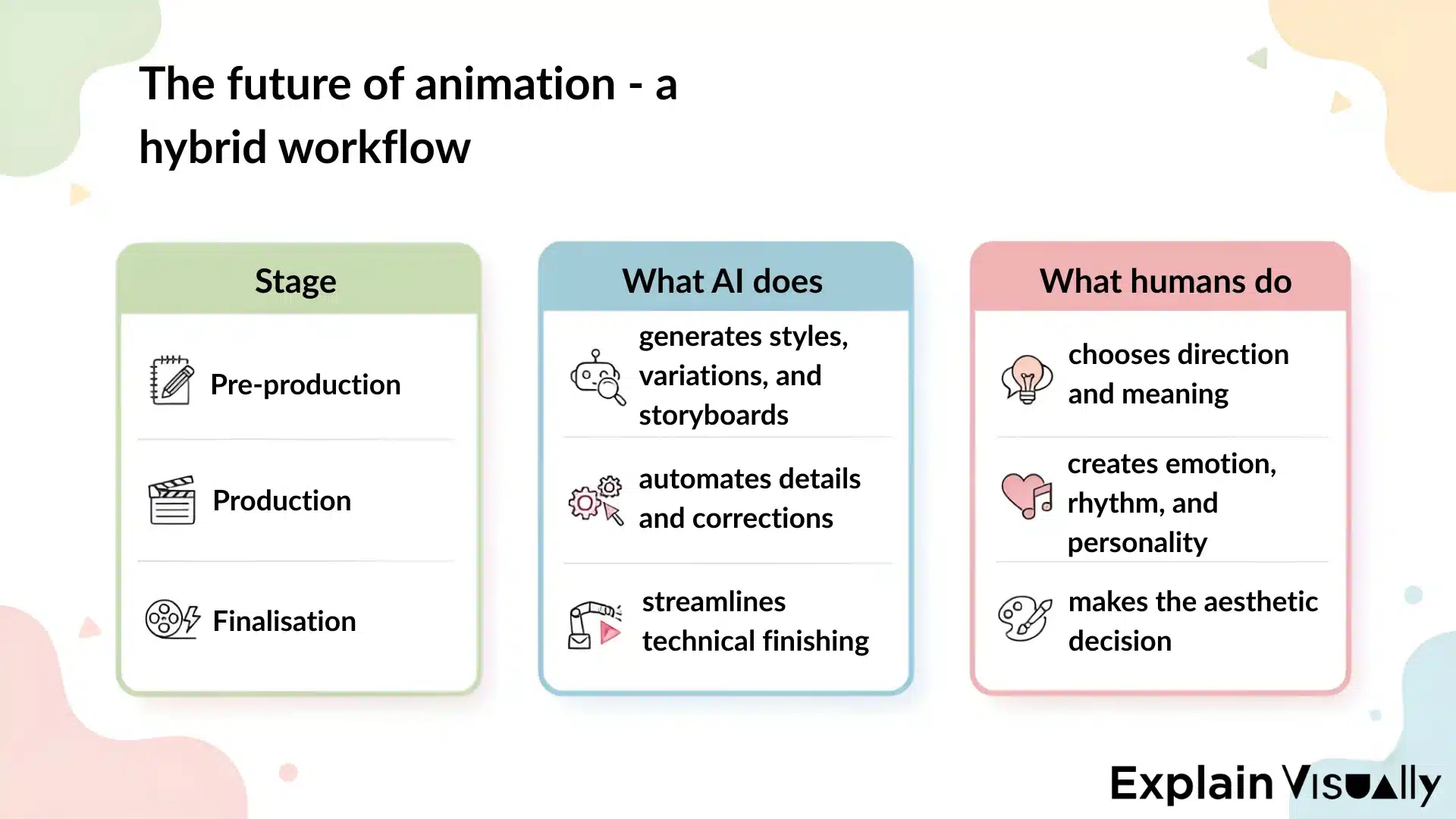
It’s also possible that completely new roles will emerge for example, an “AI animation operator”, someone positioned somewhere between animator, director and generative systems designer. Instead of arguing about who contributes more, the industry will likely move towards a model where the only thing that truly matters is the outcome, an animation that moves people and tells a story. And that still requires a human. At least for now.
Read also: Are whiteboard animations still relevant in the age of AI?
A final word from Explain Visually
This article was written to highlight the changes happening in the animation industry. But we also wrote it because we’ve spent years working exactly at the intersection of those two worlds – technology and art. At Explain Visually, we create 2D animations, whiteboard videos and visual stories for companies that want to explain complex ideas in a simple, engaging way, without losing meaning or personality.
We use new tools (AI included, of course), but not to replace our creators. Instead, we use them to give our team more time for what truly matters: style, storytelling, intention and emotion. Algorithms support the process, but people decide what the final story looks and feels like.
If you’d like to see what this looks like in practice, you can explore our portfolio or watch our animations on YouTube. That’s the easiest way to understand what we mean when we say that animation is a way of thinking, explaining and telling stories.
And maybe you already have an idea, topic or brief? We’d be happy to sit down with you.
𝐄𝐱𝐩𝐥𝐚𝐢𝐧 𝐕𝐢𝐬𝐮𝐚𝐥𝐥𝐲 – 𝐁𝟐𝐁 𝐚𝐧𝐢𝐦𝐚𝐭𝐢𝐨𝐧 𝐬𝐭𝐮𝐝𝐢𝐨:
• We create whiteboard animations for businesses
• We create corporate explainer videos
• We create visual storytelling for companies
