
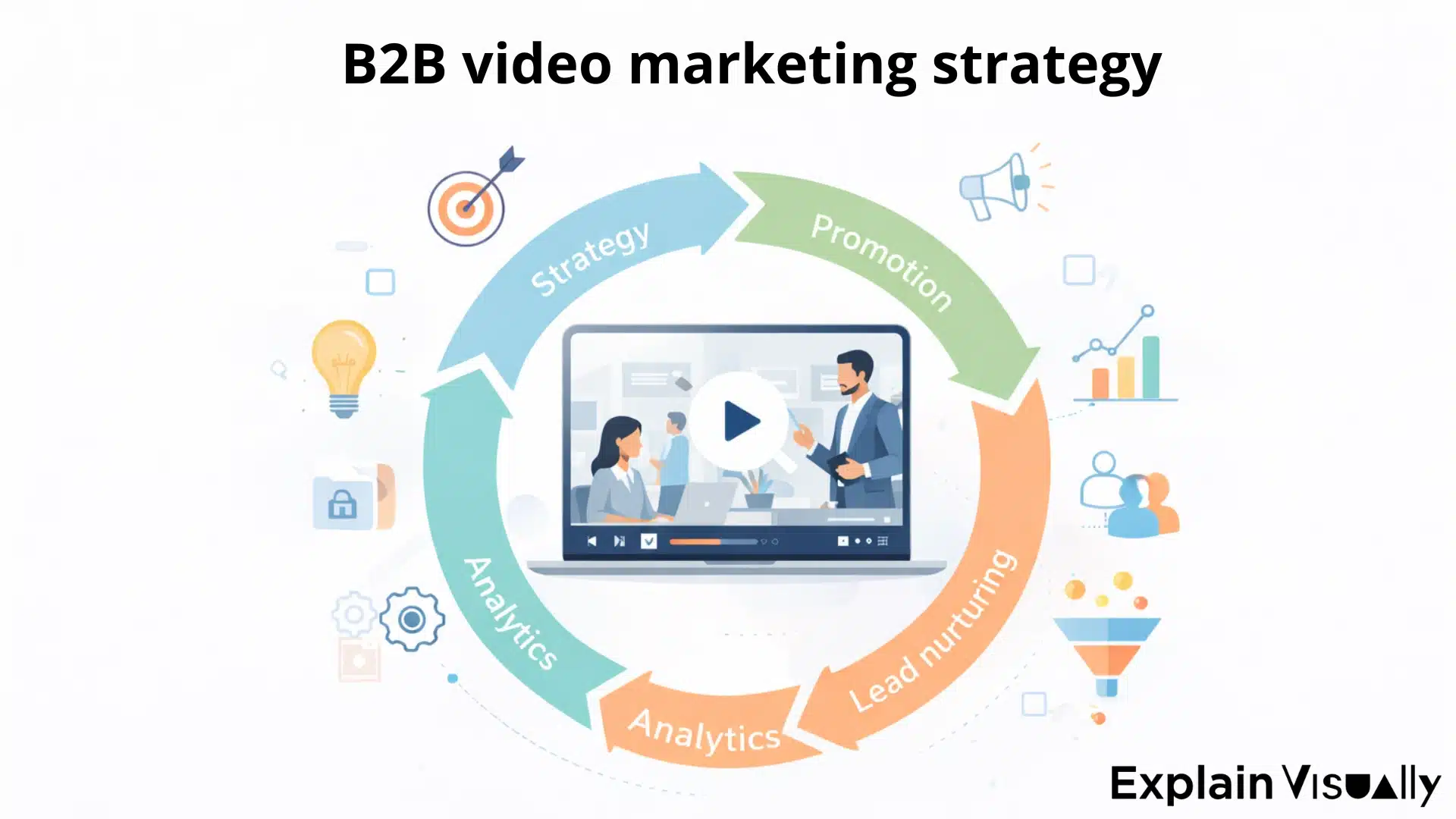
In this article we’ll show why that happens and how a B2B video marketing strategy can actually support the moments where buyers are trying to make sense of a problem, compare solutions, and move toward a decision.
Why most B2B video fails before the camera even turns on
We’ve seen this repeatedly with SaaS and enterprise software companies. A company invests in B2B video believing that telling the story a little better will be enough to drive sales. A polished explainer video is produced, a product animation, a short promotional piece. The problem is that even as the number of video views grows, it rarely translates into buying decisions. And even when some impact is visible, the results are rarely proportional to the time and budget invested in the project. So what does the company actually achieve? The video gets watched, but it does not change the course of the sales conversation.
Where does this failure come from? The answer may surprise you, because it usually appears much earlier than the script or the production stage. Teams begin by asking what type of video they should create: an animation, a product demo, a case study. Far fewer teams ask the more important question: at which moment in the decision process should this video change something?
A good B2B video marketing strategy is not about producing more videos. It is not a race with competitors. The goal is not who has more content, but when the tool is used. What matters is matching video to the moments when buyers are trying to understand a problem, compare solutions, and build confidence in their decision. That is the key, and that is what we will focus on in this article.
Before the first storyboard appears, it is worth pausing for a moment. Many B2B videos fail for the same three strategic reasons.
1. The “format-first” trap
This is one of the most common mistakes. The team begins by choosing a format: animation, product demo, explainer, testimonial. In practice, this means the decision about form is made before anyone considers the moment when the viewer will actually see the video.
The problem is that the same format can work extremely well or completely miss the mark depending on the stage of the decision process. An explainer video can be the best option at the beginning, when the viewer is trying to understand the problem. But the same material shown too late becomes unnecessary. At that point, the buyer is looking for proof, not explanations.
In a strong B2B video marketing strategy, the starting point is different. First, you define the decision moment. Only then do you choose the format that will help the viewer take the next step.
2. The hidden disconnect between marketing video and the sales process
In many companies, marketing produces the video while sales handles conversations with clients. Yet these two worlds rarely meet.
The marketing team focuses on brand messaging and an attractive presentation of the product. The sales team, however, hears very different questions from potential buyers:
– Does this solution actually solve our problem?
– How long will implementation take?
– Is anyone similar to us already using it?
If the video does not answer these questions, sales teams rarely use it. The material exists, but it does not influence the conversation with the client. And in B2B, most decisions are made during those conversations.
3. The view-first measurement trap
Another issue is how results are measured. Video marketing is often evaluated through views, watch time, or reactions on social media. These metrics can certainly be useful. But think about how much they really tell you about whether the video helped a buyer make a decision.
In B2B, the more important questions sound different:
– Did the video help explain the problem?
– Did it make comparing solutions easier?
– Was it used during a sales conversation?
Only when video is evaluated in the context of the buying process, rather than just content distribution, does its real business impact become visible.
What actually happens in a B2B buying journey
You probably know that the B2B buying process rarely looks like the classic marketing diagrams suggest. It is not linear, and it does not involve calmly moving through neat funnel stages. In reality, it looks more like a series of moments in which the buying team tries to understand the problem, explore possible solutions, and make sure the decision they are about to make is a safe one.
Within this process, there are several points where video can play an important role. Not because it is more attractive than text, but because it can explain complex ideas faster and show how a solution works in practice.
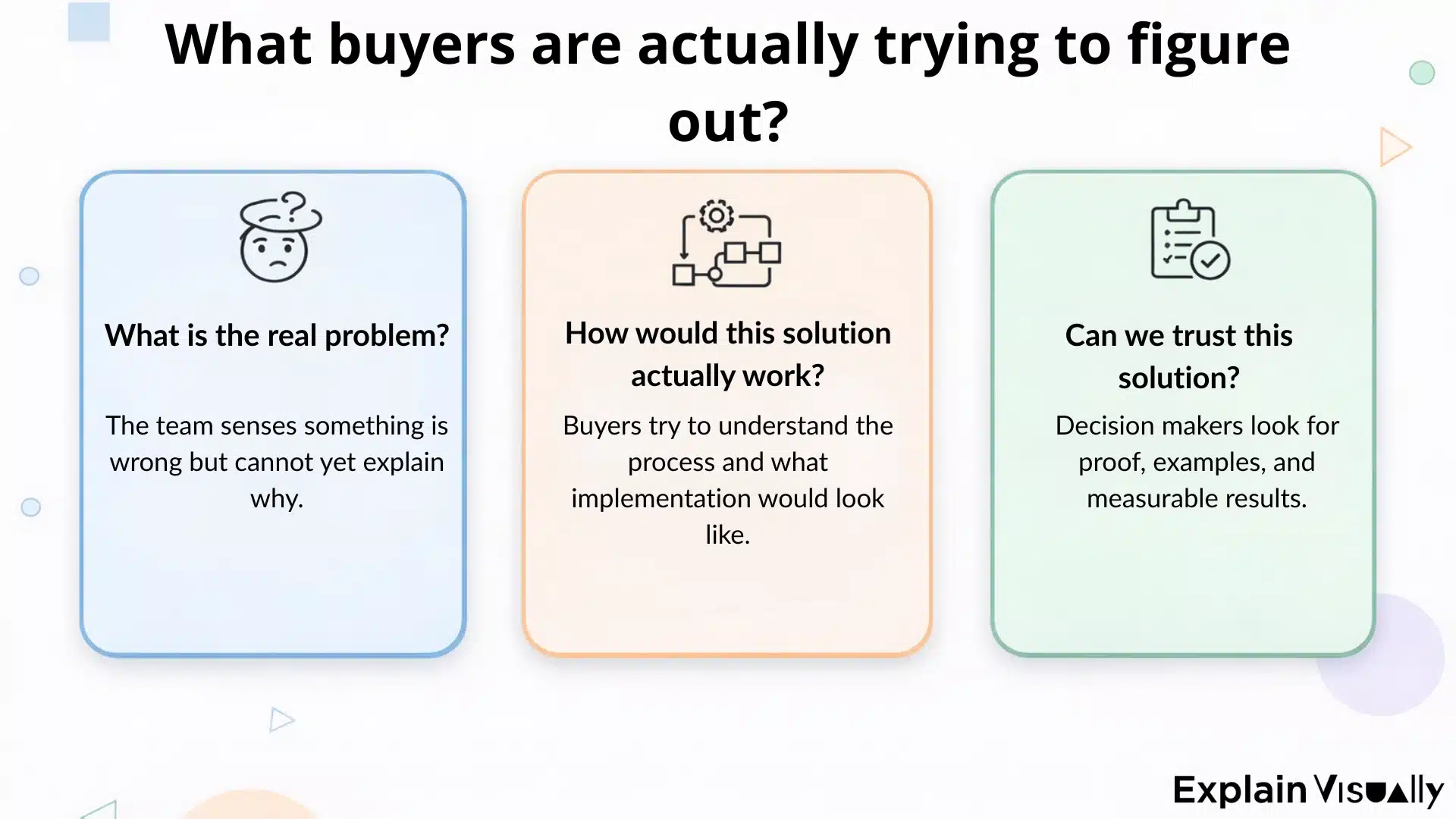
The moment buyers realize they have a problem.
At the beginning, most teams are not yet looking for a specific product. Their main goal is to understand what they are actually dealing with. The problem may be recognized intuitively, but its root cause is still unclear.
This is the moment when a well-prepared video can quickly bring clarity. Instead of a long article or document, a short piece of video can show the structure of the problem, its consequences, and possible directions for solving it. Video helps give the problem a clear name.
The stage where complexity becomes the biggest barrier.
When buyers begin to analyze possible solutions, another obstacle appears: complexity. B2B products often require understanding new processes, integrating with existing systems, or changing how a team works.
At this point, text often stops being enough. A description of features or a long list of capabilities does not always show how something works in practice. Video shows the process directly. Instead of imagining how the solution works, the viewer sees it in action.
The stage where buyers look for proof, not explanation.
At a certain point, discussions about features stop being the most important thing. Buyers want to see proof that the solution works in a real environment.
Questions begin to appear about other companies’ experiences, implementation results, and measurable outcomes. This is the stage where case studies, short customer videos, or recordings that show the product being used in real situations become more valuable than additional explanations.
Where video actually influences B2B decisions
In practice, video tends to have the strongest impact at four moments in the decision process:
-
When the problem becomes visible.
-
When buyers try to understand the solution.
-
When the team looks for proof.
-
When the idea has to be explained internally.
At the beginning of many B2B decisions the biggest challenge is simply understanding the problem. Teams see the effects: lower efficiency, growing operational costs, scattered processes. But the source of the issue is still unclear. A short video can make the situation visible much faster than a long document.
Another barrier appears when buyers try to understand how a solution would actually work in their organization. Descriptions and feature lists rarely solve that uncertainty. Seeing the process step by step makes the solution easier to imagine and reduces perceived complexity.
Later the conversation shifts toward proof. Buyers want to know whether the solution works in real situations and whether other companies have already used it successfully.
At the same time the material often starts circulating inside the organization. Someone shares it with a colleague, a manager, or an executive who was not part of the earlier discussion. A short video becomes a simple way to explain the idea without repeating the whole conversation.
Choosing the right type of video for each decision stage: when explainer videos work best
You may notice that one idea keeps returning throughout this article. That is intentional. In many B2B projects this is exactly where things start going wrong. That repetition is intentional. In many B2B projects this is exactly where things go wrong. Teams spend hours discussing whether they need an animation, a product demo, or a case study, while almost nobody asks a simpler question first: what does the buyer need to understand at this stage?
At the beginning of the process, buyers are rarely interested in product features. They are still trying to understand the problem itself and what a possible solution might look like. That is the moment when explainer videos work best.
Explainer video for Firstcoin.
A simple visual explanation of a complex cryptocurrency service for businesses.
Why explainer videos work so well in B2B marketing?
If you work in B2B marketing, you have probably seen this situation before. Someone asks a simple question about the product and suddenly the explanation turns into a ten-minute conversation. Integrations, workflows, dependencies between systems. After a while even the people in the room start losing the thread.
This is exactly where explainer videos start to make a difference. They force clarity. To explain something in ninety seconds, you first need to understand the mechanism yourself. What actually happens before the solution appears? What changes once it is introduced?
A good explainer does one thing extremely well. It turns a complex system into a clear cause-and-effect story that the viewer can follow from beginning to end.
If you want to see how these ideas work in practice, take a look at our collection of B2B explainer video examples: Top 10 B2B explainer video examples to inspire your business strategy.
Top 10 B2B explainer video examples to inspire your business strategy
Animation vs live-action in B2B marketing
We often hear the question: is it better to use animation or footage with real people? The honest answer is that there is no single correct choice. Each format brings its own value, and each serves a different communication need.
Animation works best when the goal is to explain a complex process, show how data flows through a system, or simplify abstract ideas. Live-action, on the other hand, introduces a human element and often helps build trust in the brand.
What matters most is matching the format to the message and to the stage of the buyer’s decision.
-
When animation explains complexity better than live footage
In many B2B products the challenge is that the solution is not a physical object you can simply place in front of a camera. It often involves processes, information flows, or systems operating in the background.
Animation allows you to visualize these mechanisms in a clear way. You can show how different parts of a system interact, illustrate the stages of a process, or highlight what changes after the solution is introduced. In many cases this makes it much easier for the viewer to understand how the product actually works.
-
When real people build stronger credibility
There are also situations where footage with real people works better than animation. This is especially true in moments when trust becomes the most important factor.
A client testimonial, a short conversation with an expert, or footage from a real working environment helps demonstrate that the solution operates in real conditions. In those situations the presence of real people strengthens the credibility of the message.
Can you have the best of both worlds? In many cases, yes…
What about a hybrid approach?
Here is the good news: in many B2B projects you do not have to choose between animation and live-action at all.
Some of the most effective videos combine both. Animation explains the mechanism of the product. Real people show how it works in everyday use. One part clarifies the system, the other builds trust around it. This combination works surprisingly well in B2B. Buyers first understand how the solution operates, and a moment later they see that real teams are already using it in practice.
How to build a B2B video marketing strategy that supports revenue
At this point you might notice something interesting. Throughout this article we talked about formats, explainers, animation, live-action, even hybrid videos. But the real difference between companies that simply produce videos and those that benefit from them lies somewhere else:
It is how the videos connect to the buyer’s decision process.
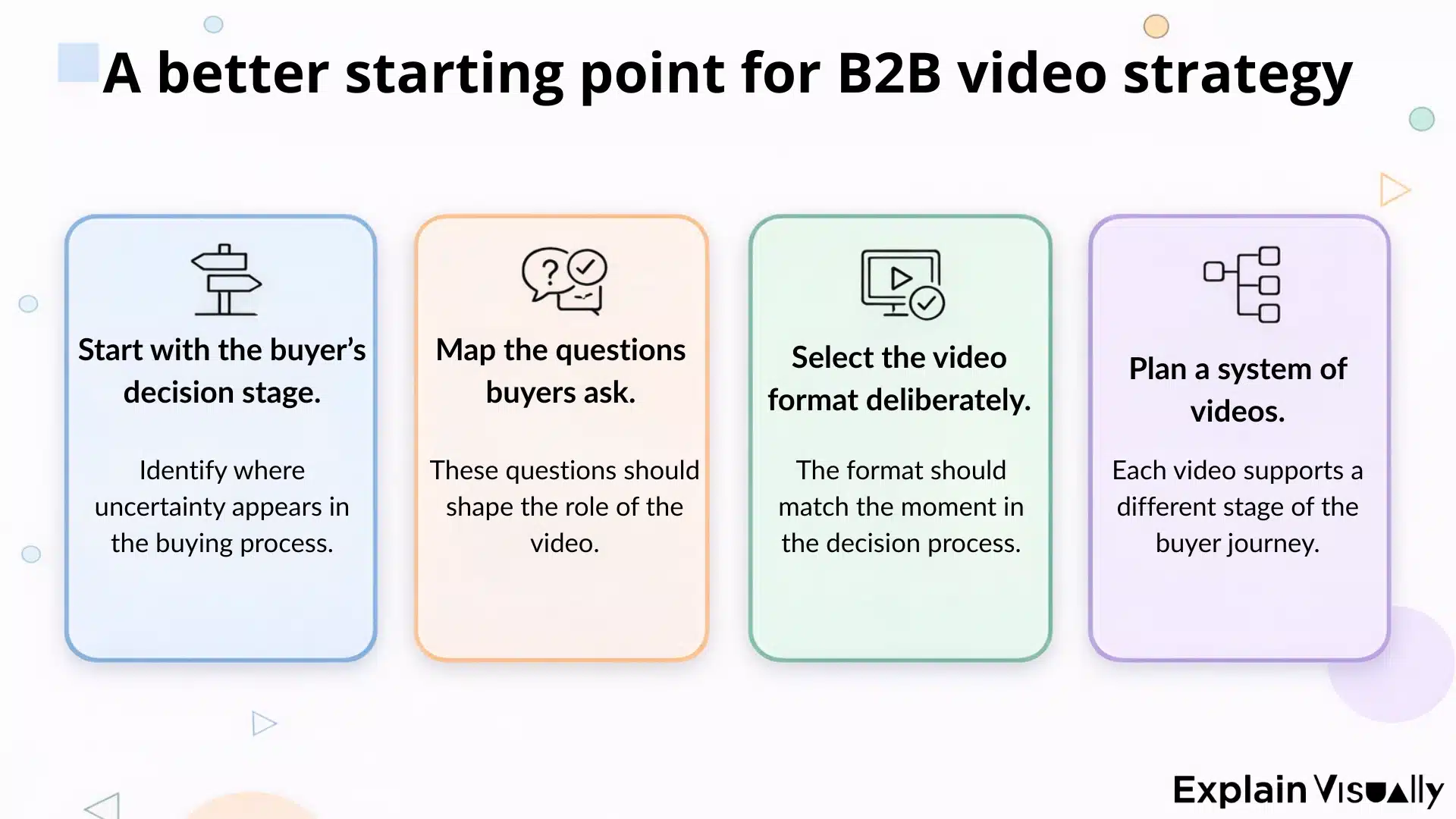
In our experience at Explain Visually, this is the point where many strategies start to change direction. Companies stop asking “what video should we produce?” and begin asking a much more useful question: “what does the buyer still need to understand before they can move forward?”
When video answers that question, it becomes part of the decision itself.
How we approach B2B video projects at Explain Visually
Over the years we’ve worked with many B2B teams trying to explain products that are not easy to describe in a few sentences. SaaS platforms, financial services, complex software, internal systems.
In those situations the challenge is rarely the lack of content. The real challenge is clarity. Teams understand their own product very well, but explaining it to someone who sees it for the first time is a different task entirely. That’s why in our projects we always begin in the same place: the decision moment. We ask a simple question first, what exactly does the buyer need to understand at this stage? Only after that do we start designing the visuals that help explain the idea clearly.
If you would like to learn more about how we work and why companies choose to collaborate with us, you can read more here: Why businesses choose us? | Explain Visually
𝐄𝐱𝐩𝐥𝐚𝐢𝐧 𝐕𝐢𝐬𝐮𝐚𝐥𝐥𝐲 – 𝐁𝟐𝐁 𝐚𝐧𝐢𝐦𝐚𝐭𝐢𝐨𝐧 𝐬𝐭𝐮𝐝𝐢𝐨:
• We create whiteboard animations for businesses
• We create corporate explainer videos
• We create visual storytelling for companies
Frequently Asked Questions
Why do many B2B videos get watched but still fail to influence purchasing decisions?
We see this very often. A company creates marketing videos, publishes them on the website or social media platforms, and the numbers look fine. People watch them, engagement is decent, sometimes they even perform well in search engines.
But the real question is different: did the video actually help someone move forward in the buyer’s journey?
Many B2B videos are created as general video content instead of being connected to the decision making process. If a video does not address the buyer’s pain points at a specific moment in the sales funnel, it may get views but still have no impact on purchasing decisions.
What should a good B2B video marketing strategy actually start with?
Not with the video format.
A strong B2B video marketing strategy starts with understanding what the buyer still needs to understand before moving forward. Once you know that, choosing between explainer videos, product demos, or testimonial videos becomes much easier.
In our experience, the companies that see the best results treat video as part of their overall marketing strategy, not just a piece of content.
Are explainer videos really effective in B2B marketing?
Yes, especially at the beginning of the buyer’s journey.
At the awareness stage most potential customers are not looking for product features yet. They are trying to understand the problem and possible solutions. That is where explainer videos work extremely well. They turn complex processes into a short, clear story that helps the target audience quickly grasp what is going on.
For many B2B companies, explainer videos become the starting point of their video strategy.
Should B2B companies use animation or live-action videos?
It depends on what you want the viewer to understand.
Animation is very effective when you need to explain systems, workflows, or processes that are difficult to show on camera. Many B2B products operate in the background, inside software or data infrastructure. Animation helps visualize those mechanisms.
Live-action videos, on the other hand, work well when trust is the main goal. Testimonial videos, leadership interviews, or footage with real teams can show that the solution works in real environments.
In many projects we actually combine both approaches.
Where should B2B videos be used in the sales funnel?
Ideally across several journey stages.
At the awareness stage educational videos or explainers can help define the problem. During the consideration stage buyers often look for product demos, comparison videos, or short explanations of how the solution works. Later in the process testimonial videos, success stories, or customer interviews can help build confidence.
A good video marketing strategy supports the entire buyer’s journey rather than relying on a single video.
Do B2B videos need to be short to work online?
Not always. Short video content works well on social media platforms like LinkedIn or in ads where attention is limited. But longer videos can be very valuable once someone is already interested in the solution. Product demos, thought leadership videos, or educational content often perform better when they are given a bit more space.
The key is matching the video length to the moment in the decision process.
Can AI tools replace professional video creation in B2B marketing?
AI tools can definitely help with certain parts of video creation. They can assist with editing, generating ideas, or adapting existing content into different formats.
However, the strategic part of B2B video marketing still requires human understanding. Someone needs to identify the real pain points of the target market, decide what message matters most, and design videos that support the buyer’s journey. Without that thinking, even high quality videos rarely drive conversions.
How can B2B companies get more value from their existing video content?
Start by looking at where the videos are actually used. Many companies have strong video content that only lives on a website page. But the same material can support many other moments in the decision process: sales presentations, landing pages, LinkedIn ads, email messages, or internal discussions between decision makers.
Sometimes improving a B2B video marketing strategy does not require creating new videos. It simply means using the existing content in the right places.
