

Whiteboard animation vs AI-generated videos – how to choose the best? Combine the power of human creativity with cutting-edge algorithms to unlock the full potential of your communication.
Let’s not turn this into a competition!
Everyone should stick to what they do best. In this article, we’ll show you that the companies achieving the greatest results are those that harness the strengths of both worlds… rather than abandoning one solution in favour of the other😄.
As artificial intelligence continues to infiltrate every domain of life, you might think that traditional visual communication methods are being left behind. In reality, things are more nuanced. Those classic whiteboard animations we’ll explore today are still breaking records for effectiveness in business, education and marketing. And we’re not afraid to say it: ever since AI burst through marketing’s doors, windows (and yes, even the roof, basement and floorboards), whiteboard animation has grown more popular than ever.
Why is this happening? What does it mean for the future of visual communication?
What does this format offer that AI-driven alternatives lack? Let’s start with our keywords:
EMPATHY, CULTURAL CONTEXT, ADAPTABILITY, MASTERFUL STORYTELLING, AUTHENTIC STYLE.
Animated explainer videos – to begin, a few sentences of theory and explanations
Engaging explainer videos is a broad term encompassing various styles of short films aimed at explaining a product, service, or concept in an engaging animated format.The process of creating explainer videos requires careful planning and attention to both technical and creative aspects.
A good explainer video combines clear messaging with visually appealing elements that resonate with the target audience.
These can include:
- 2D animations (characters, icons, infographics);
- 3D animations;
- motion graphics;
- whiteboard animation.
Whiteboard animation is one of the explainer video styles, characterized by “live” drawing of illustrations on a white background, often accompanied by a voice-over. Other animation styles employ different graphic and narrative techniques.
Whiteboard animations by the numbers – here’s why you should stick with the classics
Our new clients are often surprised by the impact of whiteboard animation and for good reason.
Professor Richard Wiseman of the University of Hertfordshire found that whiteboard animations are rated 33% more entertaining than traditional “talking head” videos, and viewers who watched a whiteboard animation were 66% more likely to share the content with others. [1]
Another study among students revealed that:
Those who learned via whiteboard animations achieved test scores 70% higher on average than a control group using standard PowerPoint presentations. [2]
This isn’t just a fluke, but I’m sure you’ll agree that numbers alone mean little. What truly matters is that whiteboard animations tap into fundamental principles of learning psychology. By combining visual and auditory elements, they significantly boost information retention in your audience. Curious how? Let’s kick this article up a notch:
Allan Paivio’s dual-coding theory offers the best explanation for this mechanism
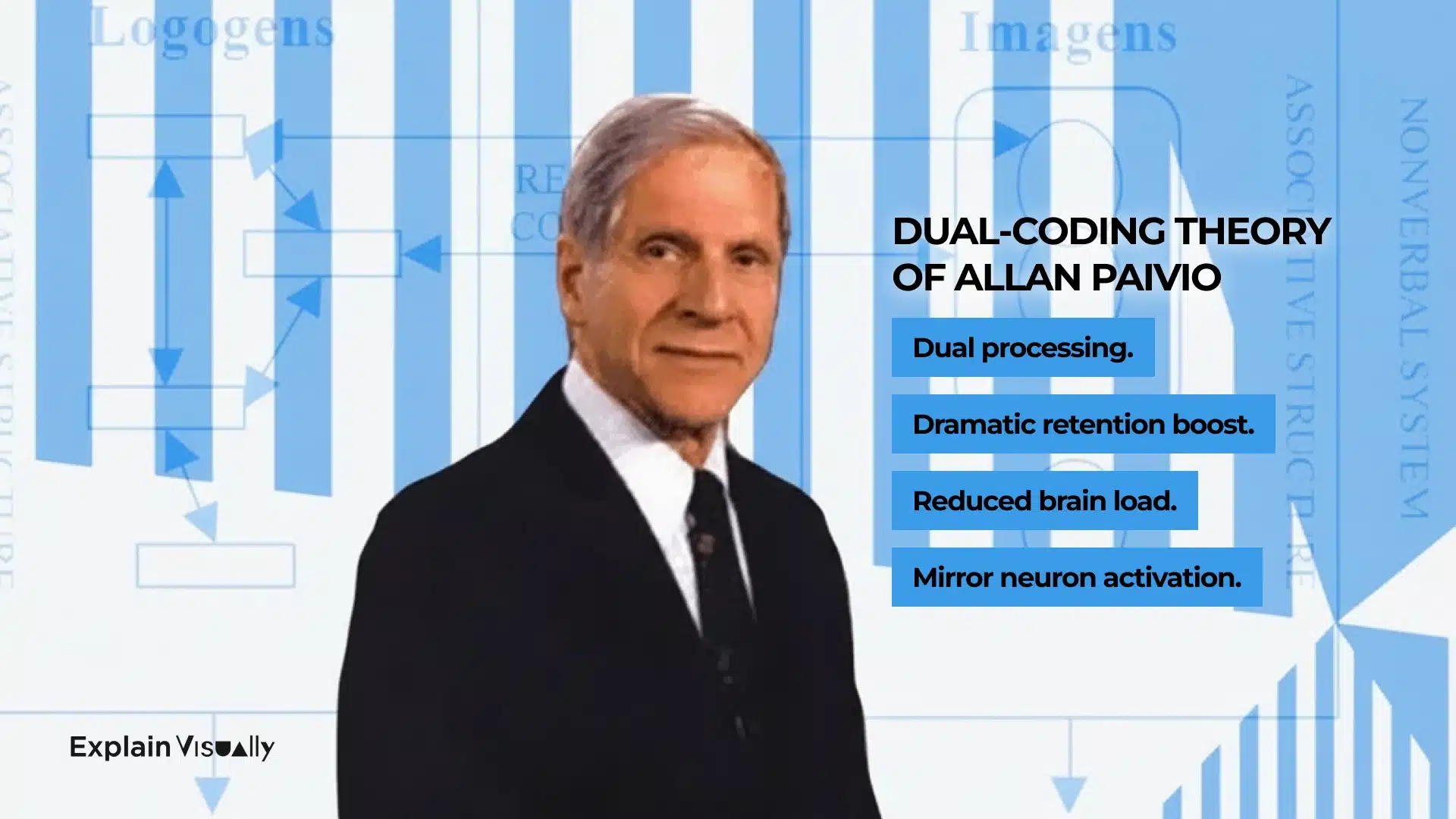
1. Dual processing
Our brain operates two independent information-processing channels:
the visuospatial sketchpad handles images, colours and motion;
the phonological loop processes sounds, words and tone.
By engaging both channels simultaneously, whiteboard animations enable multi-faceted encoding of the message, greatly easing later recall and comprehension of the information.
2. Enhanced retention
When information is encoded in both systems at once, the chances of remembering it soar. After three hours, we recall 80% of audio-visual content versus just 25% of audio-only content.
3. Long-term memory
Research shows that after three days the advantage of whiteboard animations becomes even more pronounced – information retention reaches 65%, while traditional formats (audio-only or static slides) retain at most 20% of the content.
4. Reduced cognitive load
Whiteboard animations align with Cognitive Load Theory, which states that our brain has a limited capacity for processing information at any one time. These animations address the issue elegantly.
Rather than bombarding the viewer with all the data at once, they reveal content step by step, at a pace that allows for proper absorption. This way, working memory isn’t overloaded, and the viewer can focus on understanding each element of the message before moving on to the next one.
By harnessing AI, you don’t have to abandon the classics – combine the strengths of both worlds!
And you know what? You don’t have to choose between tradition and innovation. From the outset, we’ve made it clear: the greatest success comes to those companies that can maximise the potential of both approaches. AI can support every stage of whiteboard animation production – from generating script ideas and automating certain production tasks to optimising content distribution.
Our experience shows that companies adopting a hybrid approach where AI supports the creative process but the most crucial decisions regarding:
NARRATIVE
STYLE
TONE
remain in the hands of human specialists achieve the best results. Why? Because AI can optimise workflows, but it cannot replace human intuition in building an emotional connection with the audience.
And now we’ve unlocked the secret to effectiveness:
Technology accelerates, streamlines and frees up time for creativity, but it is people who imbue content with depth and emotion.
Combining AI with human expertise can prove a winning strategy in your case. Algorithms can instantly analyse audience engagement data and suggest next steps, while an experienced animator focuses on the story that moves hearts and minds. This way, you gain the best of both worlds: the speed of AI and the authenticity of human-driven storytelling.
Leave your competitors in the dust – practical benefits of whiteboard animations
Remember how many were surprised that, far from fading away with the rise of AI, whiteboard animations have literally taken off?
According to the latest forecasts, the global whiteboard animation software market is set to grow from USD 1.5 billion in 2024 to USD 3.2 billion by 2033, at a compound annual growth rate of 9.2%. [3]
What does this mean for your business? Which benefits are we talking about?
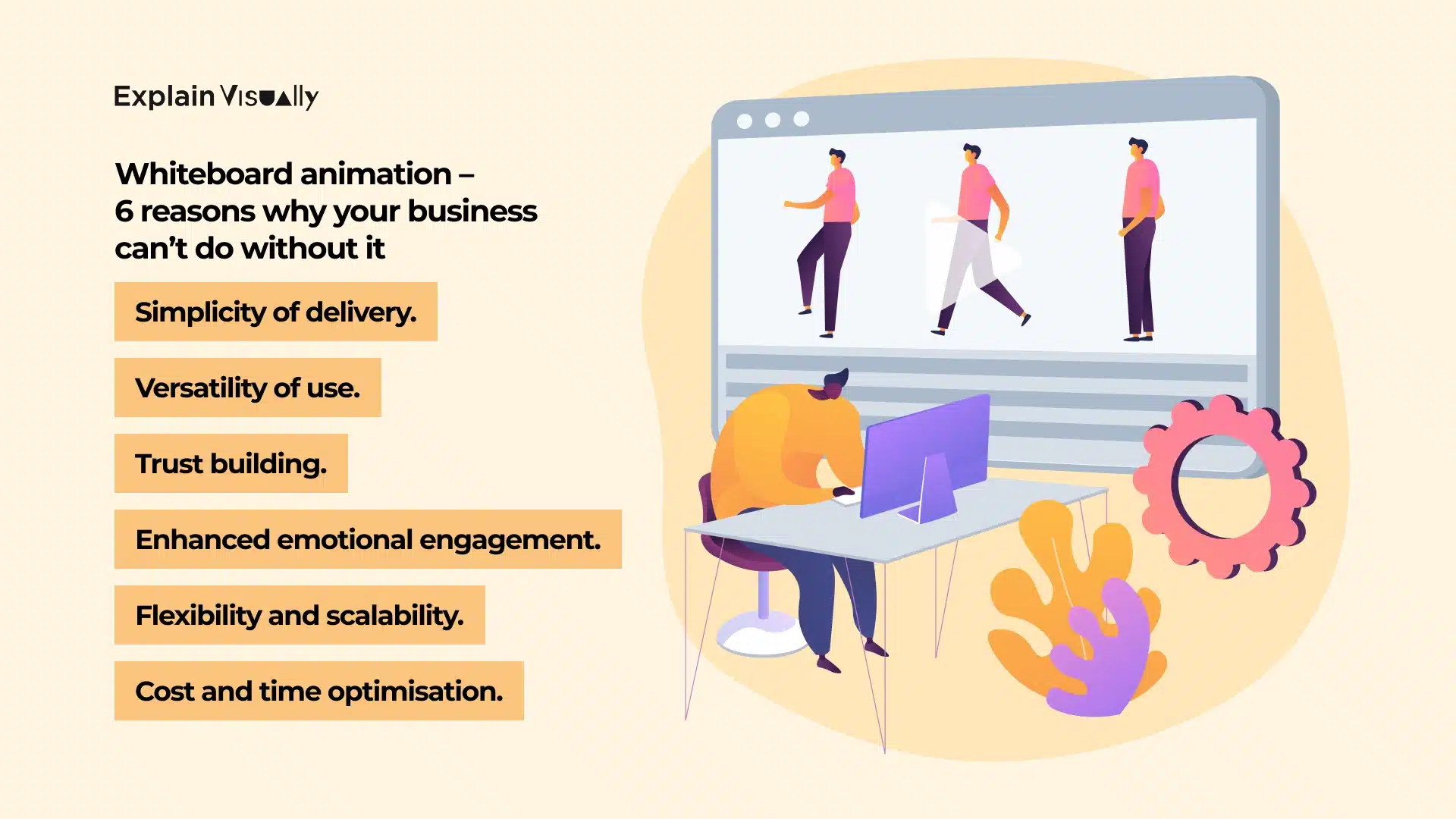
Simplicity of delivery. Whiteboard videosbreak down the most complex concepts into clear visual elements.
Versatility of use. From staff training and sales presentations to social media marketing campaigns. One animation can be repurposed across multiple contexts.
Trust building. The act of drawing on the board creates a natural bond with the viewer. The audience follows the artist’s hand, generating a sense of participation in the story.
Enhanced emotional engagement. Hand-drawn elements and step-by-step narration engage the viewer’s emotions more deeply than ready-made templates, naturally boosting brand affinity.
Flexibility and scalability. A finished script and graphics can be easily modified to suit new products, services or target audiences, so you never have to start from scratch.
Cost and time optimisation. Whiteboard videosare a savvy choice for companies seeking maximum impact without blowing the budget. Unlike complex 3D animations or live-action shoots that can cost tens of thousands, all you need here is a solid script and skilled drawing.
Let’s consider where AI shows its limitations?
We’ve taken our time crafting this section because we don’t want to mindlessly badmouth the artificial intelligence we use every day. Let’s pause for a moment to consider where AI can let us down. While it can speed up work and suggest creative ideas, it inevitably hits a wall where empathy, cultural context and human sensitivity really matter.
Industry experts agree:
AI in its current form remains “clumsy, imprecise and riddled with flaws” compared to human-crafted animation.
What, in our view, are its primary problems and shortcomings?
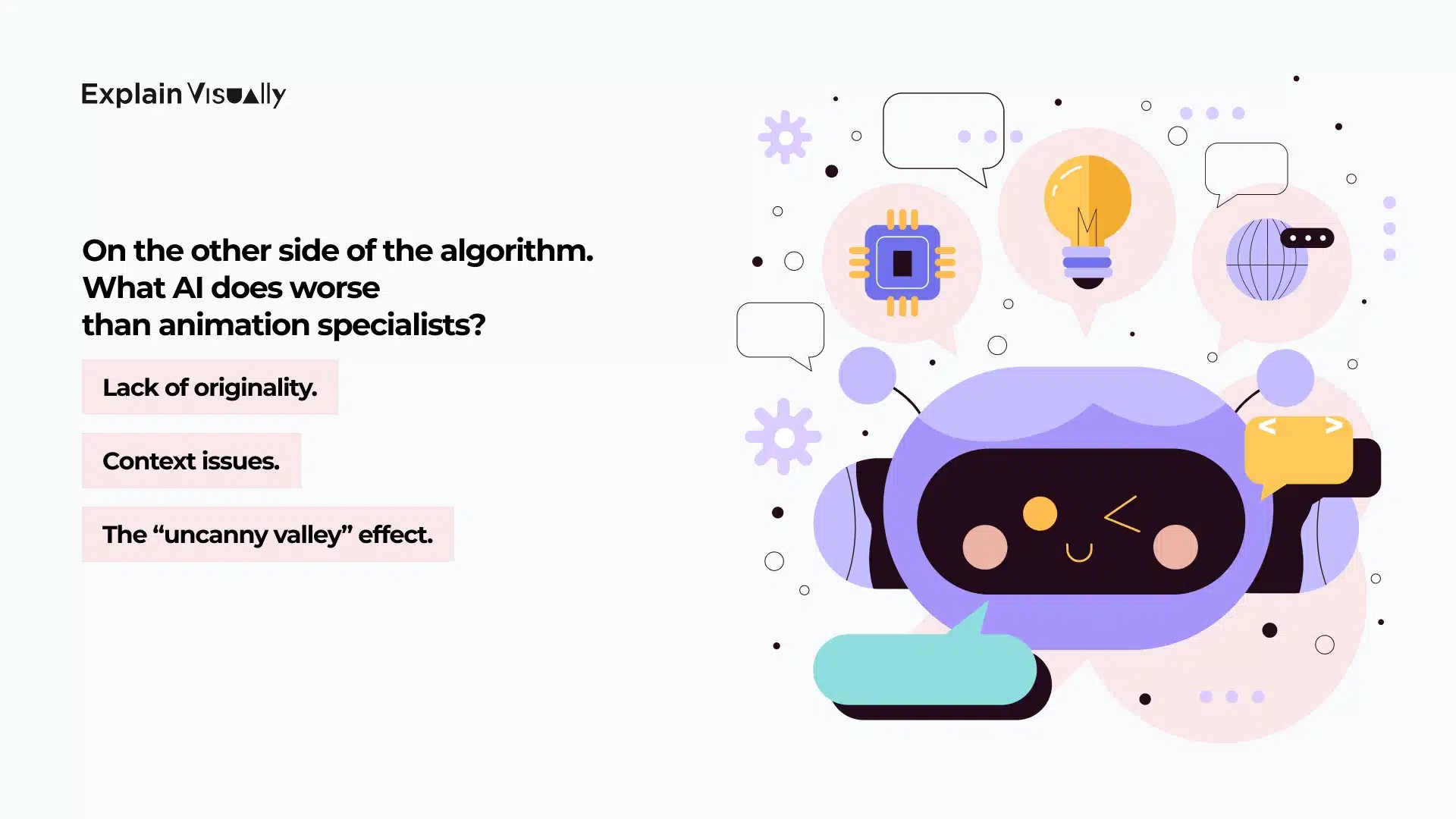
Lack of originality
This is a situation where AI generates new materials based on patterns and examples it already knows. In practice, this means replicating ideas, styles and motifs from existing animations instead of creating entirely new concepts.
The effect?
Films, whilst not outright plagiarism, look remarkably similar to one another. This way, brands lose their unique character and distinguishing features.
Context issues
AI analyses and reproduces linguistic or visual patterns but does not “understand” cultural, industry-specific or emotional nuances. It may therefore present a product or service technically correctly yet miss crucial accents, such as the tone of the message or symbolism important to the target audience.
The effect?
The message loses depth and authenticity. The viewer receives an animation that reads like a set of instructions rather than a story that stirs emotions. Instead of thinking “this is made just for me”, they feel detached and indifferent. What can happen in such a situation?
- Lower conversion rates.
- Weaker engagement.
- Loss of those customers seeking an authentic connection with the brand.
The “uncanny valley” effect
This phenomenon occurs when visual or motion elements are almost realistic, yet still provoke discomfort. Picture a character whose movements are nearly human, but something just feels “off” – the AI-generated lip sync, the impersonal, vacant gaze, the stiffness of the body…
The effect?
Odbiorcy wyczuwają ten dysonans i mogą czuć niepokój lub odrzucenie, zamiast zaangażowania.
To wrap up this fascinating look at AI’s shortcomings, here’s the key takeaway for you:
The best animations are born when technology serves people, not the other way around!
The power of the human touch in the age of algorithms
Perhaps it’s time to accept that AI is here to stay — and focus on using it wisely. Our experience from hundreds of projects shows that true success in whiteboard animation vs AI-generated videos comes from keeping the human element at the core of the creative process.
Example: This whiteboard explainer video, rendered as hand-drawn sketches on a board, was developed for Silgan Closures in the Czech Republic. Its purpose is to present the most essential health and safety rules that apply during a visit to the production facility.
Remember how we introduced our keywords at the start of the article? We’ve now arrived at this moment. What do “human” animators bring to every project?
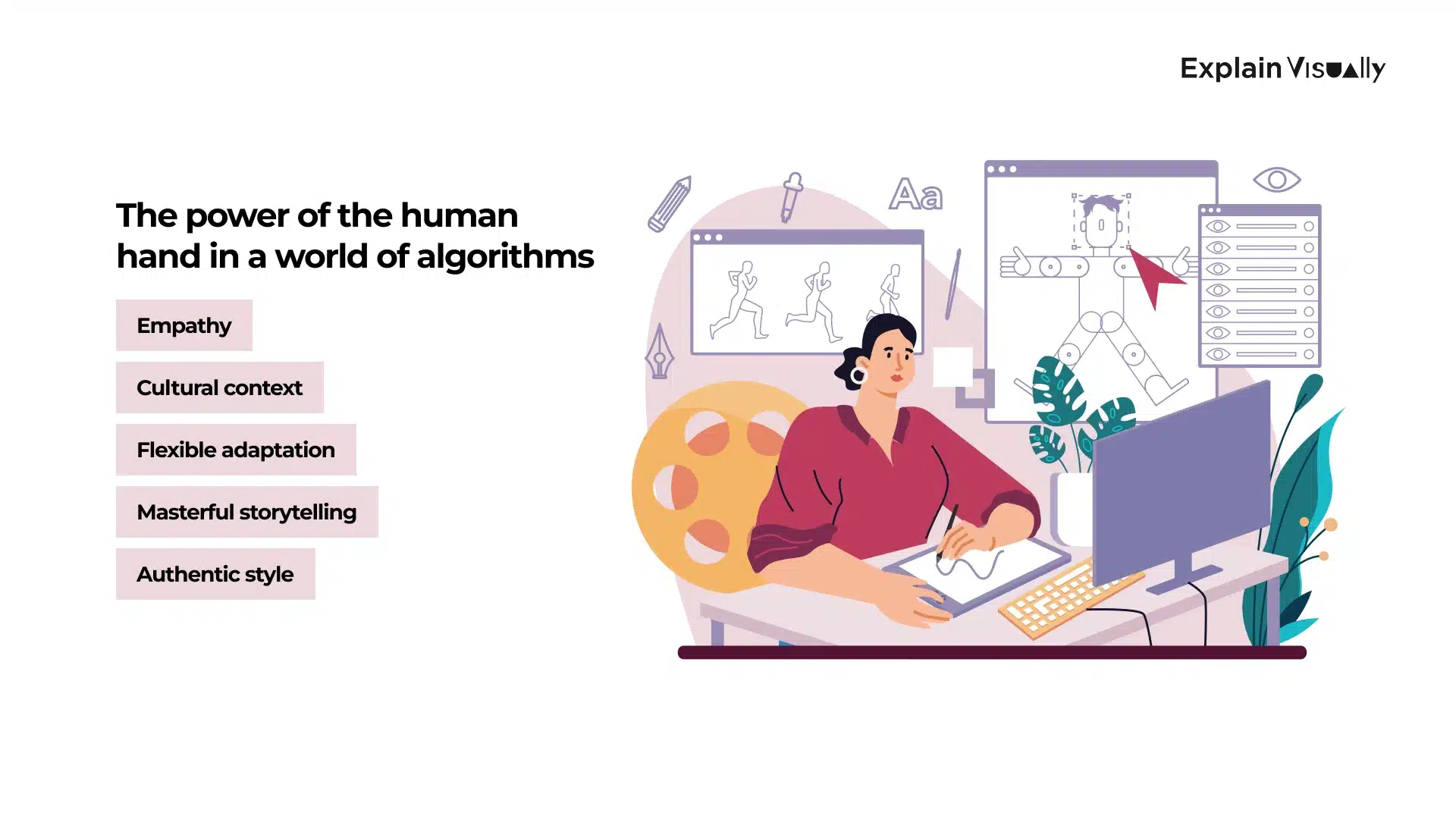
Empathy. Animators understand the emotions and needs of your target audience. They create content that truly resonates with them.
Cultural context. They know local customs and values. This insight allows them to tailor the message to the specifics of the market and avoid faux pas.
Flexible adaptation. They respond quickly to feedback! Any client suggestion can be implemented within hours, not days.
Masterful storytelling. They blend facts with narrative. They craft a story that inspires, engages and drives the viewer to take action.Genuine effortless video creation becomes reality only when experienced professionals handle the creative process.
Authentic style. Hand-drawn elements and the artist’s unique touch give your brand a distinctive character. It’s a carefully and collaboratively developed brand style. Something that cannot be replicated or copied!
Industries that can’t afford to compromise
Some industries simply cannot afford to compromise in their visual communication. In our experience, sectors such as finance, healthcare, education and B2B tech services achieve the best results by using whiteboard animations.
Example (education): Whiteboard animated videos for ZNP informing about the mentoring support project for novice teachers (polish version).
When you operate in a sector where a single word can make or break your reputation and financial results, there is no room for guesswork. In finance, every sentence must be precise; in healthcare, clear; and in tech, practical.
Whiteboard animations break procedures and rules down into simple pictograms and animations. This way, even the most complex process becomes crystal clear. It means peace of mind for you and confidence for your audience.
Read also: Top 10 B2B explainer video examples to inspire your business strategy.
Whiteboard animation vs AI-generated videos – what will the future bring?
Data from the animation industry are clear: 2025 is the year when companies stop choosing between the “old” and the “new” approach, and begin to combine them wisely. At Explain Visually we see it like this:
Integration with AI, but solely as a tool to support the creative process, never replacing human intuition.
Content personalisation based on data analysis and tailoring the message to the expectations of specific audience segments.
Interactivity, with whiteboard animations becoming part of rich, multimedia experiences.
Augmented reality, combining 2D animation with AR elements in mobile applications.
Explain Visually –your partner in effective visual communication
At Explain Visually, we specialize in creating whiteboard animations that truly drive business results. Our approach combines strategic thinking, human expertise, modern tools, and measurable outcomes. You need to know that every project is equally important to us. We don’t rank clients by importance. We all look in the same direction, guided by a single goal: success!
Are you counting on a long-term collaboration? Great!
In the whiteboard animation vs AI-generated videos debate, long-term results come from partnership, not tools. Thanks to close collaboration with our clients, we react quickly to changing market needs and keep communication effective. Our animations evolve with your brand, and every insight or piece of feedback turns into higher audience engagement. Clients return because Explain Visually is not just a production studio – we are a strategic partner in visual communication.
Our whiteboard animation services include
- Sales animations that transform complex value propositions into engaging stories.
- Training materials that accelerate onboarding and team skills development.
- Corporate presentations that build trust with investors and business partners.
- Marketing campaigns that increase brand awareness and generate leads.
It’s not about choosing between humans and machines. It’s about harnessing the best of both worlds. If you want to learn how whiteboard style animations can drive your business growth, contact us. We’ll show you how to combine the power of traditional visual storytelling with the capabilities of modern technology.
Have you seen our YouTube channel? Check out our video style and video marketing in concrete examples.
𝐄𝐱𝐩𝐥𝐚𝐢𝐧 𝐕𝐢𝐬𝐮𝐚𝐥𝐥𝐲 – 𝐁𝟐𝐁 𝐚𝐧𝐢𝐦𝐚𝐭𝐢𝐨𝐧 𝐬𝐭𝐮𝐝𝐢𝐨:
• We create whiteboard animations for businesses
• We create corporate explainer videos
• We create visual storytelling for companies
Source:
[1] “Optimising learning from animations by minimising cognitive load: cognitive and affective consequences of signalling and segmentation methods” link
[2] Dialnet Unirioja link
[3] Whiteboard Animation Software Market Insights link
