Content marketing is a strategic process that guides potential customers from their first encounter with your brand all the way to becoming loyal, paying customers. Today, we’ll show you how to build your own content marketing funnel, create content for each stage of the funnel, and turn your marketing efforts into real sales results. Buckle up! You’re about to receive a fast-track delivery of valuable insights!
Every effective marketing strategy today is based on a well-constructed content marketing sales funnel. The days of random blog posts and generic social media adverts are long gone. Now, it’s all about targeted content that meets the needs and mindset of your target audience at every stage of the buying process.
The most effective content marketing funnel generates leads, nurtures them, builds trust, and ultimately converts them into loyal (read: paying😃) customers. So, how can you use the content marketing funnel to support your sales team and generate revenue?
What Michelin, Guinness, and Pirelli teach us about the content marketing funnel
After publishing an article about the content marketing strategies of three global giants-Michelin, Pirelli, and Guinness-our subscribers were genuinely surprised. Not many knew the fascinating stories behind these brands’ marketing efforts.
The article hasn’t been translated into English yet, but here’s the essence:
- When Michelin launched their tires, there were only 3,000 cars in France. The founders, André and Édouard Michelin, published a guidebook that helped the company grow and revolutionized the world’s gastronomy. To this day, Michelin stars are the gold standard in the restaurant industry.
- In the 1950s, Hugh Beaver, managing director of Guinness Breweries, found himself in a debate about the fastest bird in Europe. With no Google to settle the argument, he created the Guinness Book of World Records-distributed initially in bars.
- Pirelli showed that a corporate calendar could be a work of art. The company invested in the best photographers, scenery and models and their calendar, a form of content marketing, became an object of desire among their business partners.
These are incredibly uplifting stories, but… how do you translate this into concrete content marketing activities in your company? First, you need to understand what exactly Michelin, Pirelli and Guinness’ plan was based on. That’s why in this article we analyze their actions and introduce the concept of the content marketing funnel.
Additionally, at the end we present a story from Poland – a brand, which thanks to brilliant content marketing surpassed the success of “Harry Potter”.
How to translate content marketing into sales
Content, if it is to support your company and not just serve as pure entertainment, should be embedded within a content marketing sales funnel. This funnel closely mirrors the stages of the traditional sales funnel, making it an invaluable support for your marketing team and sales reps alike.
Typically, we address our marketing materials to customers who:
- are just discovering our product (top of the funnel),
- are researching and comparing different options on the market (middle of the funnel),
- are facing the final decision of whom to choose (bottom of the funnel).
Content funnel analysis helps you understand why your content marketing isn’t bringing in customers.
Often marketers have a weakness for one type of content. So they create a lot of texts, which educate about their solution but almost no content that convinces people to buy.
So, the content is like a salesperson who arranges a lot of meetings with potential clients, but at the meeting does not know how to convince the client to choose the company being represented.
Another common mistake is creating texts that convince to purchase, without prior education about the solution. Then the marketers are like a salesperson who wants to push a product to the customer who does not understand why they need it.
In order not to make such mistakes, it is worth analyzing your content, see where there are gaps and focus on filling them.
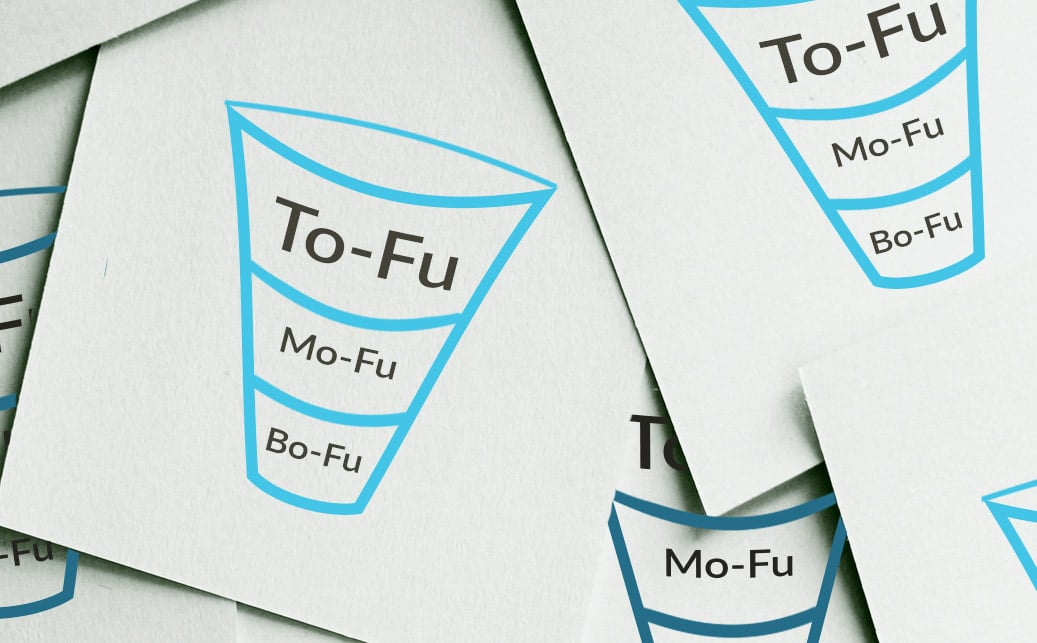
The content funnel is divided as follows:

In To-Fu (Top of the Funnel) we show the customer that there is a solution to their problem.
In Mo-Fu (Middle of the Funnel), we help the customer compare different options on the market.
In Bo-Fu (Bottom of the Funnel) we prove to the customer that our solution is the best.
To-Fu, the customer’s problems or deep needs
Top of Funnel is the widest part of the funnel. At this stage of the funnel, your content is meant to reach the broadest group of customers.
If you want to create To-Fu content, you need to think about why the customer is buying your product. What problems or needs does the customer have? What does the customer really care about?
The answers are often not obvious.
Michelin didn’t sell tires, but the opportunity to visit interesting places.
Guinness didn’t sell beer, but time well spent with friends.
Pirelli, instead of tires, sold the feeling that you are getting the best possible quality.
That’s why it’s not surprising the content they created.

Michelin created a Guide to help people visit interesting places. The Guide was only about good restaurants, so it further positioned the company’s brand.
Guinness collected world records in one place in the form of a Book, so its customers could use it to check the results of lively bar discussions.
Pirelli produced a high quality calendar each year. It met the need for exclusivity of its partners and customers, further positioning its brand.
Of course, To-Fu content can address much more tangible customer problems and needs.
At ExplainVisually, an example of To-Fu content is the text “4 unobvious reasons that make your offer land in the basket”. It explains why salespeople today find it hard to sell, and how to design offers to achieve success. The article dives deep into the real reasons why clients reject offers (often without ever telling you the truth). It shows that sometimes the problem is not your product or price, but things like the curse of knowledge (when you assume your customer understands your jargon), not reaching the right decision-makers, or failing to stand out from competitors.
Mo-Fu, or different ways to meet customer needs
Mo-Fu is a slightly narrower part of the funnel, so your content needs to be more targeted as well.
If a customer knows they have a problem or challenge, they want to make sure that the proposed solution will help to achieve their goal.
At this stage, if you are already talking about the product in a broader context.

Michelin – YouTube video ‘How different tire designs affect tire performance’.
Guinness – an article showing the advantages of dark beers, with Guinness in the background of course.
Pirelli – a series of infographics showing how different types of wheels and tires affect braking distances, using Pirelli as an example.
Bo-Fu, or why your product will meet those needs best…
Bo-Fu is usually reached by the most persistent customers.
Therefore, this is the stage to focus on your product and its competitive advantage. This is also where you encourage the customer to contact your company.

What would Bo-Fu look like in these three cases?
Michelin – Case Study of a trucking company that switched to Michelin tires and saved on tire wear,
Guinness – a blind tasting of Guinness beer (aka free trial),
Pirelli – an interview with rally driver about the reasons why they choose Pirelli tires.
Beware of misunderstanding the content marketing funnel
Often when I talk about the content funnel, I hear some harmful simplifications.
For example, I’ve encountered theories that To-Fu is infographics, Mo-Fu is articles, and Bo-Fu is case studies.
And that’s wrong.
What matters is the goal you’re there to help the customer achieve. The format is secondary. Let’s look at a YouTube video in relation to this.
It can both initially educate the client about the solution (e.g. ToFu titled “What is content marketing”) and convince them to buy (e.g. BoFu titled “See how our content consultation helped the company double the number of leads”).
Of course, it’s worth juggling formats. There are people who don’t like to read, but will gladly watch a movie, and vice versa. However, in all of this you have to remember that the content funnel is ultimately about the goal you want to achieve.
How LIDL beat Harry Potter in terms of circulation
A few years ago, LIDL’s marketing activities caused fear among Biedronka’s employees.
The company, looking to build loyalty in a very difficult grocery store market, bet on content.
Together with popular cooks – Pascal and Karol Okrasa among others – they created a series of cookbooks.
The idea was simple. The book contains recipes for dishes based on the store’s products, so it encourages customers to buy certain products.
The first cookbooks were addressed to people who wanted to eat well prepared fish or Polish dishes.
So, it is a classic Mo-Fu.
Their material helps to make a good decision (choose the right product) that will satisfy their customers’ need (to eat a good dinner).
And this is where LIDL could have stopped.
But some time ago they went a step further by creating content that broke all records.
They found that they needed to look at the problem more deeply. They addressed the need that unites practically all existing customers of the store, namely the desire to live more healthy. They addressed the need that unites practically all customers of the store, namely the desire to live more healthy. This need could be fulfilled by eating healthy (using LIDL products, of course).
Since the topic was broader, LIDL did not stop at just recipes. Part of the book “Eat healthier” tells about the new food pyramid, dietary recommendations and nutritional value of fruits and vegetables. Only the second part of the book was about recipes for healthy, tasty and balanced meals.
So LIDL created To-Fu content, reaching the deep needs of most of its customers.
The result? The circulation of the latest Lidl book reached 2 million copies.[1] For comparison, the record circulation of the last part of “Harry Potter” in Poland was… 630,000 copies.[2] The Lidl book surpassed Harry Potter three times.
How to measure the effectiveness of Your content marketing funnel – practical tips
To get the most out of your content marketing strategy, don’t just trust your gut (believe us, we’ve learned this the hard way ourselves😅). Use tools like Google Analytics to track conversion rates, user behaviour and engagement at every stage of your funnel. Sometimes, even a small tweak in your landing page or call-to-action can work wonders, but you’ll only know that if you keep a close eye on the numbers.
Keep an eye on which blog posts, landing pages and social media posts are generating the most marketing qualified leads and sales qualified leads. What really matters is whether your content is actually moving people down the funnel and turning them into potential customers.
Regularly collect customer feedback and run A/B tests on your paid ads and email marketing. Sometimes, a subject line change or a different image in your ad can make all the difference. Don’t be afraid to experiment. Even the biggest brands are constantly testing new ideas to see what really resonates with their target audience.
Look at the average time spent on your site and the bounce rate for your key funnel content. If people are leaving after a few seconds, it’s a sign that something’s off. Maybe your content isn’t relevant enough, or your page loads too slowly.
And one more thing!
Don’t underestimate the power of social listening. Sometimes a single post can trigger a wave of engagement that’s worth more than any paid campaign!
In short:
measure everything that matters,
don’t be afraid to ask your audience for their opinion,
treat every result as a clue for further optimisation.
Your content marketing funnel will thank you and so will your sales team!
Social media platforms — the role of social media marketing and paid advertising in Your funnel
Use social media ads and paid advertising to amplify your reach, target specific buyer personas, and generate leads.
Combine organic and paid strategies to maximize customer engagement and move potential customers through the funnel.
And here’s a little trick that’s often overlooked
If you’ve got an organic post that’s performing like crazy (lots of comments, shares, or saves) don’t let it fizzle out! Boost it with a bit of budget! Content that already resonates organically is much more likely to deliver results when you put paid support behind it.
Don’t be afraid to get social on social!
Join in conversations, reply to comments, and show there are real people behind your brand. If you get involved, believe us, you will be in for a big shock yourself, how much trust and engagement you can build just by being present and human.
Build your own successful content marketing funnel
Analyzing your marketing campaigns from a funnel perspective lets you spot gaps and opportunities. Once you know which funnel stage needs more high quality content, you can create content that actually leads your target audience through the buying process and supports your sales team.
So, take a step back, audit your content, and start building your own content marketing funnel.
The right content, at the right funnel stage, for the right buyer persona-that’s the secret to turning content marketing efforts into real sales.
Bibliography
[1] LIDL’s cookbooks: https://handelextra.pl/artykuly/217957,lidl-wydal-8-ksiazke-z-przepisami-naklad-2-mln
[2] “Harry Potter”‘s reach
https://www.wirtualnemedia.pl/artykul/rekordowy-naklad-harry-ego-pottera]
[3] To-Fu, Mo-Fu and Bo-Fu: https://kevintpayne.com/content-marketing-strategy-for-startups/6-tofu-mofu-bofu/