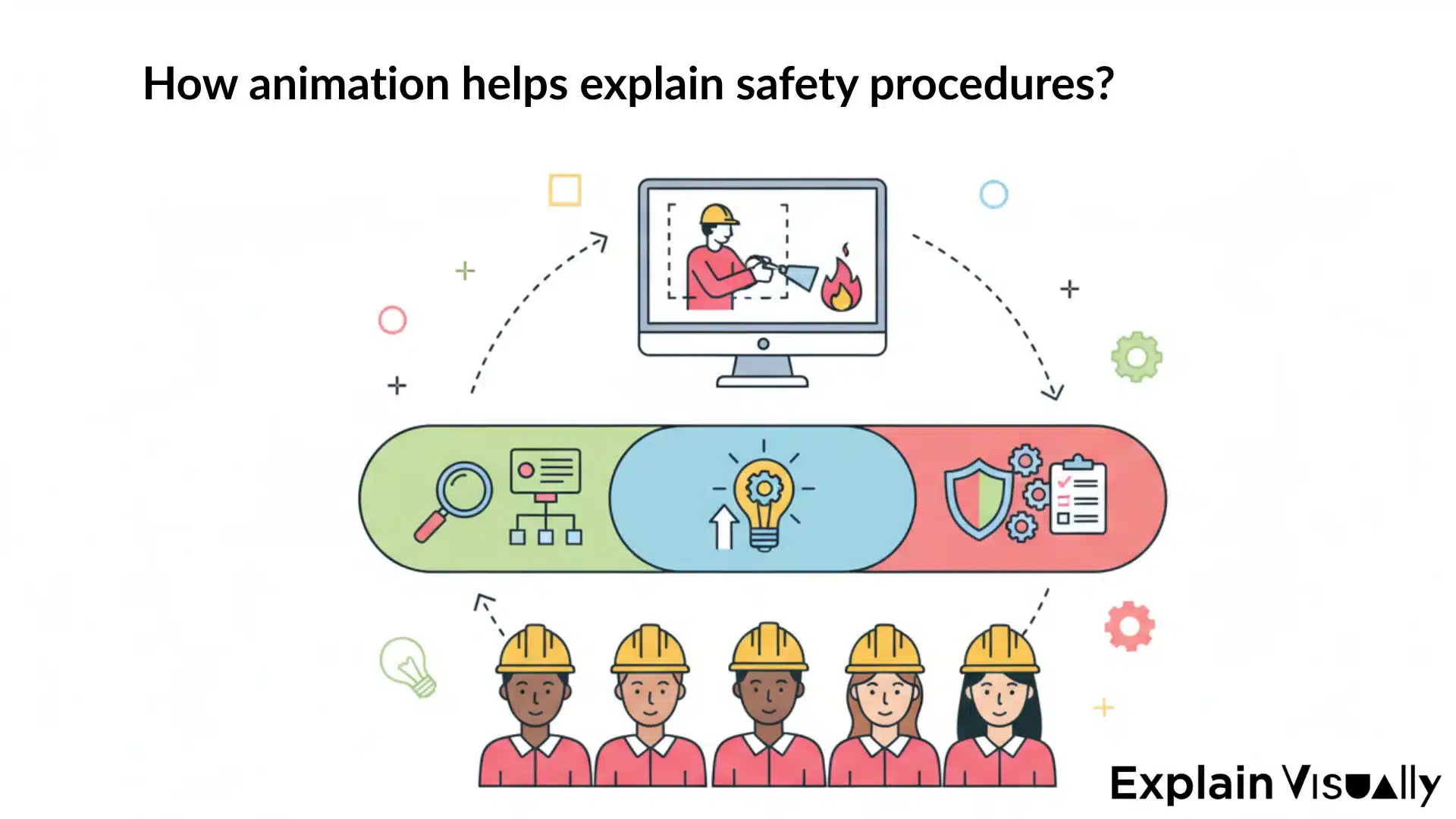
If you’re reading this, you’re probably asking a practical question: would animation actually work in our organisation? We created this guide for safety managers, HR teams, compliance specialists and anyone involved in employee training who expects clearer answers than marketing promises usually offer. Are you trying to understand how the animation process really works? Looking for concrete examples or current trends that others may already be applying in their organisations? If so, you’re in the right place.
We take a closer look at how animation is used to explain safety procedures. The goal is simple: fewer assumptions, clearer communication and safety information that remains useful beyond the training room.
Why safety protocols need a visual rethink in 2026?
For years, organisations have relied on documents to communicate safety procedures. Policies, manuals, protocols. Read, signed, archived…
This approach creates a sense of order. Everything is documented. Everything is traceable. Yet the moment procedures leave the page, their impact becomes far less certain.
Most safety documentation is absorbed in passing. Between meetings. During onboarding. Under time pressure. Rarely in the conditions where those instructions are later expected to guide behaviour.
Why “read and sign” stopped working years ago?
“Read and sign” persists largely because it satisfies formal requirements. It produces evidence. It produces records. What it does not reliably produce is recall in moments shaped by stress, distraction or urgency.
Why visual learning now sits at the centre of compliance?
By 2026, this disconnect is visible across many industries. Attention is fragmented. Work environments are faster and less predictable. The margin for hesitation or misinterpretation has narrowed. The real cost often appears indirectly. In assumptions that procedures are understood. In confidence that exists on paper rather than in practice.
Safety protocols tend to surface when something goes wrong. At that point, clarity depends less on how carefully they were written and more on whether they were ever truly internalised.
In this context, visual communication plays a central role in compliance. It helps reduce ambiguity without adding cognitive load, particularly in situations where procedures need to be recognised quickly and acted upon with confidence.
Safety protocol animations – explained without buzzwords or marketing gloss
Safety protocol animations are often introduced as a modern alternative to documentation.
We understand why this comparison appears so frequently. It is intuitive and easy to communicate. At the same time, it simplifies the role animation plays in effective safety communication.
Well-designed safety animations are built on existing procedures. They start from what is already defined inside an organisation. Their task is to translate those procedures into a form that can be recognised and followed in situations shaped by time pressure, divided attention and emotional strain.
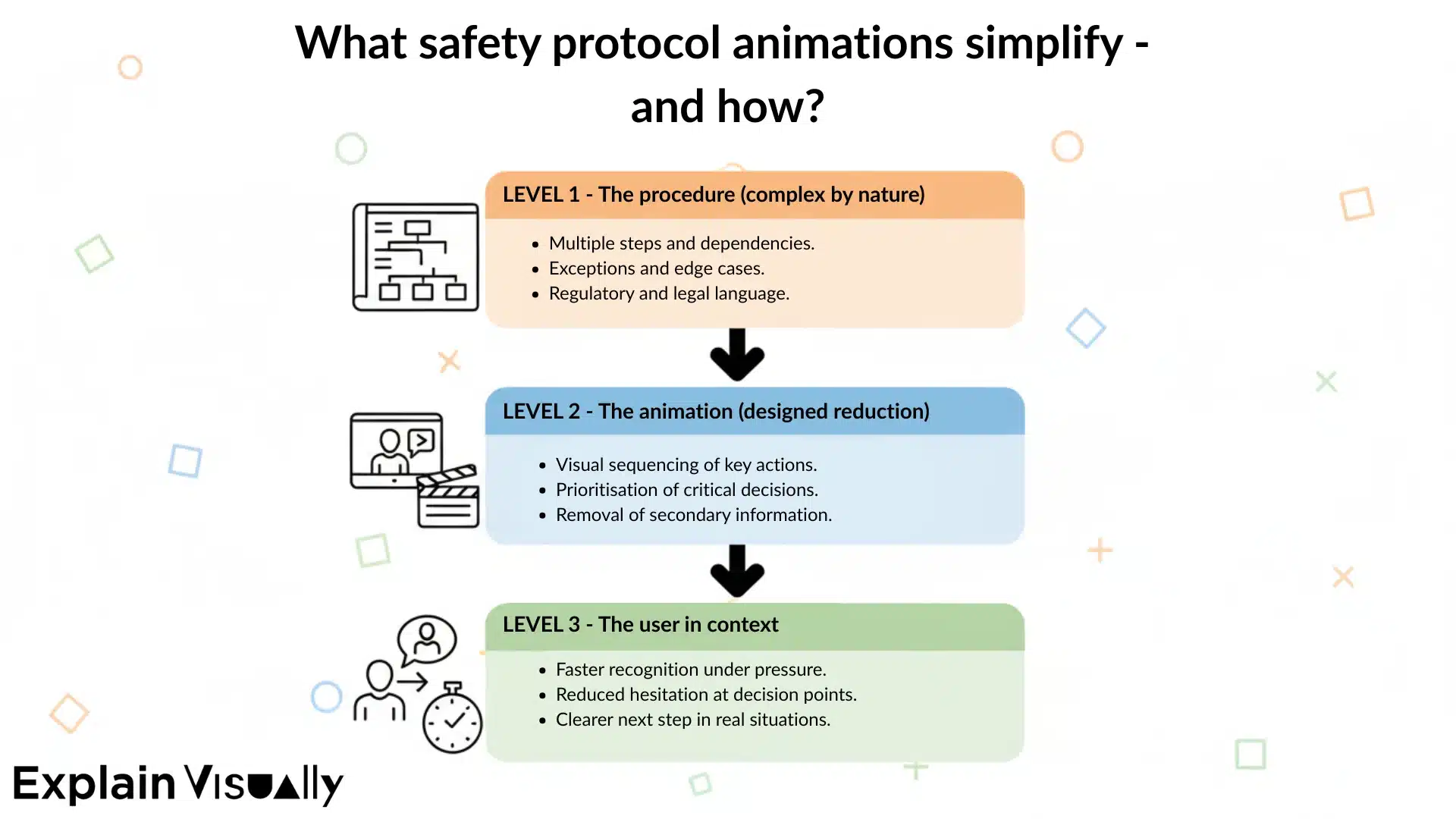
Animation sits between formal rules and real-world behaviour. It supports the moment when instructions must move off the page and into action.
Where expectations start to drift?
Problems tend to emerge when animation is treated as a shortcut. This usually happens late in the process. Visuals are added after decisions about responsibility, risk or sequence have already been made. In such cases, animation is expected to compensate for issues it was never meant to resolve.
Used with intention, safety animations play a clearly defined role:
– They help structure sequences of action.
– They clarify decision points.
– They support recognition in situations where hesitation carries consequences.
Written procedures remain essential, but animation strengthens them by making critical information easier to recall.
From our perspective, effectiveness depends on purpose rather than visual style. A clear understanding of risk, audience and usage context determines whether animation truly supports understanding at the moment it is needed.
Where safety protocol animations are used today and why context matters?
At this point, the question is usually a practical one. Will this work in my organisation? In my industry? In my day-to-day reality?
There is no single answer that fits every context. We are not attempting to map every sector or every possible use case. In our experience, well-designed safety animations can support almost any team, provided they are created with a clear understanding of risk, role and environment.
The sections below look at several common contexts where safety protocol animations are used today. Each offers a practical point of reference that may help you assess how animation could fit into your own environment.
High-risk, low-attention environments
Safety protocol animations are commonly used in environments where attention is limited and decisions have to be made quickly. Manufacturing floors, logistics operations, construction sites and clinical settings share similar constraints: procedures need to be recognised and followed under physical or cognitive pressure.
These environments often involve emergency response or evacuation scenarios, where even small delays or misunderstandings can have immediate consequences. Animation helps create a shared visual point of reference for critical actions. Clear sequencing, recognisable cues and a consistent visual language support faster orientation, especially in situations where written instructions are unlikely to be consulted.
When animations are grounded in real working conditions (including noise, interruptions or protective equipment) they tend to be easier to recognise and apply when it actually matters.
This example illustrates how safety animations are used in health and safety training. Notice how visual sequencing and simplified cues help focus attention on critical actions, rather than on exhaustive procedural detail.
Invisible procedures with real consequences
Not all safety procedures involve visible physical risk. Cybersecurity, data protection and compliance often sit in the background of everyday work. Their impact is delayed and rarely obvious, which makes them harder to communicate through static documentation.
Animation helps make these processes easier to grasp. By showing sequences of responsibility, data flows and decision paths, it connects everyday actions with real organisational risk. This is especially relevant in areas such as cybersecurity awareness and data protection, where consequences are not immediately felt.
This animation demonstrates how visual storytelling can clarify abstract or invisible risks. By showing cause-and-effect relationships, it helps understand why specific behaviours matter, even when consequences are not immediately visible.
When one animation must serve multiple audiences
Safety protocol animations are rarely used by one group only. The same material often supports onboarding for new hires, refresher training for experienced employees and alignment across teams or external partners. That means one animation is expected to work for people with very different levels of knowledge, responsibility and exposure to risk.
In practice, this is where many projects quietly become more complicated than planned.
Clear scope, simple structure and well-defined use cases help keep the message relevant without overwhelming the viewer. When audience context is considered early, animations are easier to reuse across roles, locations and stages of employment.
This example shows how safety and procedural animations are used during onboarding. Rather than covering every detail, the animation focuses on shared understanding, roles and expectations across different audiences.
Whiteboard vs 2D vs motion vs simulation – what breaks first?
At some point, you’ll likely find yourself comparing formats. Whiteboard, 2D explainer, motion design, simulation. The temptation is to look for the “strongest” option. In reality, the better question is much simpler: what does this procedure actually need?
Some procedures are about logic and order. Others depend on spatial awareness, timing or realistic context. That’s why no single format works equally well in every situation. Whiteboard animation brings clarity when sequence matters. 2D explainer helps people recognise familiar situations. Motion design supports understanding of systems that operate in the background. Scenario-based animations come into play when decisions have to be made under pressure.
Problems usually appear when the format is chosen before the context is clear. When a procedure requires realism but is reduced to symbols. When a complex system is turned into a story that feels too literal. Or when a simulation carries more detail than the viewer can realistically process.
Choosing the right format is less about avoiding failure and more about matching the medium to how the procedure is actually used. That’s where safety communication stops looking correct on screen and starts being usable in real situations.
Below, we look at the animation formats most commonly used in safety and procedural communication. Not to rank them, but to help you understand where each one tends to work best.
Whiteboard animation
Whiteboard animation is usually the first format teams reach for when they need to explain how something works. Not because it looks impressive, but because it forces structure. Ideas appear step by step. One decision leads to another. Nothing jumps ahead of the logic.
This format works particularly well when you need to explain:
-
onboarding scenarios,
-
compliance explanations,
-
introductory safety training,
-
procedural overviews where context matters more than realism.
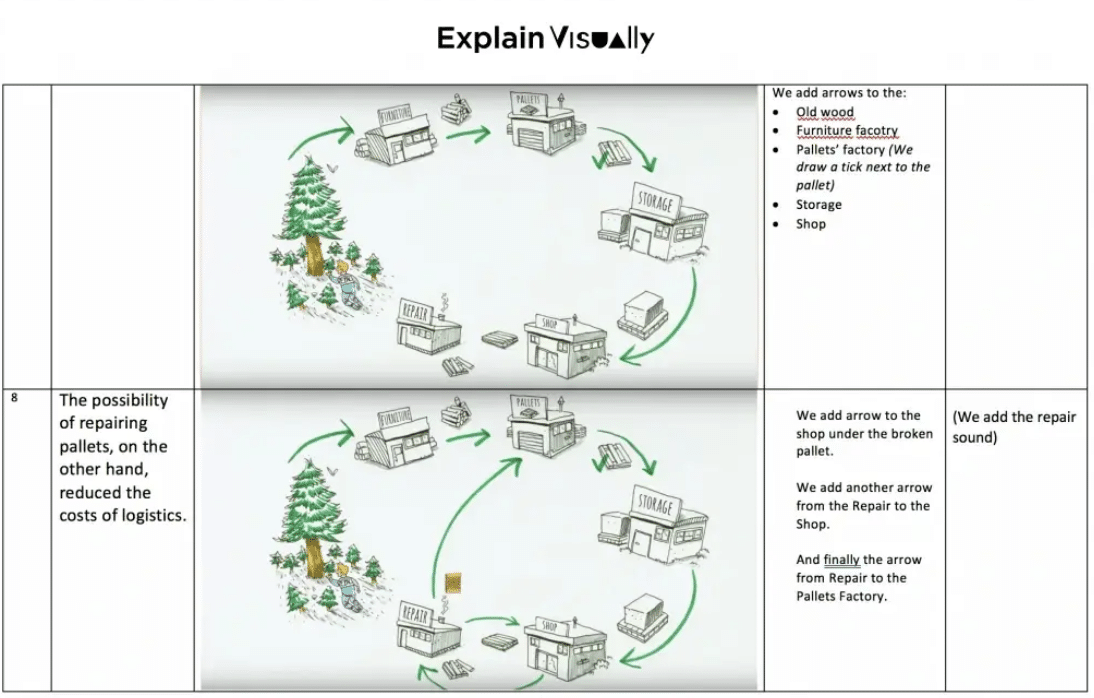
Example of storyboards for our Client.
Because whiteboard animation keeps visual noise to a minimum, it helps people focus on sequence and meaning. That makes it especially useful for audiences encountering a procedure for the first time, or for regulated environments where clarity and order matter more than visual detail.
A short example of how whiteboard animation can be used to present procedural logic in a clear, structured way.
2D explainer animation
2D explainer animation is often chosen when teams want something more concrete than a whiteboard, but still easy to follow. It allows people, spaces and actions to be shown in a recognisable way, without pushing the level of detail too far.
This format is typically used for:
-
health and safety procedures,
-
workplace behaviour guidelines,
-
role-based safety responsibilities,
-
internal standards shared across departments.
2D explainers work well when viewers need to see situations that resemble their own work environment. Equipment, spaces and interactions can be shown clearly, while visual simplicity keeps cognitive load under control. This balance makes the format easy to scale across multiple topics without losing consistency.
If you’re interested in the background of 2D animation and how this format evolved over time, this article provides a broader introduction: What is 2D animation? Your introduction to the basics.
Motion design
Motion design is usually chosen when there is no single scene to show. The topic is a system, a process or a set of relationships rather than a physical action. Instead of characters and environments, the animation relies on symbols, diagrams, simple shapes and movement to organise information.
This format is commonly used for:
-
cybersecurity awareness,
-
data protection and information flows,
-
compliance frameworks,
-
risk models and escalation paths.
Motion design is particularly useful when procedures operate in the background of everyday work. It helps make invisible processes easier to follow, especially in digital or highly regulated environments. At the same time, this format requires restraint. Clear hierarchy matters more than visual energy, because too much motion can quickly make complex information harder to process.
How safety protocol animations are built? From procedures to real use
If you’re considering animation for safety communication, the starting point might surprise you. It’s not visuals. It’s not style. It’s not even the format. It’s understanding how your procedures are actually used, by real people, in real situations.
Before anything is written or drawn, there’s usually a moment of stepping back. Looking at existing procedures and asking a few uncomfortable but necessary questions. Who uses this? When? Under what pressure? And what tends to go wrong in practice?
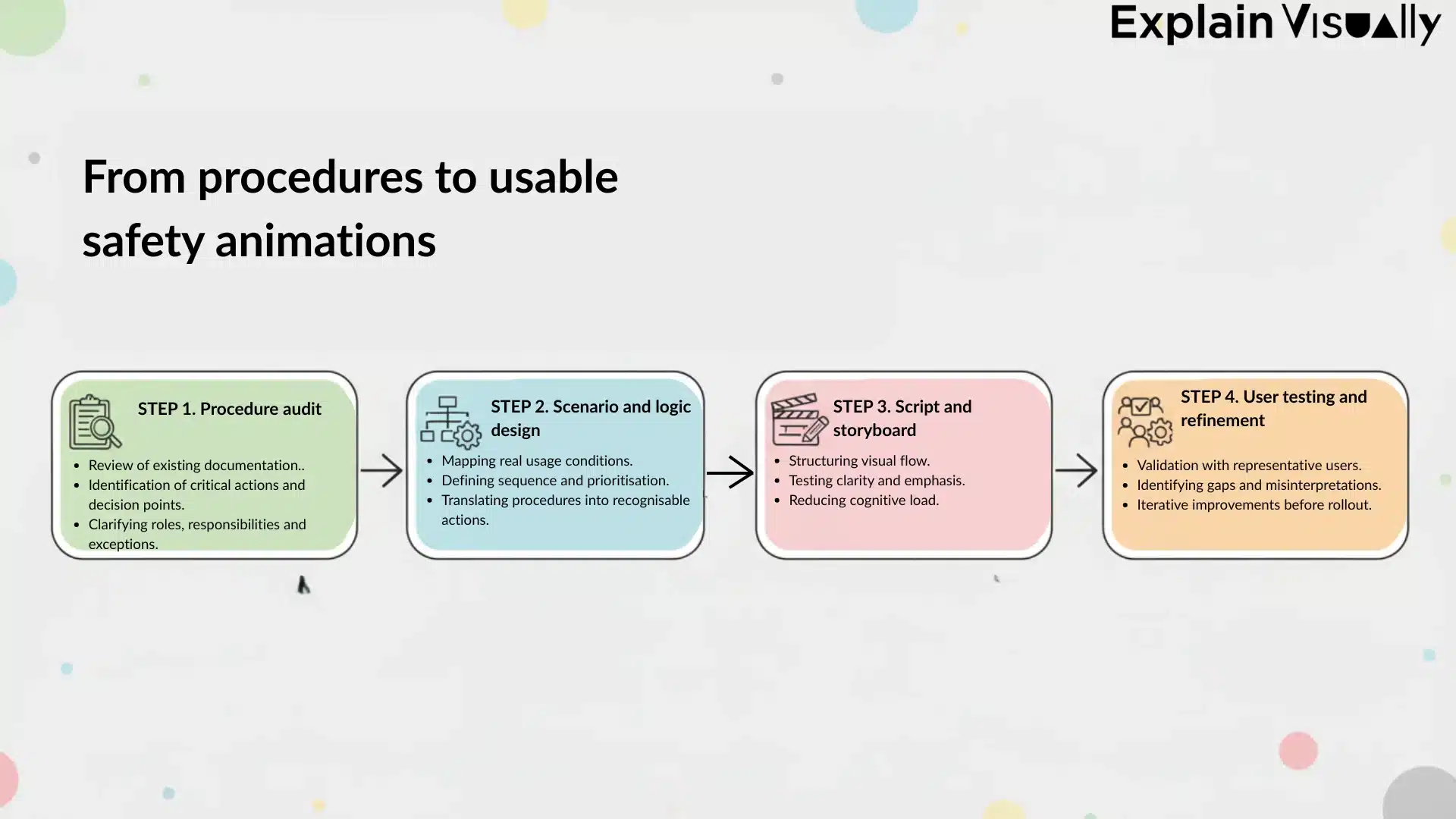
This part of the process is rarely neat. It involves clarifying assumptions, untangling overlaps and making decisions that will later shape how information is understood and remembered.
Auditing procedures. What needs to be clarified first?
Most organisations already have documentation. Often a lot of it. The challenge is that procedures are not always as clear as they look on paper. Steps may overlap. Responsibilities may be implied rather than stated. Exceptions often live in separate documents.
At this stage, the goal is to get aligned. Identifying critical actions, decision points and hidden assumptions helps determine what truly needs to be communicated visually and what can remain in supporting materials.
From procedures to scenario logic
Once procedures are clearer, the focus shifts to use. Safety protocols are rarely followed in ideal conditions. They come into play when attention is divided, time is limited or uncertainty is high.
This is where practical questions start to matter. Where does someone encounter this situation? What do they need to recognise first? What happens if they hesitate or interpret a step differently than intended?
Answers to these questions shape the structure of the animation long before anyone talks about visual style.
Scripting and storyboarding
The script is where priorities become visible. It defines sequence, emphasis and pacing. Just as importantly, it defines what is left out.
Storyboarding turns that logic into flow. It allows teams to see whether transitions feel natural, whether decision points stand out and whether the overall sequence makes sense. This is often the moment when gaps or inconsistencies in the original procedure finally surface.
Testing with users before rollout
Sign-off is not the same as understanding. Before animations are used at scale, they need to be seen by the people they are meant for. Ideally in conditions close to real use.
Feedback at this stage tends to be practical and revealing. Unclear cues. Too much information on one screen. Assumptions that don’t hold up outside the meeting room. Addressing these early helps ensure that the final animation supports recognition and action when it matters, not just formal compliance.
So what does “best practice” actually look like in safety communication?
Let’s pause for a moment and talk about best practices.
Everything we’ve covered so far already gives you a solid framework to work with. But when safety animations move from theory into real organisations, a few patterns tend to matter more than anything else.
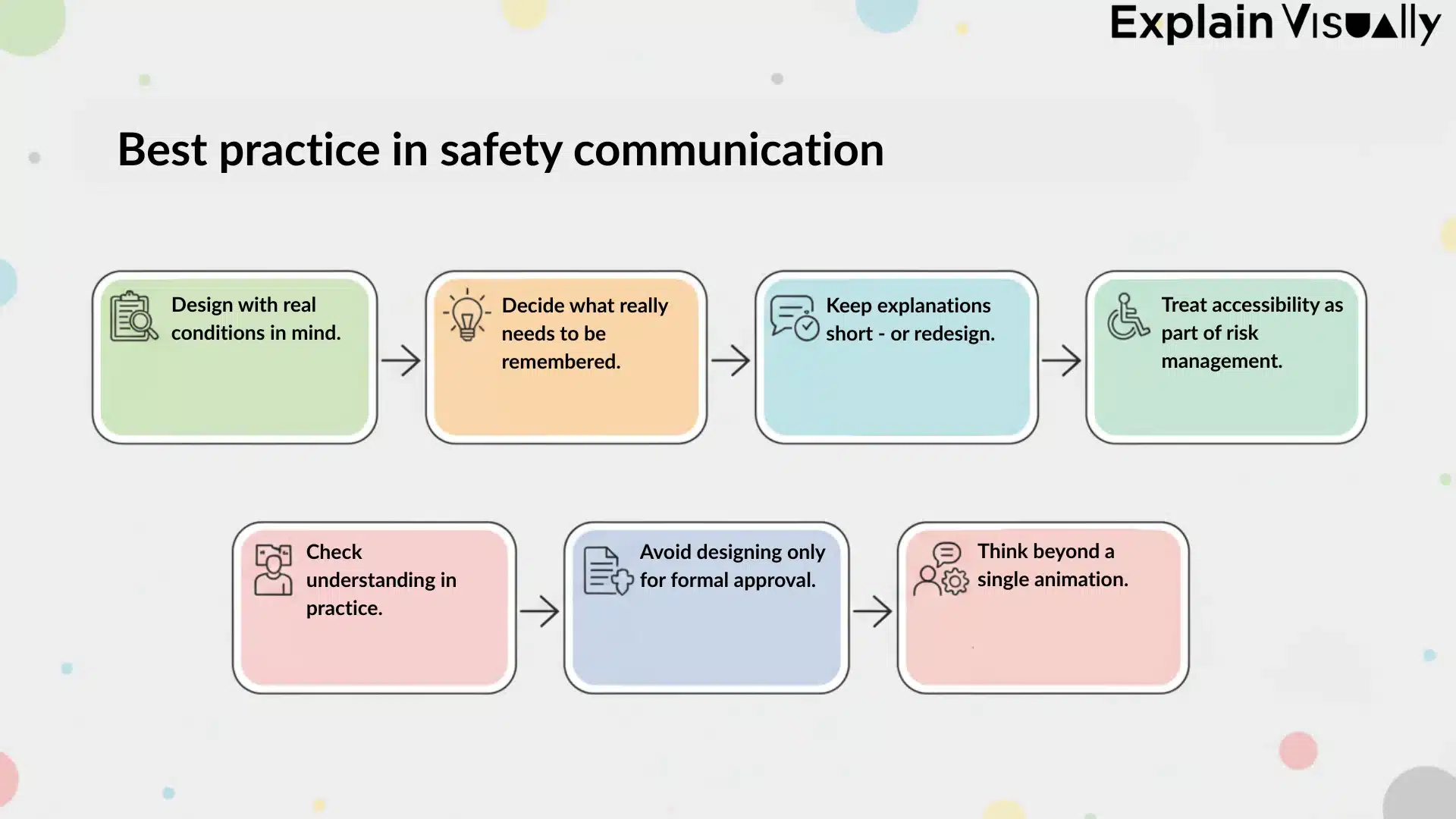
They’re observations (not rules!). Things that consistently make the difference between content that looks correct and content that actually works.
-
Design with real conditions in mind.
People don’t consume safety content in perfect conditions. They are distracted, rushed or overloaded. Animations that work acknowledge this upfront and focus attention where it is needed most.
-
Decide what really needs to be remembered.
Not everything deserves the same level of emphasis. Strong safety animations make clear choices about priorities, sequences and moments of decision.
-
Keep explanations short or redesign.
If an animation needs long explanations during training, something is off. Good safety visuals should remain understandable when revisited later, without additional context.
-
Treat accessibility as part of risk management
Language level, symbols and visual complexity directly affect understanding. Small design choices here often prevent much bigger problems later.
-
Check understanding in practice
Viewing content tells you very little. Short scenarios, discussions or practical checks reveal whether people know what to do when context changes.
-
Avoid designing only for formal approval
Sign-offs and documentation are part of the process. They do not reflect how procedures are actually used day to day.
-
Think beyond a single animation
Safety animations work best as part of a broader system. Onboarding, refreshers and ongoing training benefit from a shared visual language and structure.
Safety communication trends for 2026 – and where caution is needed
If you’re planning safety communication for the coming year, you’ve probably already noticed a shift in how information is absorbed at work. Attention is divided across tasks. Learning happens in short moments between responsibilities. Procedures tend to be revisited in response to concrete situations that come up during the day.
This shapes how safety content needs to function. It has to remain easy to access and recognise over time. Short, scenario-based elements often fit naturally into everyday workflows, especially when they reflect situations people recognise from their own experience. Microlearning appears in this context as a practical response to how work is organised.
Evaluation criteria are changing as well. Safety communication is increasingly judged by how it supports decisions in real situations. Clear timing, understandable structure and visual restraint play a central role. The trends that tend to hold up are usually the quiet ones. Those that integrate smoothly into reality and everyday use.
Partnering with Explain Visually for long-term safety communication
If safety communication is something you’re responsible for, you already know that one project rarely closes the topic for good. Procedures change. Teams rotate. New risks appear. What works today often needs adjustment tomorrow.
We approach safety protocol animations as part of an ongoing process. It usually starts with understanding how your procedures are used right now and where friction already appears. From there, we focus on building a visual language that stays familiar over time and across different teams, locations and use cases.
This makes future updates more straightforward. Content can be extended, refreshed and reused without rebuilding everything from scratch. Animations support onboarding, training and everyday safety awareness as your organisation evolves. If you’re looking for a partner who stays involved beyond delivery, we’re happy to talk.
Want to see our work in action?
For proof of our unmatched skills and dedication to every project, be sure to visit our YouTube channel.
𝐄𝐱𝐩𝐥𝐚𝐢𝐧 𝐕𝐢𝐬𝐮𝐚𝐥𝐥𝐲 – 𝐁𝟐𝐁 𝐚𝐧𝐢𝐦𝐚𝐭𝐢𝐨𝐧 𝐬𝐭𝐮𝐝𝐢𝐨:
• We create whiteboard animations for businesses
• We create corporate explainer videos
• We create visual storytelling for companies
FAQ - Safety protocol animations
How animation helps explain safety procedures?
Animation helps explain safety procedures because it removes the need to imagine situations described in text. Actions, order and consequences are shown directly. For many teams, this makes safety procedures easier to recognise later, especially when they are not used every day.
How do safety animation videos improve workplace safety training?
Safety animation videos are often used to bring consistency into workplace safety training. They help organisations avoid repeating the same explanations during multiple training sessions and support the same message across locations and teams.
In practice, they work best as part of a broader training approach, alongside discussions and hands-on practice.
How does animated safety training compare to traditional safety training methods?
Traditional safety training methods rely heavily on documents, presentations and spoken instruction.
Animated safety training adds visual demonstration, which helps simplify complex safety concepts and supports visual learners.
Most organisations combine animated safety with traditional methods rather than replacing them completely.
Can animated safety training simplify complex safety procedures?
Yes, particularly when complex safety procedures involve: multiple steps, potential hazards and critical procedures that must be followed in order.
Animated safety training helps structure this information visually, making correct procedures easier to recall under pressure.
Are animated safety videos suitable for emergency procedures and fire safety?
Absolutely. Animated safety videos are widely used for emergency procedures, fire safety, fire drills and emergency response.
They are especially effective when teams need to recognise what to do quickly, such as during evacuation or confined space entry.
How does safety animation support compliance requirements and safety regulations?
Safety animation supports compliance requirements by helping ensure compliance through consistent safety messaging. When safety protocols are presented visually, it becomes easier to align workplace training with safety regulations and safety standards across the organisation.
Which industries benefit most from animated safety training?
Industries benefit from animated safety training across multiple sectors.
It is commonly used where workplace safety procedures involve electrical safety, hazardous materials, chemical spill response or safe handling.
Manufacturing, logistics, construction, healthcare and energy are typical examples, but the approach is not limited to a single industry.
How does animation help overcome language barriers in safety training?
Animation videos reduce language barriers by relying less on text and more on visual training. This makes safety knowledge easier to share across diverse workforces and multiple locations, even when language proficiency varies.
Can animated safety training help reduce accidents?
Clear visual training supports better recognition of potential hazards. Over time, improved safety awareness and understanding of correct procedures can contribute to fewer accidents and a stronger safety culture.
How does Explain Visually approach safety animation production?
Explain Visually treats animation production as part of a long-term safety communication system. Projects are designed around the intended audience, real working conditions and compliance requirements, with space to gather feedback and test audiences before rollout.