
Many animated Facebook Ads grab attention only for a moment, which is why they never turn into clicks or sales. Why do some animations stop viewers and increase conversions, while others disappear in the scroll after just two seconds?
Did you know that most animated Facebook Ads fail before the viewer even has time to read the first sentence? Your ad may be one of them, and if it is, it is time to change your strategy. Contrary to what many companies believe, the lack of response is usually not caused by poor execution. In our experience, the problem appears much earlier. The ad may be full of movement, colours and effects, but still give people no reason to stop, even for a moment.
On social media, you are not only competing with other brands. You are also competing with messages from friends, videos, memes and hundreds of other posts, and unfortunately this is something many people forget. The viewer makes a decision instantly: keep watching or keep scrolling. The reaction is black and white, yes or no, with nothing in between.
In most cases, the first few seconds are enough to decide whether an ad has any chance of working. The role of a good, effective animation is to show the viewer as quickly as possible why they should pay attention to this product, service or problem. The faster the ad does that, the greater the chance that someone will watch it until the end and, most importantly, click.
Why most animated Facebook Ads fail before they even start
Many companies assume that if animation catches the eye more effectively than a static image, it will automatically perform better. That is why so many ads are filled with transitions, moving icons, dynamic text and visually impressive scenes. But let us debunk that myth right away: it does not work like that.
Movement without clarity kills conversions. If people do not instantly understand what they are looking at, they scroll. If the ad does not click right away, they will not keep watching, no matter how many elements appear on the screen.
The myth that movement automatically means engagement
This is one of the most common mistakes in animated advertising. Brands add more movement because they assume it will make the ad more engaging. In reality, the opposite often happens.
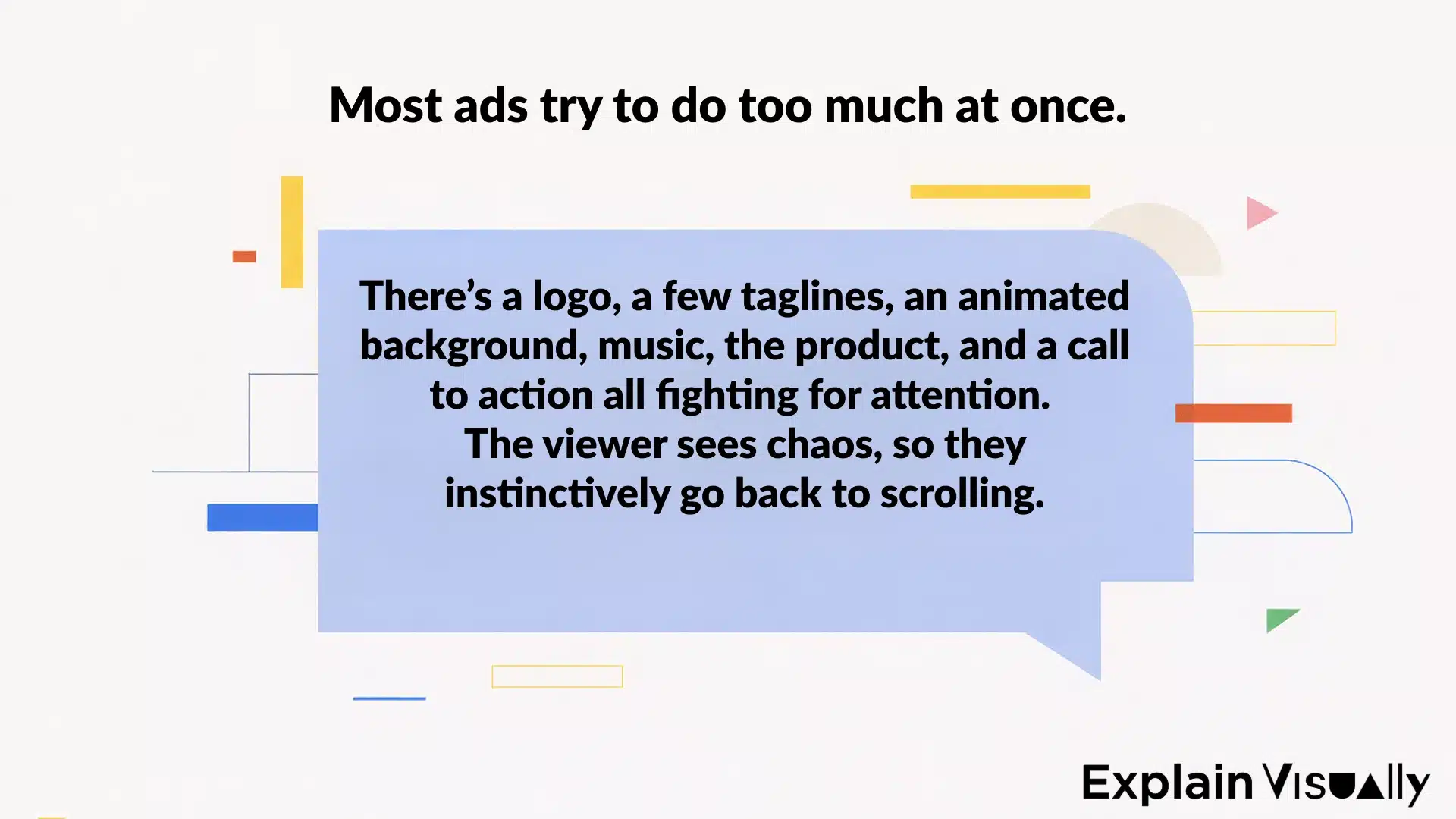
Just because someone briefly looks at an ad does not mean they are actually paying attention to it. Many animated ads manage to catch the viewer’s eye for a split second, only to be scrolled past immediately afterwards. When everything is moving at once, people do not know where to focus. Should they read the text? Look at the product? Follow the animation in the background?
Instead of grabbing attention, the ad creates confusion and frustration, and this is only the beginning. If the first impression already feels overwhelming, it is difficult to expect the viewer to stay. The more questions they have in their head, the more likely they are to scroll away.
So what is the right balance?
The best animated ads are usually much simpler than they seem. They focus on one thing at a time:
One problem the viewer immediately recognises.
One benefit they actually care about.
One clear message that stands out.
The ads that convert are rarely the busiest ones. They are the clearest.
Getting attention is not enough you need people to stay
The hardest part is keeping someone with your ad for just one second longer. If you manage to do that, you increase the chance that they will stay for another second after that. It may be hard to believe, but that one extra second often changes everything. This is the moment when the viewer starts to understand what the ad is about and whether the problem it shows applies to them. And here is another secret behind effective advertising: the best ads never start by introducing the brand. They focus entirely on something the viewer recognises immediately.
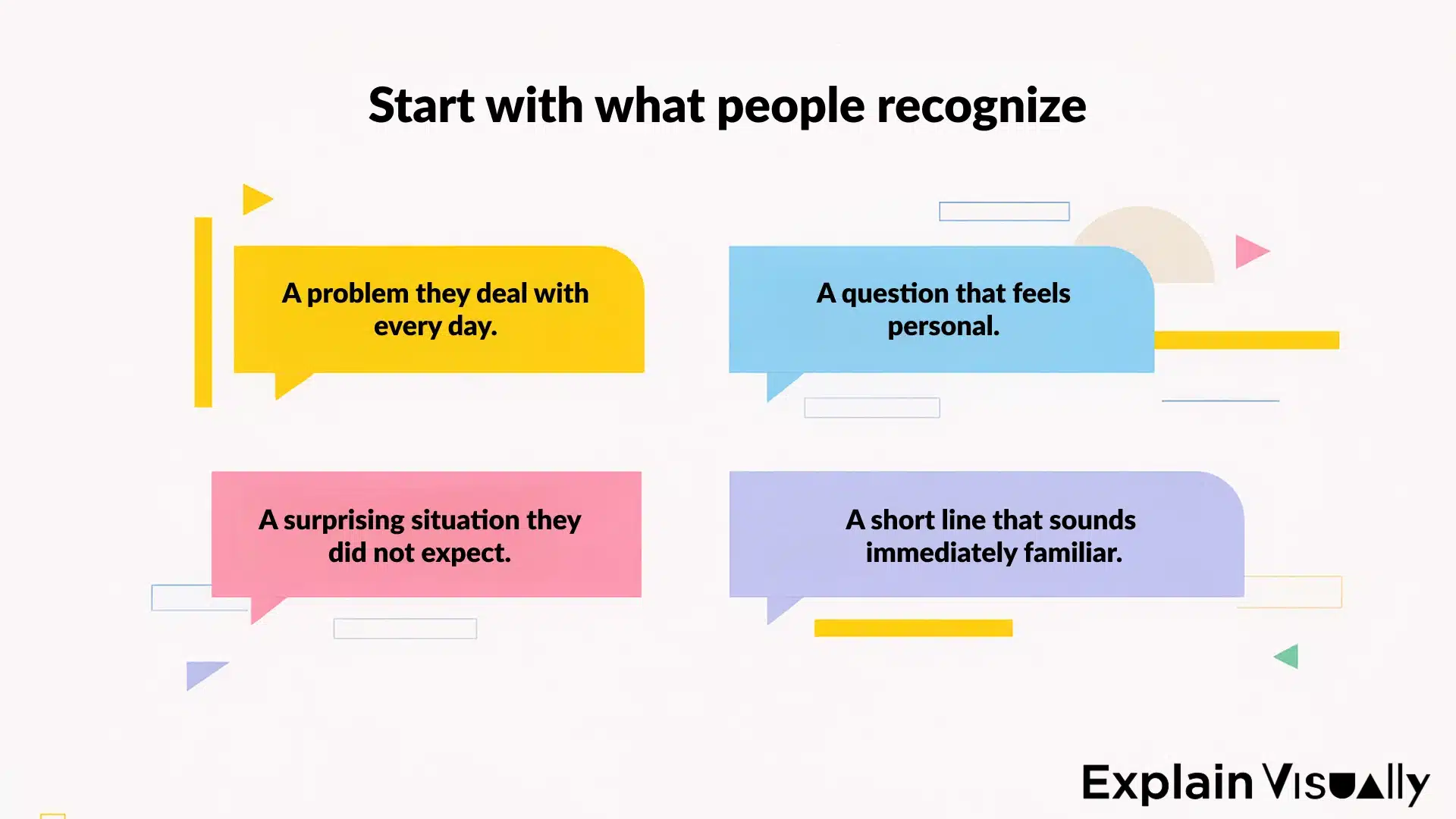
Many ads begin the same way: first the logo appears, then the company name, then an animated slogan. None of those elements answer the only question that matters: why should I keep watching? If they do not know your brand, your logo means almost nothing to them. Instead of building interest, it often wastes valuable seconds.
The strongest ads earn the right to show the brand. They do not start with it.
The strongest ads earn the right to show the brand. They do not start with it. Think of it this way: first the interest, then the brand.
For example: “Most people stop watching an ad after 3 seconds.”, “This is what a website that loses customers looks like.”, “One small change could cut your workload in half.”
Not just Facebook? If you want to know what works on other platforms too, read: Best video animations for YouTube Ads to boost your engagement.
Best video animations for YouTube Ads to boost your engagement
What makes someone stop scrolling for a second longer
The things that work best are usually the ones that do not look like a typical Facebook ad. The goal is to break the pattern. That could mean an unexpected opening line, a large and simple message on screen, a close-up of a specific detail, a sudden pause in the movement, or a question that instantly sparks curiosity.
It also helps to show something unfinished. When viewers see the beginning of a situation, they naturally want to know what happens next. It could be a messy screen that turns into an organised process, a before-and-after transformation, or someone making a simple mistake before the ad reveals how to avoid it.
Most importantly, it should be clear within the first few seconds what the ad is actually about. If the viewer has to guess, they probably will not stay long enough to find out.
The 3 questions every viewer asks in the first 3 seconds
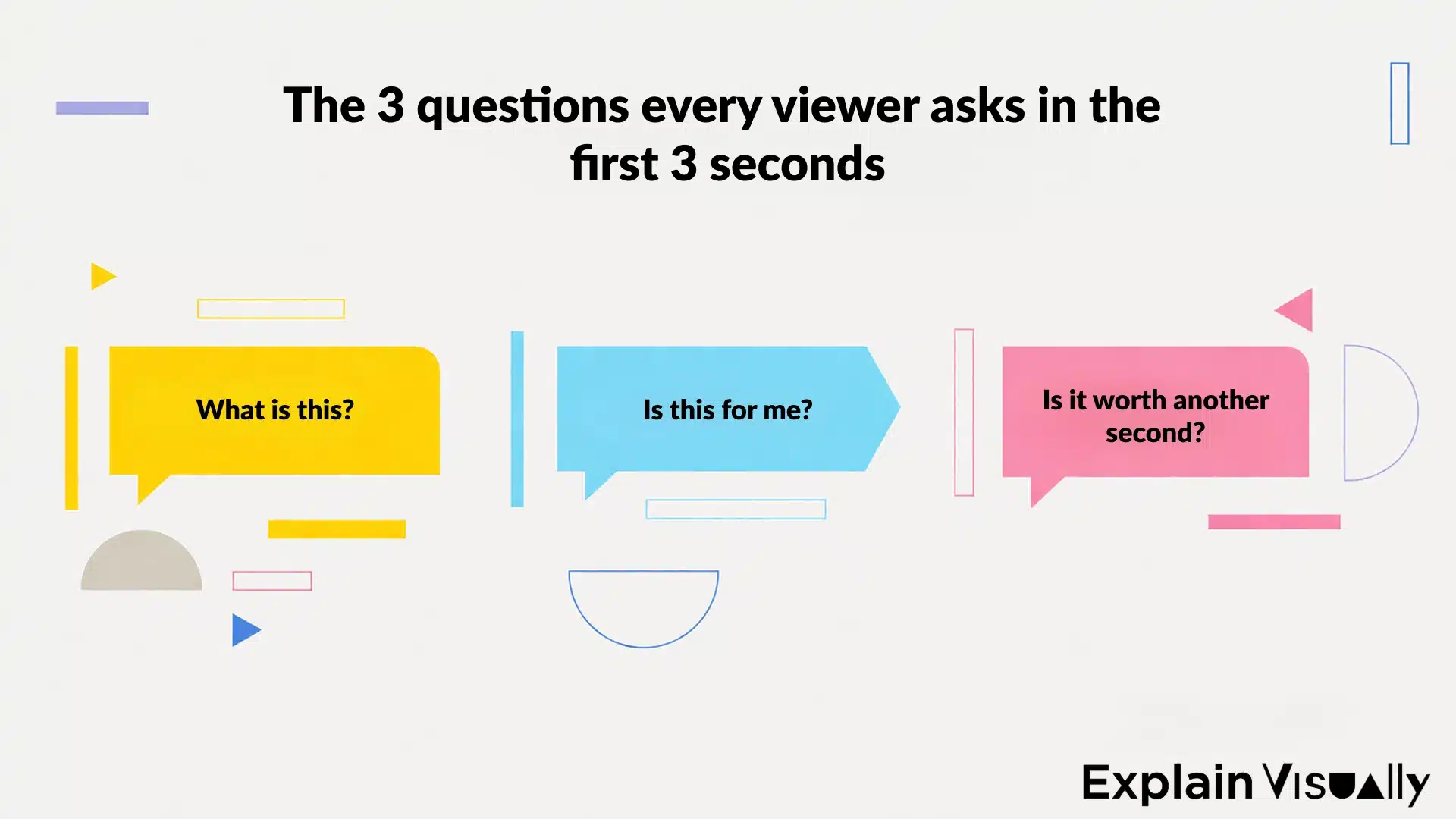
The first question appears immediately: “What am I actually looking at?” If an ad starts off too abstract, too polished or too obviously “advertising”, the viewer has no chance of understanding it quickly. That is why the very first frame should make it clear whether the ad is about a product, a problem, a service or a specific situation. This is the first-frame test. If people cannot instantly tell what the ad is about, the ad has already lost.
A second later, the viewer makes another decision: “Is this relevant to me?” At this point, the most visually impressive animation does not win. The one that wins is the one that shows a familiar problem, frustration or situation that the viewer instantly recognises.
Only then does the third question appear: “Is this worth watching?” If the ad suggests that it is about to reveal a solution, an easier way of doing something or an interesting result, the viewer will stay. If not, they will scroll past, even if the animation itself looks great.
After those first few seconds, the viewer makes one more simple decision: “Do I actually understand what is going on here?” At that point, both the message and the way you present it matter. Not every style of animation works in the same way. Some are great at stopping the scroll but do very little to explain the offer. Others may look calmer, but do a much better job of showing a product, a process or a specific benefit. When an ad fails, the problem is often not the idea itself. It is that the chosen style of animation simply does not fit the message.
Choosing the right type of animation
We have often worked with clients who chose an animation style very intuitively, based on what their competitors were doing or simply because a certain style looked modern. Viewers do not care whether your ad looks modern. They care whether they understand it.n. They judge it by how easy it is to understand.
That is why the right type of animation should always come from one simple question: what does the viewer need to understand within the first few seconds? We would never recommend choosing a style just because we personally like it or because it fits our taste. After all, we are not the audience for the ad. We are the people creating it.
If you are still not sure which animation style fits your brand, take a look at our article: Animation in social media marketing.
When explainer-style animation works best
Explainer-style animation becomes essential when your product cannot be understood in a single glance.
Instead of simply showing the product, this type of ad shows:
-
What problem the viewer is dealing with.
-
What changes after using the product or service.
-
Why the solution is easier, faster or more convenient.
If people need a few extra seconds to understand what you do, a static image is usually not enough. This is where explainer-style animation earns its place.
This works especially well when you are selling something that cannot be explained with a single image or sentence, such as an app, a service, a course or a product people are not familiar with yet.
In these cases, a static graphic is often not enough. The viewer sees the ad, but still does not understand why they should click. Explainer animation makes it possible to show everything step by step, without over-explaining. First, it shows the problem. Then the solution. Finally, it shows what to do next.
5 Rules of an easy-to-understand ad
-
One message per scene.
-
No more than 5–7 words on screen.
-
The eye should know where to look first.
-
Every new scene should add something new.
-
If you mute it and still understand it, it works.
Most animated Facebook Ads fail because they create visual noise instead of message clarity. The product, a headline, several benefits, the logo and the CTA all appear at once. As a result, the viewer remembers nothing. It works much better when each scene is built around just one clear idea.
Another problem is pacing. Many ads move from one scene to the next so quickly that viewers do not have time to read the text or understand what they are looking at. If an important piece of information appears on screen for less than a second, most people simply will not notice it. A visually impressive ad that is difficult to understand will almost always lose to a simpler one that is instantly clear.
And there is one more thing that people rarely think about: a good ad should still make sense if you pause it at any moment. Look at any single frame and ask yourself whether it is still clear what you are advertising and why someone should care. If it is not, the problem is not the design. It is the message.
Why Facebook Ads should work without sound
This rule should be near the top of the list. Many people watch Facebook and Instagram with the sound off: at work, on the bus, or in the evening when others are nearby. If your ad only starts to make sense once someone hears the voice-over or music, you lose a large part of your audience before they even understand what it is about. Design the ad as if nobody will ever turn the sound on. It can add emotion or improve the pacing. But it should never be the only thing carrying the message.
The most common mistake we see is this: the screen shows a few nice-looking shots, but all the important information comes from the voice-over. Without sound, the ad becomes impossible to understand. The viewer sees movement, but has no idea what is being advertised or why they should care.
It works much better when the main message is clear from the visuals and a short line of text alone. If you are promoting a productivity app, do not write several sentences about saving time. Show a messy screen, then an organised one, and add one simple line: “Less chaos. More time.” That combination works because the image shows the problem and the change, the text explains what the viewer is seeing, and the sound becomes an extra rather than a necessity.
Try this yourself. Play any ad without sound and pause it after 2 or 3 seconds. If you still instantly know what it is advertising, who it is for and what you would gain from it, the message is strong enough. If not, the problem is probably that the ad is trying to explain everything with words instead of showing it visually.
Creating different versions without starting from scratch
Very rarely does an ad work perfectly the first time. Sometimes the problem is the opening. Sometimes it is the pacing. Other times, it is the ending or the call to action. In that situation, many companies start from scratch and create a completely new ad, but that is usually unnecessary.
It works much better to think of your ad as a few separate parts: the beginning, the middle and the end. If something is not working, do not change everything at once. Change only the part that is most likely causing the problem. That way, you will see much faster what is actually affecting the result.
What should You Change First?
Always start with the beginning. If the first few seconds do not stop people from scrolling, the rest of the ad has very little chance of working. In most campaigns we review, the biggest drop happens before second three.
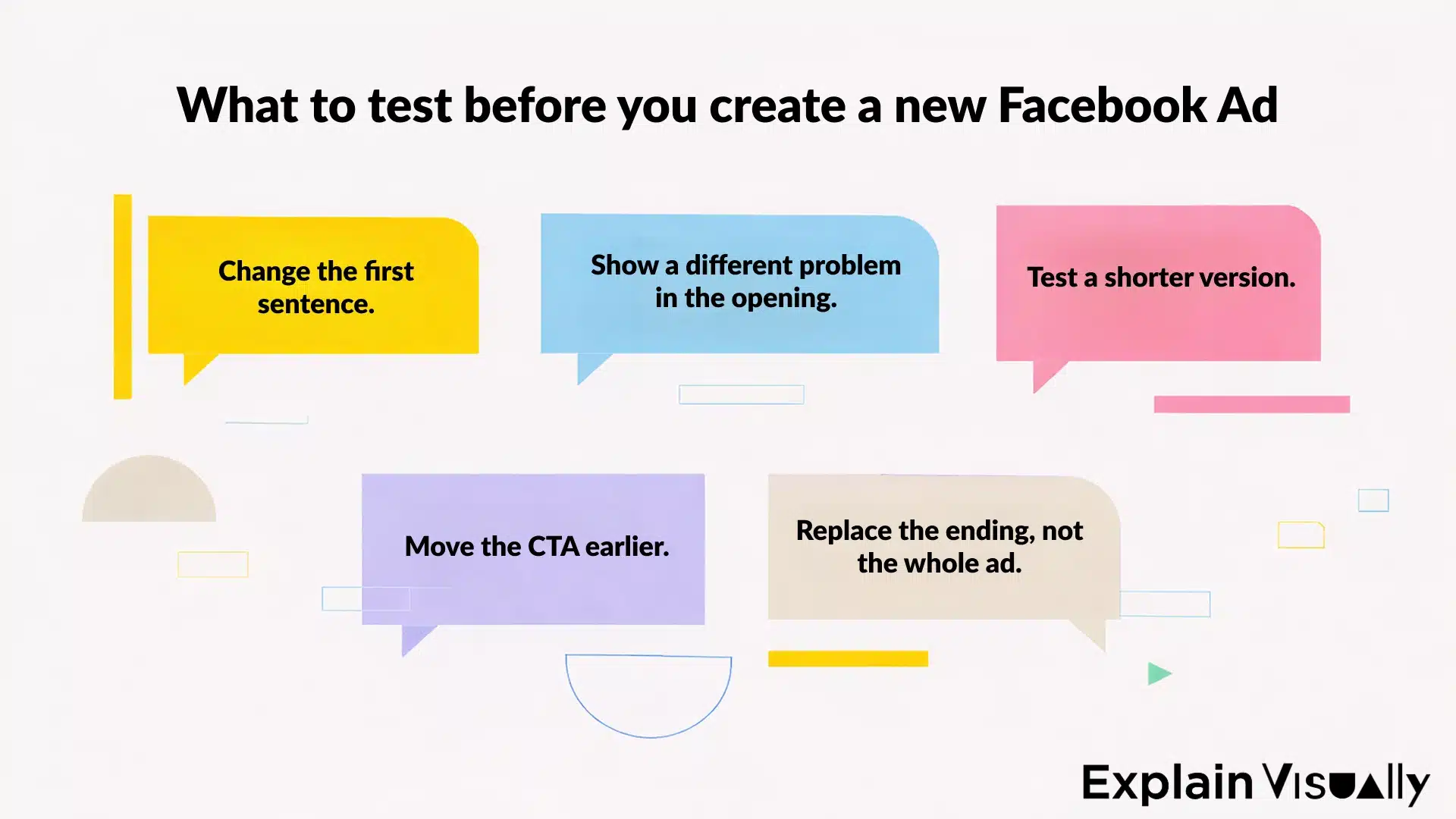
Sometimes all it takes is changing one sentence at the start or showing a different problem in the opening scene. A small change like that can keep viewers watching for a few seconds longer, and that often makes the biggest difference. We often see one small change in the opening outperform a complete redesign.
If the new version performs better, it does not mean the original ad was a failure. Most of the time, it simply means that the first frame did not give people a strong enough reason to keep watching.
The same goes for the ending. Sometimes people watch almost the entire ad but still do not click. In that case, you usually do not need to rebuild everything. Often, it is enough to change the final scene, shorten the ad or introduce the call to action a little earlier.
So instead of asking whether an ad is good or bad, look for the exact moment when it stops working. That is usually where the real problem is hiding.
What to look at instead of just CTR
Many people judge an ad very simply: if lots of people clicked, it must be working. The problem is that clicks do not always mean genuine interest.
An ad can have a high CTR because it was surprising or eye-catching. But if nobody buys, signs up or leaves their details afterwards, it usually means the ad attracted the wrong people or promised something it never actually delivered.
That is why you should always look at the bigger picture.
Which numbers actually matter?
CTR is only one metric, and often not the most important one. What happens afterwards usually tells you much more. Pay attention to:
– how many people watched the first 3 seconds,
– how many people watched half of the ad,
– how many people watched almost until the end,
– how many people clicked,
– how many people took a meaningful action after clicking.
The best ad will not always have the highest CTR. Sometimes the better-performing ad is the one that attracts fewer people, but attracts the right ones.
Choosing the right partner matters more than the animation itself
If there is one thing to take away from this article, let it be this: effective advertising starts with understanding the audience. Even the best animation will not work if it shows the wrong problem, appears at the wrong moment or tries to say too much at once.
That is why, when choosing an agency, it is worth looking beyond the visuals. Take a close look at the portfolio and ask yourself whether different projects solve different problems. A good agency should know how to adapt the ad to the product, the industry and the audience, rather than applying the same style to everything.
And do not be afraid to ask questions. What do they think should happen in the first few seconds? How would they show the problem? Why do they believe a particular ad will work? At Explain Visually, we start with the moment your audience decides whether to keep watching or keep scrolling. Because by the time the logo appears, that decision has usually already been made.
𝐄𝐱𝐩𝐥𝐚𝐢𝐧 𝐕𝐢𝐬𝐮𝐚𝐥𝐥𝐲 – 𝐁𝟐𝐁 𝐚𝐧𝐢𝐦𝐚𝐭𝐢𝐨𝐧 𝐬𝐭𝐮𝐝𝐢𝐨:
• We create whiteboard animations for businesses
• We create corporate explainer videos
• We create visual storytelling for companies
Frequently Asked Questions
How long should animated Facebook Ads be to actually convert?
Most animated Facebook Ads fail in the first few seconds, not because of their length. If your video ads do not communicate a clear message immediately, duration will not save them.
Are animated ads more effective than static ads?
Animated ads can be a powerful tool, but only when they help communicate the message more clearly than static ads or image ads. In many cases, simple static images outperform complex animated video ads if the message is easier to understand.
What makes animated Facebook Ads engaging?
The most engaging video ads capture the audience’s attention instantly and hold viewers attention through clarity, not complexity. Strong eye catching visuals, animated text, and intentional motion help, but only when they support understanding.
Should Facebook video ads be designed for sound or silence?
Facebook video ads should always be designed for silence first, especially on mobile devices. Adding captions and clear visuals ensures your video content communicates the message effectively without sound.
How do you improve the conversion rate of video ads?
Improving conversion rate starts with understanding where viewers drop off. In Meta Ads Manager, look beyond click through rate and focus on video views, retention, and whether your call to action button leads to a clear desired action.
What type of animation works best for Facebook Ads?
There is no single best approach, effective animation styles depend on the target audience and the message. In most cases, simple animations and subtle motion outperform complex visuals because they are easier to process.
Can you create animated ads without a large production budget?
Yes, but strong thinking matters more than tools. Even with a video template or basic assets, effective animated ads require a clear message, strong ad creative, and alignment with brand guidelines.
What should you test first when optimizing video ads?
Start with the opening. If your ad does not stop users within the first few seconds, nothing else in the final product will matter.
How do animated ads support brand recognition?
Well-designed animated video ads can build brand recognition by creating a consistent visual style and message. Over time, this creates a lasting impression across social media platforms.
Are animated Facebook ads suitable for all audiences?
Not always. Different audience segments respond to different formats. While animated Facebook campaigns can be highly effective, the style and pacing should match your potential customers and how they consume video.
