
Finding the right corporate film production company can transform your business communication from mundane to memorable. Yet most companies struggle to identify what separates exceptional corporate film makers from the countless mediocre options flooding the market.
Producing corporate videos often comes with high hopes. The company hopes to enhance its image, build trust among customers and excitement among employees. Unfortunately, the truth is that most corporate films are… boring. Why is this the case? And what can you do to make your corporate film production as successful as the films we have described in this text?
Let’s establish what we think a corporate film is and what a professional video production company should deliver. After reading our article, you’ll know exactly how to distinguish a truly professional production company from the average crowd and how to confidently choose a partner who will genuinely support your business goals.
What is a corporate film according to our definition?
Corporate films are not strictly advertising films. Instead of talking about products, they tell about the activities of the company.
A corporate video production services provider understands that a corporate film most often achieves one of the objectives:
- to inspire confidence in customers or investors,
- summarizing the stage of, for example, the 10th anniversary of the company,
- or promoting the company among employees (new and existing).
It is usually distributed through the website, e-mail, social media, conferences, and Intranet.
What types of corporate video content do businesses actually need?
Modern companies require a diverse range of video content to address different business challenges. Partnering with a corporate film production company ensures strategic, high-quality videos tailored to every challenge.
Employer branding videos help attract top talent by showcasing company culture and values authentically.
Internal communication videos become crucial during organizational transformations, mergers, or strategic changes, helping employees understand their role in the evolving business landscape. And since we’ve touched on the topic of mergers, be sure to read: Mastering your merger communication strategy for a seamless transition.
Explainer videos simplify complex ideas and processes, while promotional videos and brand films support marketing campaigns across various channels.
Want to see specific examples? Be sure to read: Best corporate videos – 9 examples to help you create the best video for your company.
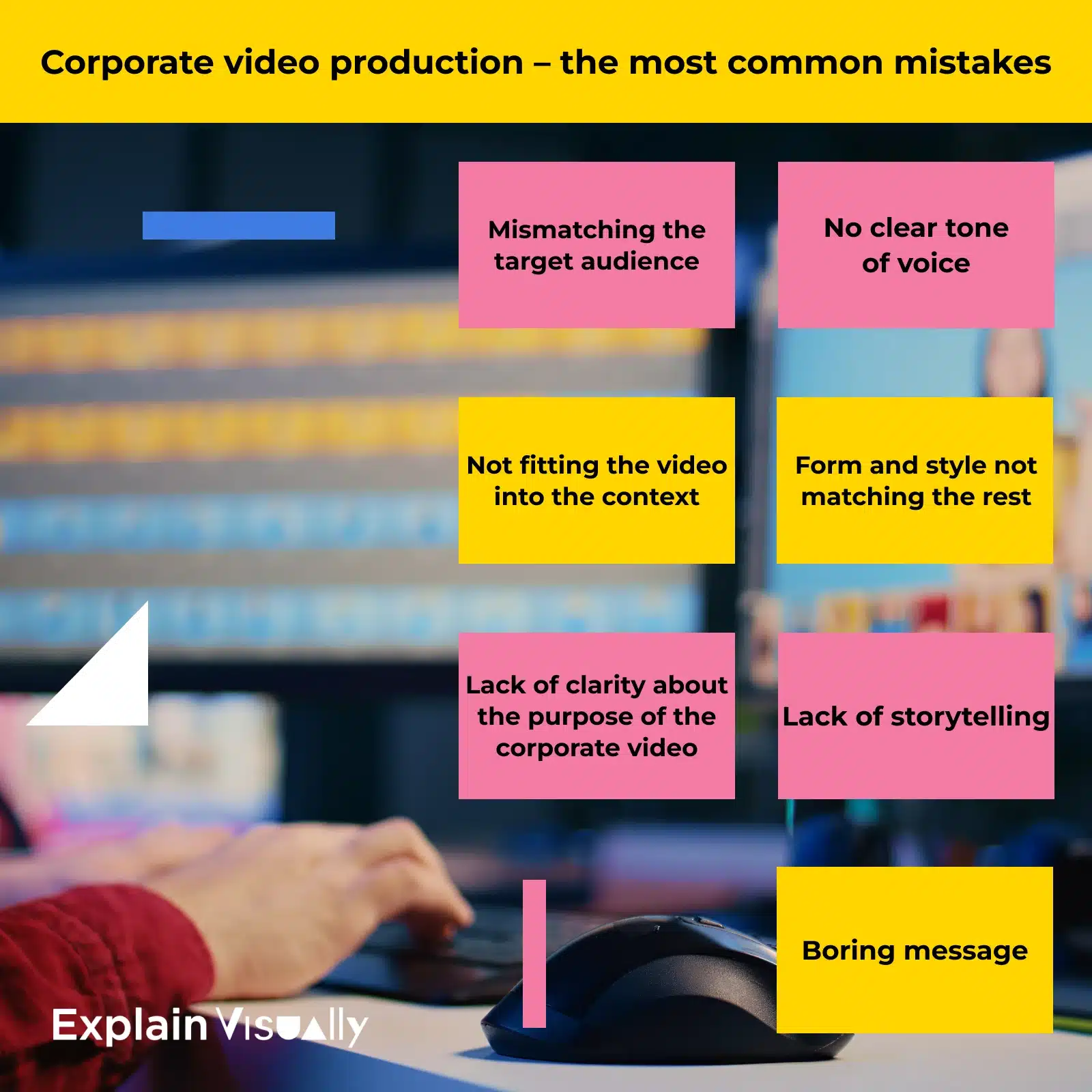
Corporate video production – the most common mistakes
1) Mismatching the target audience
This is the most egregious and probably the most common mistake.
It takes different forms:
- A stiff Employer Branding video that is supposed to appeal to young students,
- A video full of technical jargon aimed at non-technical conference attendees,
- A client meeting video that talks about how many markets they have conquered instead of focusing on the problems they can help solve.
How to avoid this mistake:
Create a brief description of the target audience. It is crucial to think about the needs of the target audience. While working on the video project, verify that the scene would appeal to this group.
2) Not fitting the video into the context
This mistake is a bit more subtle than the previous one.
Imagine the following situation:
A company has acquired its competitor and wants to create a corporate video for its employees.
What will the film be about? It is most likely about how big their company has become after the acquisition, how many markets it operates in, and why employees should be proud of it.
But that ignores an important factor – the merger means uncertainty for many employees.
Employees fear for their jobs. They don’t know where the company is headed next. They also wonder how the implementation of changes will happen in practice.
A good decision would be to create material that will familiarise employees with the situation and dispel their doubts.
During organizational transformations, effective internal communication becomes critical. Employees need clear, honest communication about changes rather than corporate cheerleading. The video production process should account for the emotional context, addressing fears, uncertainty, and practical concerns that arise when two companies merge or undergo significant change.
How to avoid this mistake:
Consider what situation your target group is currently in and what they are thinking about. What emotions they are feeling and what they are talking about with their friends over coffee.
3) Lack of clarity about the purpose of the corporate video
Often many people are working on the production of a corporate film and that means many different, often conflicting, views of the film’s goals.
Someone wants to build an image. And someone wants to sell. Still another person wants to dispel employee doubts. It usually ends up being wasted money.
“When something is for everything, it’s for nothing,” – says the folk proverb. And in the case of corporate videos, this is true.
How to avoid this mistake:
Set one specific goal for this film to accomplish. If you find it difficult to do this internally, then ask the studio to hold a workshop where this goal is established prior to production.
4) Boring message
The message of most corporate videos can be summarized with the sentence: “Look how cool our company is!”.
It’s not surprising, after all, as this video is supposed to tell a story about your company. But it can be done in different ways.
You can talk about how many customers the company has and in how many countries. Or you can tell customers and employees about the “WHY?” behind the company’s actions.
Why does the company operate at all? What customer problems does it solve? What is distinctive about its approach? What values are close to the company?
Such a message will be much more interesting than “We have 6,500 customers in 27 countries”.
How to avoid this mistake:
Consider what exactly you want to convey to your audience. What thoughts and feelings they should leave with after watching the video.
5) No clear tone of voice
What is tone of voice?
It is the tone that a message takes.
When we talk to someone live, it is clear to us what the tone of our interlocutor’s speech is. We perceive the volume of their voice and its timbre, we see their facial expression, posture, what they are wearing and where they direct their gaze.
How does this relate to a corporate video?
In the case of video material, the tone is the entire form that the video takes. The types of characters, colors, dynamics, narrator’s voice and music.
Let’s imagine that our corporate video is created in a tone:
The wise benevolent teacher – Dumbledore from “Harry Potter”.
Then the narrative will be calm, full of pictorial examples, with vibrant and warm colors.
Classroom smarts – Sheldon Cooper from “Big Bang Theory.”
The narration will be more challenging, there will be a lot of jargon, and the film will be more dynamic.
The cheerful talker, or Donkey from “Shrek.”
The narrative will be created in colloquial language, there will be various stories and curiosities, and the whole thing will have a slightly chaotic dimension.
Cool guest, namely King Julian from “Madagascar”.
The film will be full of color, animation, changing frames and jokes.
The boring teacher, or Dolores Umbridge character from “Harry Potter.”
The video will look like a typical corporate video – staid, stiff and boring.
If a company deliberately doesn’t choose its tone, it very often ends up with the tone of a boring teacher.
How to avoid this mistake:
Consciously choose the tone you want to take.
6) Form and style not matching the rest
Sometimes an animation will be better, sometimes a video shot by a film crew and sometimes a video shot with a smartphone.
The form of the video needs to fit with:
- the target audience,
- context,
- purpose,
- the message,
- and tone of voice.
Similarly with the style, i.e. colors, choice of characters, dynamics, music, and voiceover.
It is much easier to choose the form and style, when we know that e.g.:
- we are directing the material to employees,
- worried about the recent merger,
- we want to familiarize employees with the upcoming changes,
- showing the impact of the merger on the daily functioning of the company,
- in the tone of a benevolent teacher – Dumbledore.
How to avoid this mistake:
Go through points 1-5 and choose your form and style based on them.
7) Lack of storytelling
The truth is that you can create a good corporate video without storytelling. One example is Ripo’s video, where most of the work is done with good shots and dynamic editing.
But in most cases, storytelling will be very helpful because it can bring dry facts into an interesting and engaging story.
Unfortunately, most often the storytelling of corporate videos looks like this:
“We are one of the largest companies in the leasing industry. We have been in business for 30 years and have 75,000 customers…”
Easy to fall asleep, right?
You can dress the whole thing up, as we did for TechnoNICOL:
Animation about the history of TechnoNICOL
How to avoid this mistake:
Consciously build storytelling.
What makes a corporate film production company worth your investment?
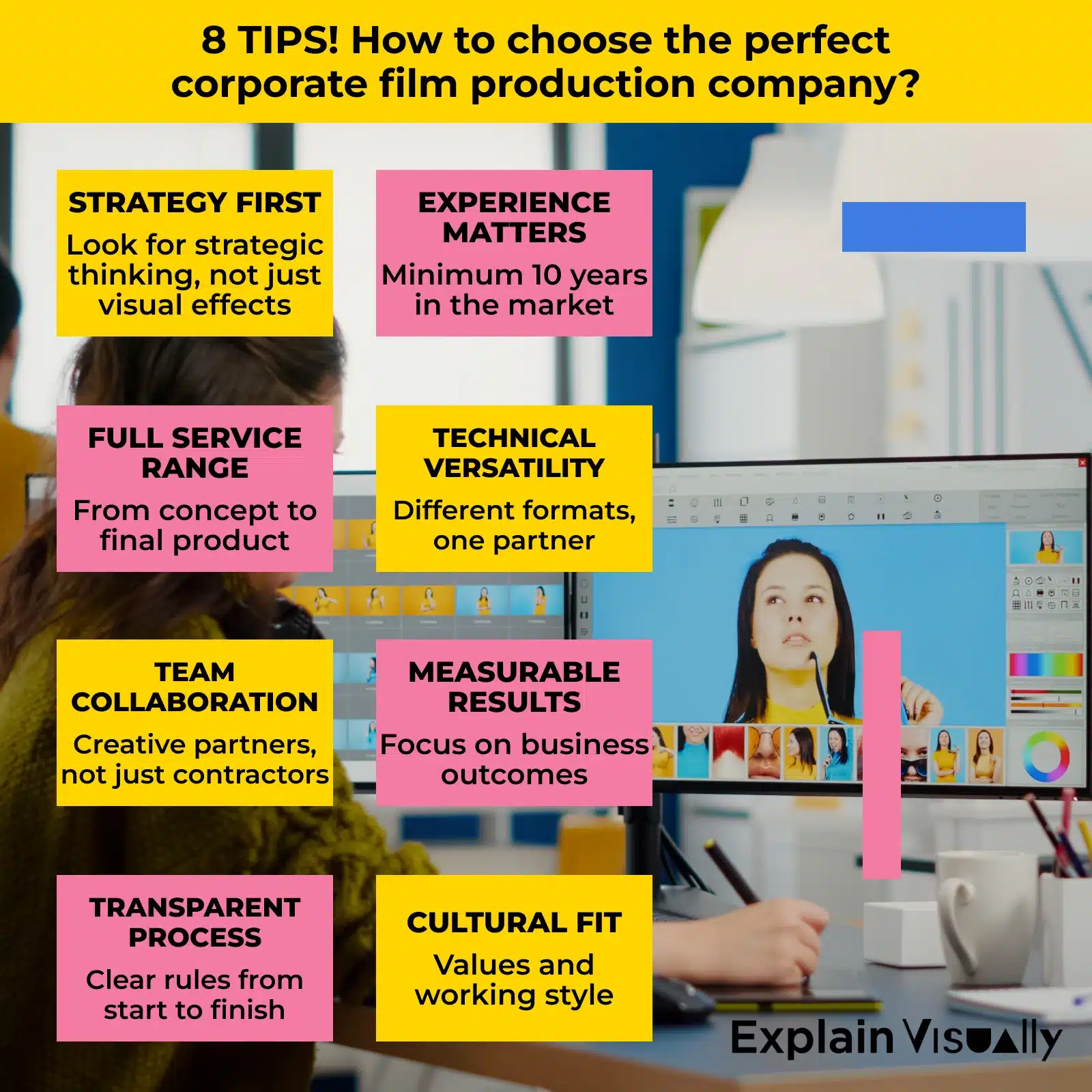 When selecting a video production company, look beyond flashy reels and impressive client lists. The best corporate video production services providers understand that successful projects start with strategic thinking, not just technical expertise.
A professional production company should offer full service video production capabilities, from initial concept development through final delivery. This includes pre production planning, where the creative team works closely with your business to understand objectives, target audience, and company culture. The production process should be transparent, with clear timelines and regular communication to keep all stakeholders on the same page.
Look for a production company with over a decade of experience in creating diverse content types (from explainer videos and promotional videos to complex brand narratives and TV commercials). An experienced team should demonstrate technical expertise across different formats, including animated video content, live-action corporate films, and hybrid approaches that combine both.
Be sure to check out our portfolio on YouTube.
The real business impact of strategic video content
Professional video content drives measurable business results when executed properly.
Businesses that incorporate video into their marketing strategies often experience much greater engagement and attract a larger number of new clients through content shared on social media platforms.
In the realm of internal communications, video is even more effective, helping employees retain information far better than traditional text-based methods.
The success of your investment frequently hinges on the quality of the editing and post-production stages. A proficient creative agency will prioritise producing compelling video content tailored to your unique business goals, whether focused on employer branding, communicating organisational change, or telling your brand’s story.
Navigating organizational change through strategic video communication
When companies undergo transformations, mergers, acquisitions, or major strategic shifts – video becomes an essential tool for maintaining employee engagement and trust. The challenge lies in balancing transparency with reassurance, addressing real concerns while maintaining confidence in the company’s direction.
Effective change communication videos should acknowledge the uncertainty employees feel rather than glossing over it with corporate platitudes. Location scouting might involve finding spaces that feel familiar and safe to employees, while the creative vision should focus on human connection rather than impressive visuals.
Smart companies create a comprehensive communication strategy that includes multiple video touchpoints throughout the transformation process from initial announcements through implementation milestones to celebration of successful integration.
Summary:
Producing corporate videos is no easy task, with many traps lurking along the way. A reliable corporate film production company can guide you past these pitfalls and craft the varied content today’s businesses demand.
To avoid them, remember the seven deadly sins of corporate video production:
- Mismatching the target audience,
- Mismatching the context,
- Lack of clarity about the purpose of the corporate video
- Boring message,
- Lack of clear tone of voice,
- Form and style mismatched with the rest,
- Lack of storytelling.
Choosing the right corporate film production company requires more than comparing quotes and reviewing portfolios. The perfect partner understands that every video project serves broader business objectives (building employer brand, facilitating organizational change, or strengthening customer relationships).
At Explain Visually, our experienced crew has spent over a decade helping businesses navigate these challenges. For us, successful corporate video production always begins with listening to your specific needs. Our approach combines creative vision with business acumen, ensuring your final product serves real objectives, not just looking impressive in a showreel.
Our corporate videos: