Seasonal employee onboarding is about clarity, not volume
Imagine that 80 new employees arrive at a production site on Monday morning.
Some start early. Others begin in the afternoon or at night. A few have worked in similar roles before. Others are entering a warehouse, factory, retail store, hotel, or logistics centre for the first time. Some speak the local language fluently. Others need additional support.
The company has only a few days to prepare them for work.
The wrong response is to add more information: a longer presentation, a thicker handbook, or another introductory meeting.
The real goal of seasonal employee onboarding is simpler. Every new hire should understand:
- what they are expected to do,
- which rules they must follow,
- where the main risks are,
- what they should never do,
- who they should ask for help,
- how to react if something goes wrong.
When a company is onboarding a large group of employees, the process must be repeatable. It cannot depend on who happens to deliver the training that day.
- what they are expected to do,
- which rules they must follow,
- where the main risks are,
- what they should never do,
- who they should ask for help,
- how to react if something goes wrong.
When a company is onboarding a large group of employees, the process must be repeatable. It cannot depend on who happens to deliver the training that day.
Why onboarding seasonal employees is more difficult
A permanent employee may have several weeks to learn how the company works. A seasonal worker often does not.
In manufacturing, logistics, retail, hospitality, agriculture, food production, and e-commerce, companies may need to train dozens or hundreds of people within a short period.
When onboarding seasonal employees, several challenges appear at once:
- employees start on different days and shifts,
- training takes place in several locations,
- supervisors may explain the same rules differently,
- time for training is limited,
- employees may speak different languages,
- essential safety rules must be understood before work begins.
A good process must be fast, but it should never feel improvised.
Start with the five rules no one can afford to forget
Ask one question:
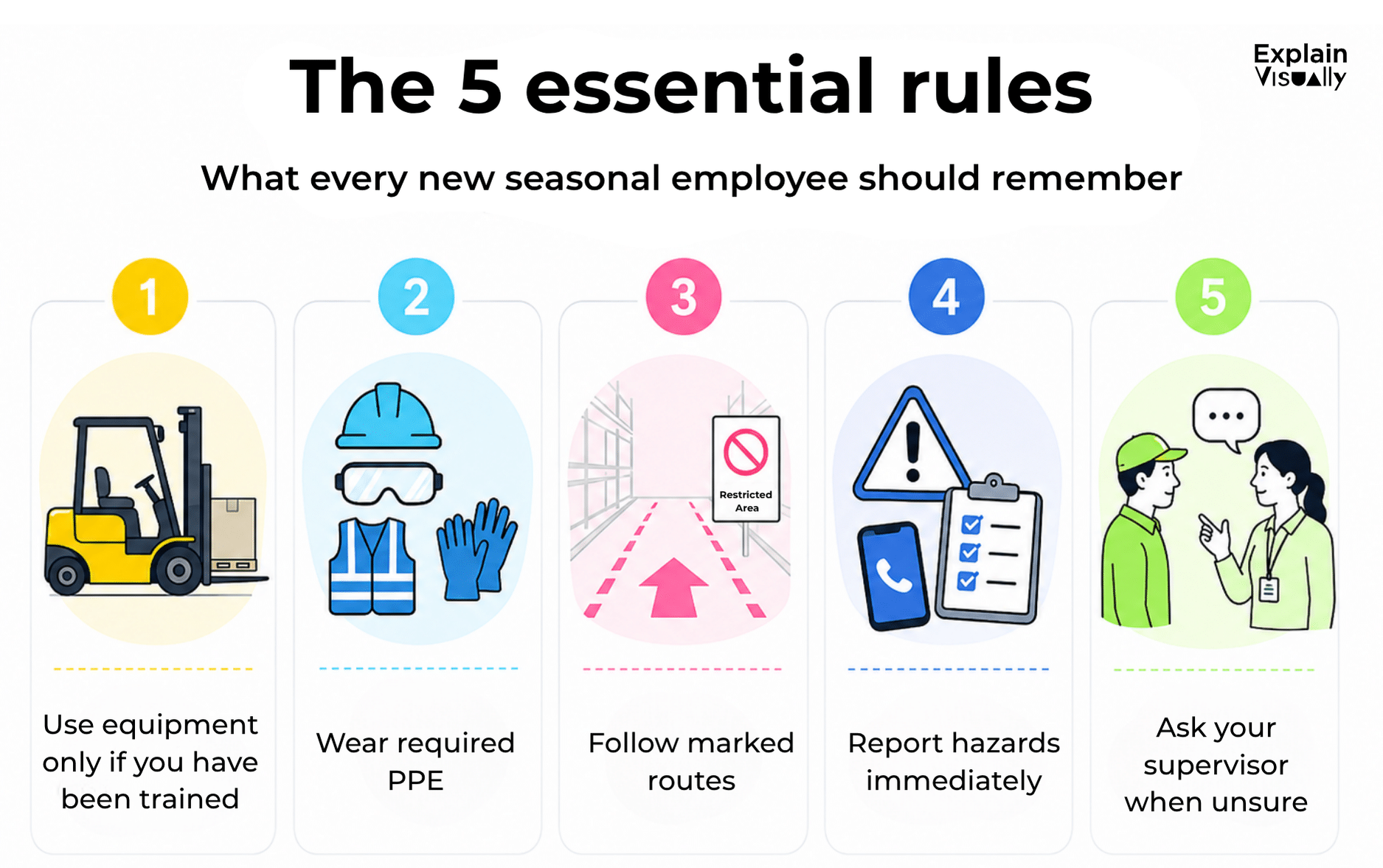
If a seasonal employee remembers only five things after the first day, what should they be?
The answer depends on the workplace, but it may look like this:
- Never operate equipment unless you have been trained and authorized.
- Wear the required protective equipment.
- Follow marked routes and stay away from restricted areas.
- Report hazards, incidents, and near misses immediately.
- Ask your supervisor whenever you are unsure.
Repeat these rules during the introductory session, in an employee onboarding video, on a visual checklist, and during the site walk-through.
Repetition does not mean saying everything several times. It means reinforcing the essentials in several clear formats.
Divide seasonal worker training into three layers
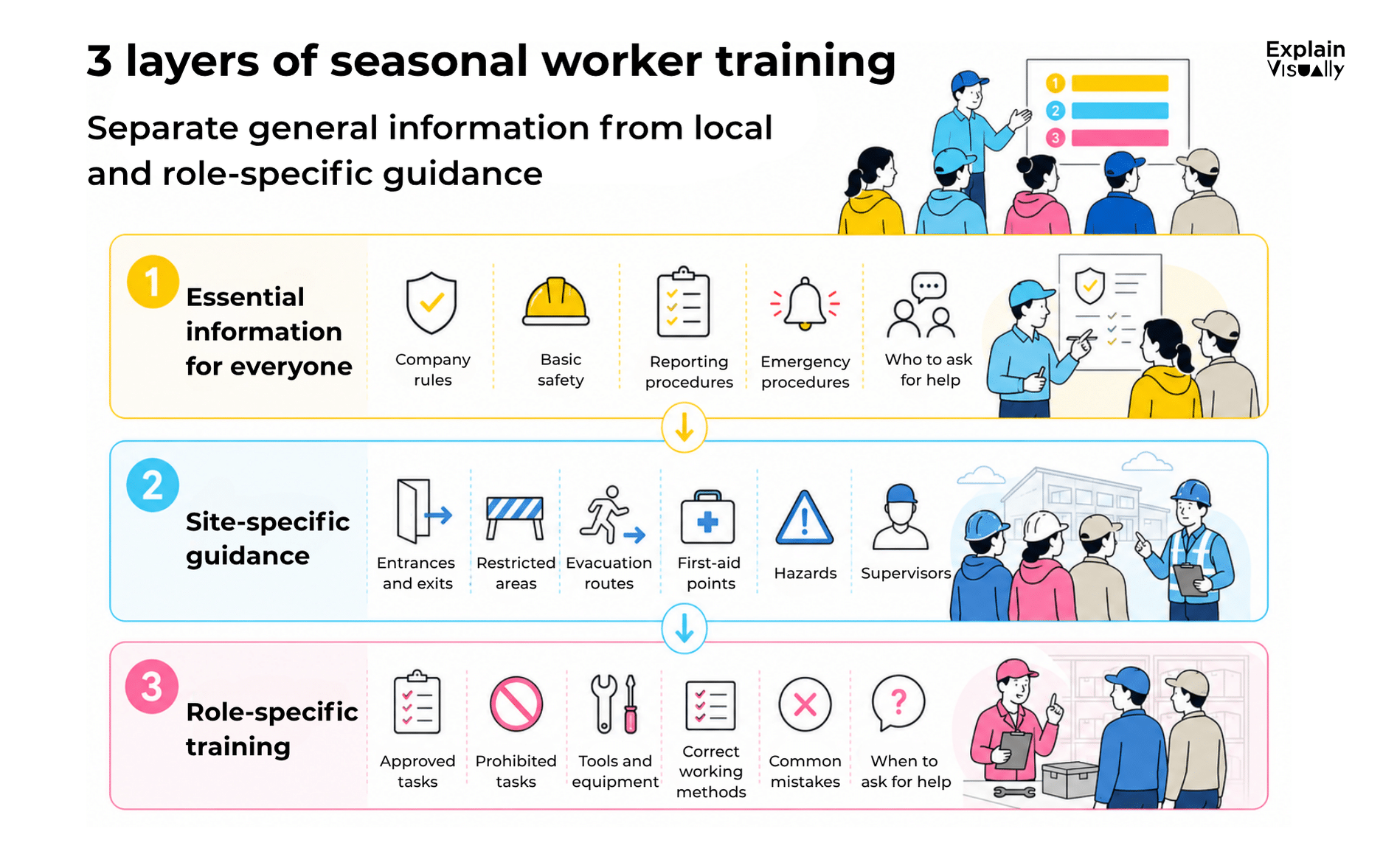
The simplest way to scale seasonal worker training is to separate general information from local and role-specific instructions.
1. Essential information for everyone
Every seasonal employee should receive a clear introduction covering:
- the most important company rules,
- basic organizational information,
- reporting procedures,
- key safety principles,
- emergency procedures,
- essential signs and symbols,
- who can answer questions.
This content can usually be standardized and reused.
2. Site-specific guidance
Employees should also see the actual workplace.
Show them:
- entrances and exits,
- restricted areas,
- evacuation routes,
- first-aid points,
- protective equipment,
- common hazards,
- the location of supervisors.
This part should reflect the real site.
See our example of a site-specific health and safety animation created for an industrial facility.
3. Role-specific training
A warehouse worker, machine operator, cleaner, and retail assistant do not need the same instructions.
Each person should understand:
- approved tasks,
- prohibited tasks,
- tools and equipment they may use,
- correct working methods,
- common mistakes,
- situations in which they should stop and ask for help.
This layered model keeps the process efficient without making it superficial.
Use short videos, checklists, and visual materials
A video cannot replace practical training. Employees may still need a walk-through, demonstrations, and answers to questions.
But an employee onboarding video can provide the same starting point for every new hire, regardless of shift, location, or supervisor.
See how an animated guide can introduce employees and visitors to the most important safety rules in a production facility.
A short video can show:
- what the first day will look like,
- what protective equipment is required,
- how to move around the site,
- which actions are safe and unsafe,
- how to report a problem,
- what to do in an emergency.
Animation is especially useful when a company needs to show a situation that would be difficult, expensive, or unsafe to film.
For example, an animated scene can demonstrate the correct way to lift an object, what happens when someone enters a restricted area, or how a small shortcut creates a hazard.
Visual materials also help when employees speak different languages. Useful formats include:
- short animated videos,
- illustrated checklists,
- step-by-step diagrams,
- icons,
- photographs of actual hazards,
- simple floor plans,
- colour-coded routes.
The goal is not to remove written instructions. It is to make essential information easier to understand and remember.
Show real situations, not abstract rules
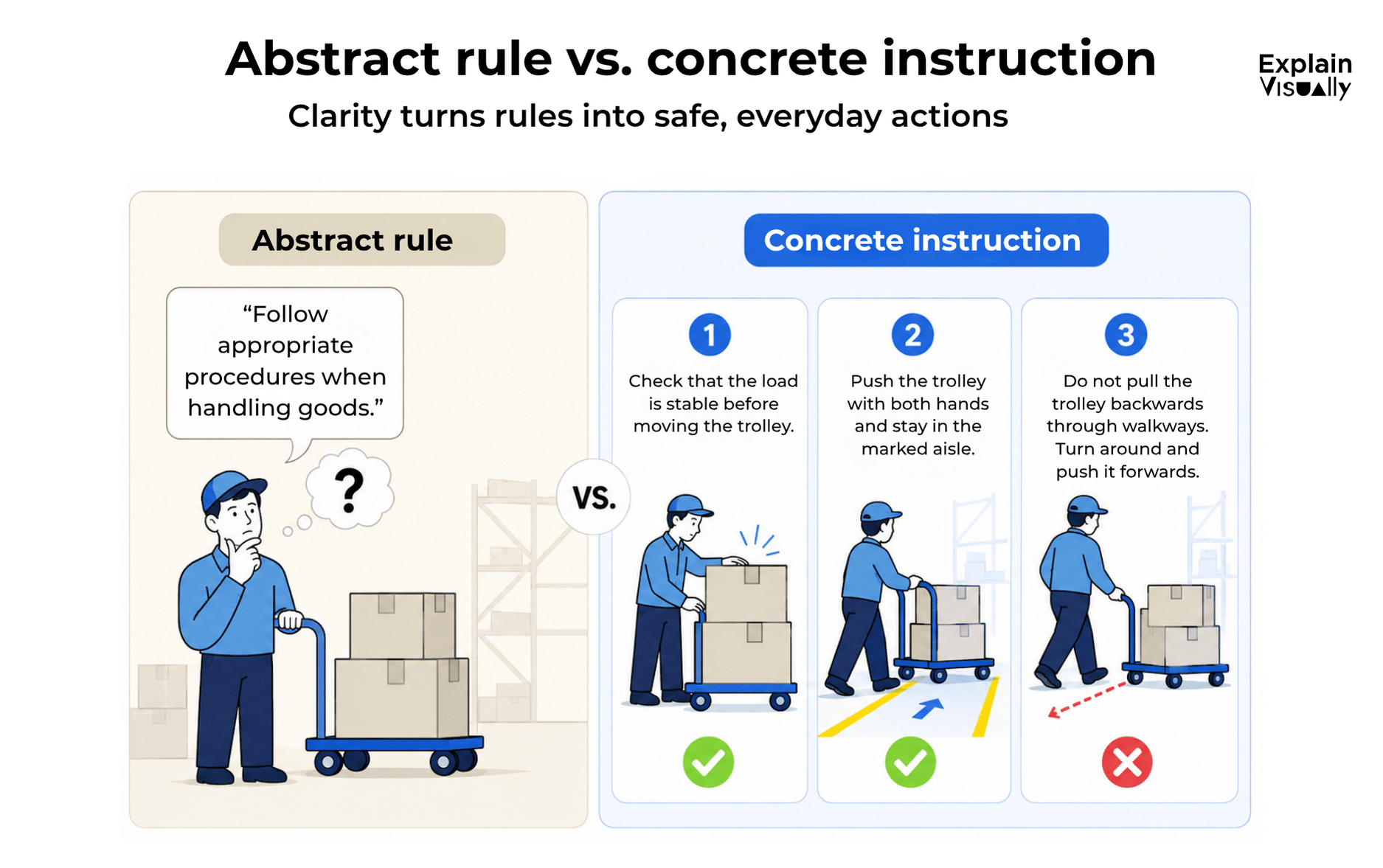
Compare these two instructions:
Abstract instruction:
“Employees must follow appropriate procedures when handling goods.”Concrete instruction:
“Before moving the trolley, check that the load is stable. Push it using both hands. Do not pull it backwards through a busy aisle.”
The second version is easier to remember because employees can picture the situation.
The same principle applies to other rules:
- Instead of saying, “Be careful around machinery,” show the safe distance.
- Instead of saying, “Use personal protective equipment,” show the correct equipment.
- Instead of saying, “Follow evacuation procedures,” show the route and assembly point.
- Instead of saying, “Report incidents,” show who the employee should contact.
A good example is our health and safety communication project for Carlsberg, in which short animated stories show real incidents, their causes, and practical lessons for employees.
How to train seasonal employees: a simple process
Companies asking how to train seasonal employees need a system that is easy to repeat and update.
Step 1: Define the non-negotiable core
List the rules every employee must understand before starting work. Keep the list short.
Step 2: Create modular content
Divide the materials into reusable blocks:
- company introduction,
- general safety rules,
- reporting procedures,
- local site instructions,
- role-specific training,
- short knowledge check.
Step 3: Prepare short videos and a one-page checklist
Several focused videos often work better than one long presentation.
Add a simple checklist with:
- the five essential rules,
- emergency contacts,
- required protective equipment,
- reporting procedures,
- a QR code linking to additional materials.
Step 4: Conduct a site walk-through
Show employees entrances, exits, restricted areas, evacuation routes, first-aid points, common hazards, and supervisors.
Step 5: Confirm understanding
Use a short quiz, a practical demonstration, or a conversation with a supervisor.
Ask concrete questions:
- What should you do if you notice a hazard?
- Which route should you use?
- Who should you contact if you are unsure?
- Which tasks require additional authorization?
Step 6: Improve the process after each recruitment cycle
Collect recurring questions.
If many new hires ask the same thing, the training material may need to be clearer.
A practical seasonal employee onboarding checklist
Before employees arrive
- Separate general, site-specific, and role-specific instructions.
- Prepare language versions where necessary.
- Update videos, checklists, and diagrams.
- Confirm who is responsible for each training module.
- Prepare a short knowledge check.
On the first day
- Show the onboarding video.
- Explain the five essential rules.
- Conduct a site walk-through.
- Introduce the local supervisor.
- Explain reporting and emergency procedures.
- Confirm understanding before work begins.
During the first week
- Observe new employees closely.
- Repeat the most important safety reminders.
- Collect recurring questions.
- Update unclear instructions before the next group arrives.
Example: replace one overloaded presentation with a repeatable system
Imagine a company with four distribution centres and several hundred seasonal employees joining before the busiest period of the year.
Instead of relying on a two-hour presentation delivered differently by each supervisor, the company can use:
- A short welcome video.
- An animated safety video.
- A local visual guide for each site.
- A role-specific checklist.
- A supervisor-led walk-through.
- A short knowledge check.
This does not eliminate human contact.
It uses human contact where it matters most: answering questions, showing the real workplace, and checking that people understand the rules.
Seasonal onboarding should be fast, but never improvised
The best approach is not to compress a standard onboarding process into a shorter meeting.
It is to build a simple and repeatable system:
- prioritize essential information,
- show concrete examples,
- divide training into reusable modules,
- adapt selected parts to the site and role,
- use short videos, checklists, and visual materials,
- account for language differences,
- confirm understanding,
- improve the process after each recruitment cycle.
The result is not only faster onboarding.
It is more consistent onboarding.
Every seasonal employee receives the same core message, regardless of shift, location, supervisor, or language version.
Do you need materials that make seasonal employee onboarding easier?
If you want your training to be clearer, more consistent, and easier to repeat, it is worth supporting it with well-designed visual materials.
At Explain Visually, we create training, instructional, and onboarding animations that help explain safety rules, procedures, common mistakes, and situations employees may encounter in practice. We also prepare illustrations, infographics, checklists, and simple visual materials that can be used during training sessions, in internal communications, or on-site.
We adapt each material to the specific workplace, target audience, and required language versions, so that it remains clear and accessible even for people who are just starting a new job.
If you are planning to onboard a larger group of employees and need materials that will help you organize the process, get in touch with us. We will be happy to suggest the format that will work best for your company.
- We create whiteboard animations for businesses
- We create corporate explainer videos
- We create visual storytelling for companies
FREQUENTLY ASKED QUESTIONS
What is seasonal employee onboarding?
Seasonal employee onboarding is the process of preparing temporary employees to work safely and effectively during a period of increased demand. It usually includes basic organizational information, site-specific guidance, role-specific training, key safety rules, and practical instructions for the first days of work.
How is seasonal employee onboarding different from standard onboarding?
Seasonal onboarding usually needs to be delivered faster and to larger groups. Employees may start on different shifts, work in several locations, and speak different languages. The process should therefore be concise, repeatable, and easy to adapt.
How can a company onboard a large group of employees quickly?
Use reusable modules: a short introduction, site-specific guidance, role-specific training, a walk-through, and a knowledge check. Short videos and visual checklists help deliver the same information consistently.
What should seasonal worker training include?
Seasonal worker training should cover responsibilities, approved tasks, prohibited actions, workplace hazards, required protective equipment, emergency procedures, reporting rules, and information about who to contact when questions arise.
Can an employee onboarding video replace in-person training?
No. An employee onboarding video can provide a consistent foundation, but it should complement practical training, demonstrations, and a site walk-through.
How can companies train seasonal employees who speak different languages?
Use clear language, appropriate translations, and visual support. Animated videos, illustrated instructions, icons, diagrams, and photographs of actual hazards can make essential information easier to understand.