Nobody gets excited about another process diagram or 80-slide presentation. Discover how visual storytelling helps organizations explain change, build trust, and bring people on board.
Most companies begin their digital transformation journey with technology. They choose new tools, implement systems, automate processes, and develop ambitious growth strategies. Everything seems carefully planned, and project timelines and presentations point in a clear direction. But if everything is going according to plan, why do so many transformation projects run into difficulties at such an early stage? Today, we’ll show you where the real problem lies: the way change is communicated to people.
Employees often don’t understand why existing solutions are no longer enough, while customers struggle to see the benefits of a new service. Teams hear about upcoming changes but fail to connect them to their day-to-day work. What happens next? Even the best business strategy can be met with resistance, uncertainty, or simply a lack of engagement. After all, it’s hard to get excited about something when its purpose remains unclear.
This is where visual storytelling in digital transformation starts to play an important role. A well-told story helps translate complex processes, new technologies, and strategic goals into something people can actually understand. Instead of another diagram or data-heavy presentation, audiences get a narrative that provides context, explains the direction of change, and helps them see where they fit into the transformation journey.
In this article, we’ll show you why storytelling serves as a bridge during organizational transformations, how it helps create emotional connections, and why more and more organizations see it as one of the foundations of successful digital transformation.
Stories make people take action
Organizations going through digital transformation often have access to enormous amounts of data. Research findings, process analyses, forecasts, reports, and presentations can clearly explain why change is necessary. We are certainly not questioning their value, because we know better than anyone how important numbers are in the decision-making process. They provide the clearest and most objective picture of the situation. The challenge is that information alone is rarely enough to convince people to act.
An employee may understand that a new system will be more efficient. A customer may know that a digital service will save them time. An investor may be familiar with the numbers behind the project. Even so, none of them necessarily feels that the change actually matters to them.
This is where storytelling starts to play its real role. Research indicates that storytelling engages audiences more effectively than mere facts, leading to greater retention and emotional connection, which is crucial during times of change. Stories help people place information within a broader context. Instead of receiving isolated facts and figures, they are introduced to a sequence of events, people, challenges, and the consequences of specific decisions.
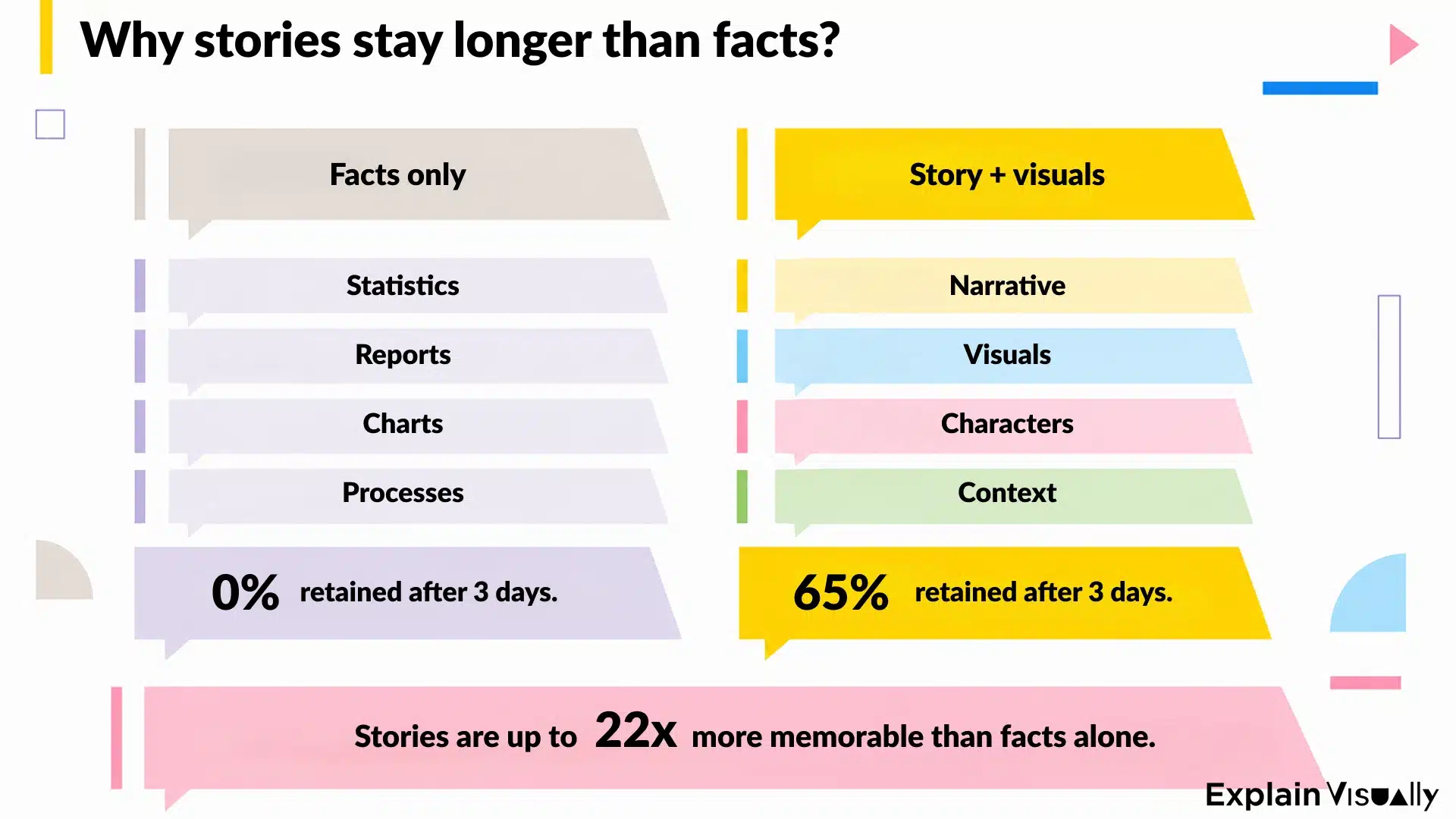
There is a reason why stories are up to 22 times more memorable than facts alone. Our brains find it much easier to remember information presented through a narrative than disconnected statistics, charts, or reports. What’s more, people typically retain around 65% of information presented visually after three days, while retention drops to approximately 10% when the same information is delivered through text alone.
A well-designed explainer video, infographic, or storytelling-based presentation can explain a complex change more effectively than dozens of slides filled with data, because it helps people interpret information, understand its meaning, and see how it connects to the bigger picture.
We’ve been talking a lot about stories, emotions, and memorable communication. If you’d like to see how these principles translate into video, our article on video storytelling explores why some stories capture attention immediately while others are forgotten within minutes. Read: The Art of Video Storytelling: Crafting Compelling Narratives.
The Art of Video Storytelling: Crafting Compelling Narratives
When technology becomes too complex, visuals start gaining the advantage
One of the biggest challenges of digital transformation is its sheer complexity. Organizations introduce new platforms, redesign processes, implement artificial intelligence, automate tasks, and rethink the way entire teams operate. For the people leading these initiatives, many of these concepts are part of everyday work. For everyone else involved in the transformation, they can feel abstract and difficult to visualize.
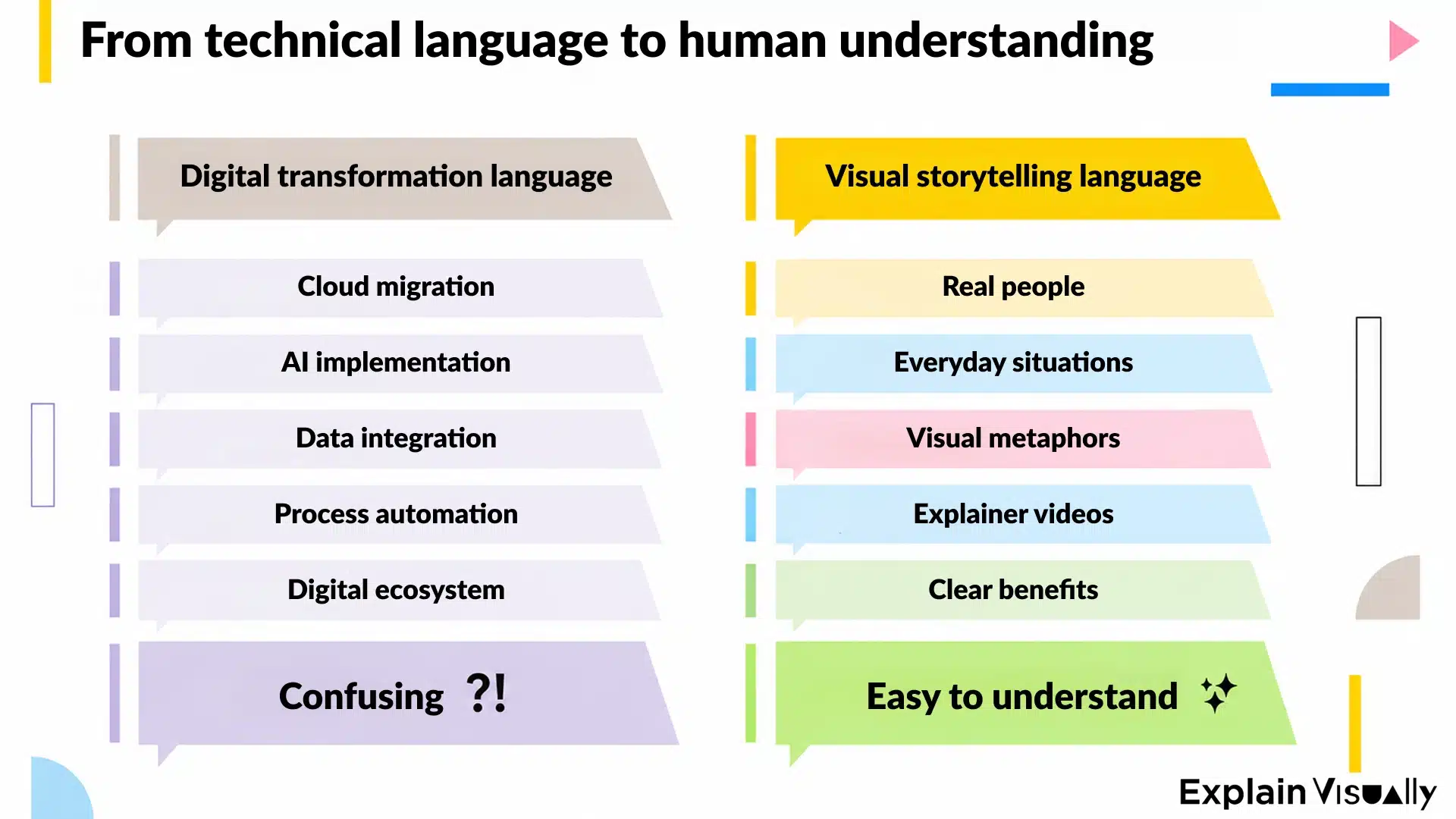
Imagine a presentation explaining a migration to a new system. You can present it through a list of features, processes, and diagrams, or you can tell the story of an employee whose daily work improves because of the new solution. The same information is being communicated in both cases, yet the experience is completely different. Visual storytelling humanizes technology by using imagery to show the people using the technology, making the digital shift more relatable.
Instead of talking about a system, we start talking about people. Instead of focusing exclusively on features, we show real situations, challenges, and benefits.
This becomes especially important in projects involving multiple departments, locations, or teams spread across different parts of the world. In these situations, visual metaphors, illustrations, and icons help overcome language barriers and make even highly complex ideas easier to understand.
Technology explains what is changing. Visual storytelling explains why it matters.
Using visual metaphors and icons allows organizations to transcend language barriers and communicate across diverse, global teams. The result is fewer misunderstandings, faster adoption of change, and a much greater chance that people will actively engage with the transformation process.
Every transformation has its main characters
Once a project is finished, very few people remember the diagrams, procedures, or implementation timelines. What they do remember are the moments that changed the way they work. Personal stories help translate business goals, strategies, and technologies into situations that audiences can relate to almost instantly. The story of an employee who gained back several hours each week thanks to a new tool, a customer who can now solve a problem online in minutes, or a team that no longer has to deal with repetitive tasks often explains the purpose of a transformation far better than the most detailed process diagram.
Effective visual storytelling bridges the gap between abstract technology strategies and human adoption by making change tangible, relatable, and emotionally engaging. When audiences see real people, real situations, and real outcomes, it becomes much easier to understand why a change was introduced and what value it brings. Stories stay with us far longer than slides, procedures, or project milestones because they reveal the real impact of transformation on everyday work.
Storytelling is older than technology
Do you think visual storytelling is a relatively new concept that emerged alongside the internet, social media, and modern digital tools? You might be surprised. In reality, people have been telling stories for thousands of years. The only thing that has changed is the way we share knowledge, emotions, and experiences.

Long before presentations, videos, and social media, people used images to share stories, knowledge, and experiences. The cave paintings of Lascaux, created around 17,000 years ago, are among the earliest known examples of visual storytelling.
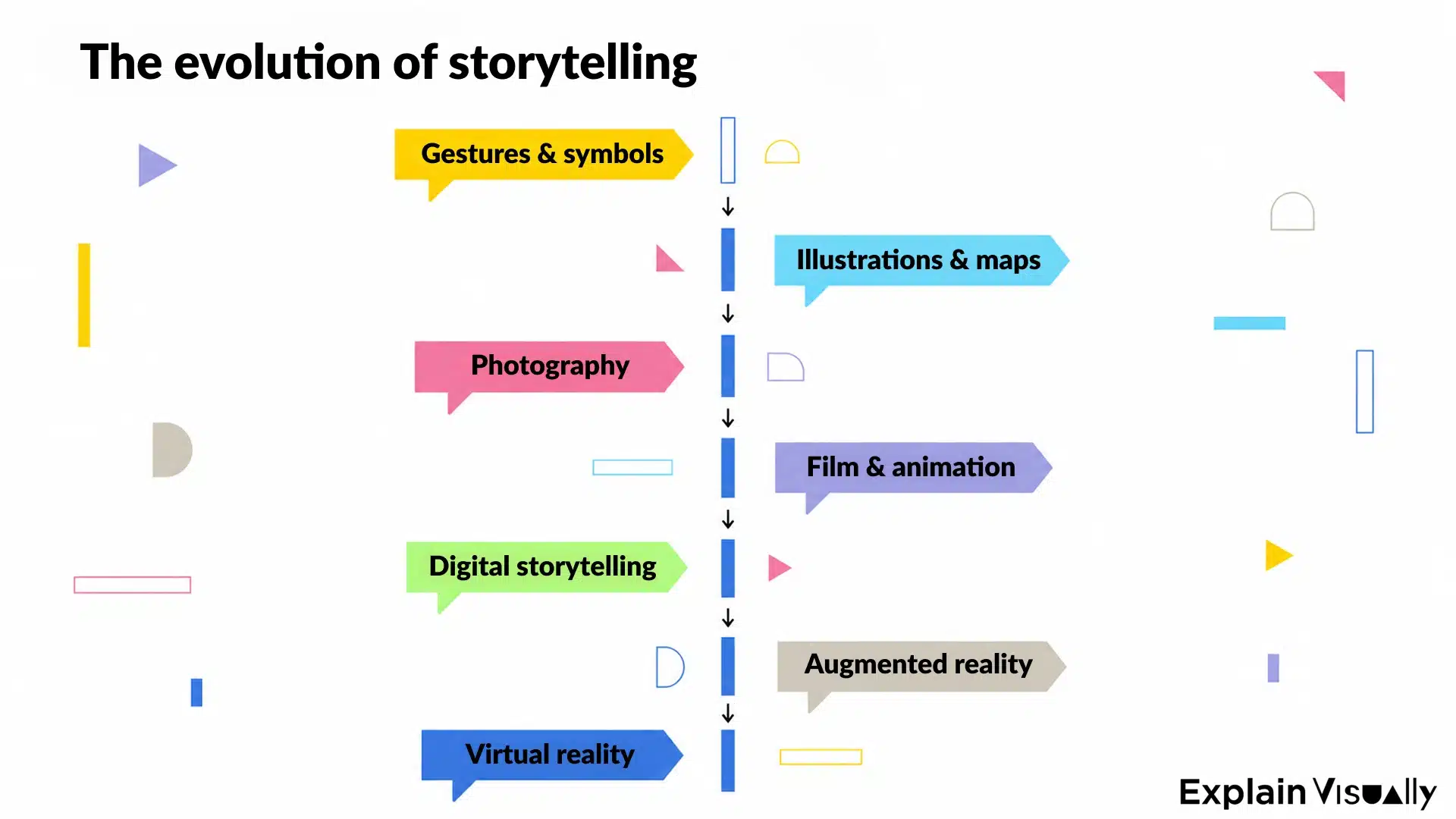
It started with gestures, drawings, and symbols. Later came paintings, maps, illustrations, photography, and film. Today, we can add animation, interactive presentations, explainer videos, and experiences powered by augmented reality and virtual reality to that list. The tools may have changed, but the underlying mechanism remains exactly the same. Humans make sense of the world through stories.
Visual storytelling is an essential aspect of human experience, allowing individuals to connect and communicate through various mediums, from gestures to digital platforms. Storytelling works regardless of industry, technology, or audience. It helps create a shared understanding where facts alone are not enough. It can simplify complex processes, but it can also preserve memories of events that might otherwise be forgotten.
Great examples can be found in projects that use digital storytelling to explore historical and social narratives. The PickRick Project and Nagasaki Kitty: Enhanced Edition show how visuals, storytelling, and modern technology can bring overlooked events to light, give a voice to forgotten individuals, and offer entirely new ways of looking at the past.
Visual storytelling helps preserve our collective memory by using digital maps, archives, and augmented reality to reinterpret history in engaging ways.
There is an interesting lesson here for businesses as well. If storytelling can help people better understand events that happened decades ago, it can certainly help explain a new strategy, an organizational change, or the future direction of a company.
This animation shows how visual storytelling can simplify complex business concepts and make digital transformation easier to understand for different audiences.
From slides to experiences: how AR and VR are changing the way stories are told
Reading about a change, seeing a change, and experiencing a change are three very different things.
The integration of augmented reality (AR) and virtual reality (VR) provides new opportunities to create immersive storytelling experiences that engage audiences more deeply. In many transformation projects, the biggest challenge is not a lack of information. People often receive presentations, training materials, and detailed documentation. What is much harder is imagining how a new technology, process, or way of working will actually look and feel in practice.
AR and VR help close that gap, because instead of describing a new work environment, organizations can show it. Instead of explaining how an artificial intelligence solution works, they can place audiences inside a specific scenario and let them see the outcome for themselves. As technology advances, storytelling methods can evolve, with tools like augmented reality and virtual reality providing new opportunities for brands to create immersive experiences that engage audiences and leave lasting impressions.
This shift is particularly interesting from a visual storytelling perspective. Increasingly, the goal is no longer to tell a story as effectively as possible. The goal is to create an experience where the audience becomes part of the story itself.
The tools have changed, but the human need for stories has not.
Why do companies that can tell stories navigate change more effectively?
One of the fastest ways to derail a transformation project is to let every department explain it differently.
–The leadership team talks about growth.
– IT focuses on implementation.
– HR discusses new ways of working.
– Managers concentrate on day-to-day operations.
None of these perspectives is wrong, yet employees often end up hearing several different versions of the same change.
Storytelling helps create a common narrative around transformation. Instead of dozens of disconnected messages, people receive a clearer picture of where the organization is heading, why the change is happening, and what success is supposed to look like. This becomes particularly valuable in large organizations, where information passes through multiple teams, locations, and management levels before reaching the final audience.
Effective storytelling can increase investor confidence during periods of change and market volatility, as narratives that demonstrate resilience and clarity are more likely to attract support. Visuals help people envision future states, reducing fear of the unknown and building trust in leadership.
There is always a story between technology and people
Most people do not get excited about new systems, implementation plans, or process diagrams. They get interested when they understand what is changing, why it matters, and how it will affect their work, customers, or business.
At Explain Visually, we spend our days turning complex ideas into stories people can actually follow. We create animations, explainer videos, presentations, and visual content that help organizations communicate change more clearly. After years of working with companies from different industries, we have learned one thing: even the best strategy can struggle if people do not understand it. A clear story gives technology context, helps ideas stick, and makes change easier to accept.
And if you’re looking for a clearer way to explain a complex product, process, or transformation, you already know where to find us!
𝐄𝐱𝐩𝐥𝐚𝐢𝐧 𝐕𝐢𝐬𝐮𝐚𝐥𝐥𝐲 – 𝐁𝟐𝐁 𝐚𝐧𝐢𝐦𝐚𝐭𝐢𝐨𝐧 𝐬𝐭𝐮𝐝𝐢𝐨:
• We create whiteboard animations for businesses
• We create corporate explainer videos
• We create visual storytelling for companies
Frequently asked questions
What is visual storytelling in digital transformation?
Visual storytelling in digital transformation is the practice of using visuals, videos, graphics, animations, and narrative techniques to explain complex technological and organizational changes. Instead of relying solely on reports, presentations, or technical documentation, organizations use visual storytelling to make transformation easier to understand and easier to support.
Visual storytelling plays a critical role in digital transformation by converting complex data and abstract concepts into engaging, digestible, and memorable content. It helps people see not only what is changing, but also why the change matters.
Why is storytelling important during digital transformation?
Digital transformation often involves complex new technologies and significant organizational change, both of which can face resistance.
People are far more likely to support a new initiative when they understand its purpose and impact. Storytelling serves as a bridge during organizational transformations, unifying employees and reassuring stakeholders by making complex transitions understandable and inspiring.
Can visual storytelling improve employee engagement?
Yes. Employees are more likely to engage with change when they can connect it to their own experiences and responsibilities. Personal stories, strong visuals, and compelling narratives help build connections between organizational goals and everyday work.
Visuals also help people envision future states, reducing fear of the unknown and building trust in leadership.
Why do visuals communicate complex ideas better than text alone?
The human brain processes images significantly faster than text. Research also suggests that people typically retain around 65% of information presented visually after three days, compared to only 10% of text-based information.
This is one of the reasons why visual storytelling simplifies complex technical concepts into digestible formats like infographics, explainer videos, and presentations, making them accessible to broader audiences.
How does visual storytelling help build emotional connections?
Facts explain. Stories create meaning. Authentic and meaningful stories can cultivate emotional connections with consumers, employees, and stakeholders. When people recognize themselves in a narrative, they are more likely to trust the message and remember it later. Visuals evoke stronger emotional responses than text alone, which is critical for building brand loyalty and trust.
Is visual storytelling only useful for marketing?
Not at all. While visual storytelling is often associated with marketing campaigns, companies also use it in product management, internal communication, employee onboarding, training, change management, investor relations, and leadership communication.
Any situation that requires people to understand complex issues can benefit from effective storytelling.
How do augmented reality and virtual reality influence storytelling?
The integration of augmented reality (AR) and virtual reality (VR) provides new opportunities to create immersive storytelling experiences that engage audiences more deeply.
Instead of simply watching a story unfold, users can explore environments, interact with content, and experience narratives from a first-person perspective. As technology continues to evolve, AR and VR are opening entirely new possibilities for digital storytelling.
Why do brands invest in storytelling instead of simply presenting facts?
Because facts alone rarely inspire action. Storytelling is a powerful tool for brands to engage with their audience by communicating values, mission, and vision in a relatable way. Studies suggest that stories are up to 22 times more memorable than facts alone, making them far more effective at creating emotional engagement and long-term recall.
In a competitive market, that difference can have a significant impact on brand perception and customer loyalty.
What makes a compelling visual story?
A compelling story usually starts with a clear beginning, a challenge that needs to be addressed, and a meaningful outcome. The most effective visual storytelling projects combine narrative, emotion, visuals, and human connection. Whether the format is an explainer video, presentation, infographic, or interactive experience, the goal remains the same: help the audience understand, remember, and connect with the message.
Can artificial intelligence replace human creativity in storytelling?
Artificial intelligence can support the creative process by helping teams analyze data, generate ideas, identify patterns, and automate certain production tasks.
However, human creativity remains essential for building emotional connections, understanding personal experiences, and creating stories that resonate with real people. Technology can enhance storytelling, but meaningful narratives still require human insight, empathy, and perspective.