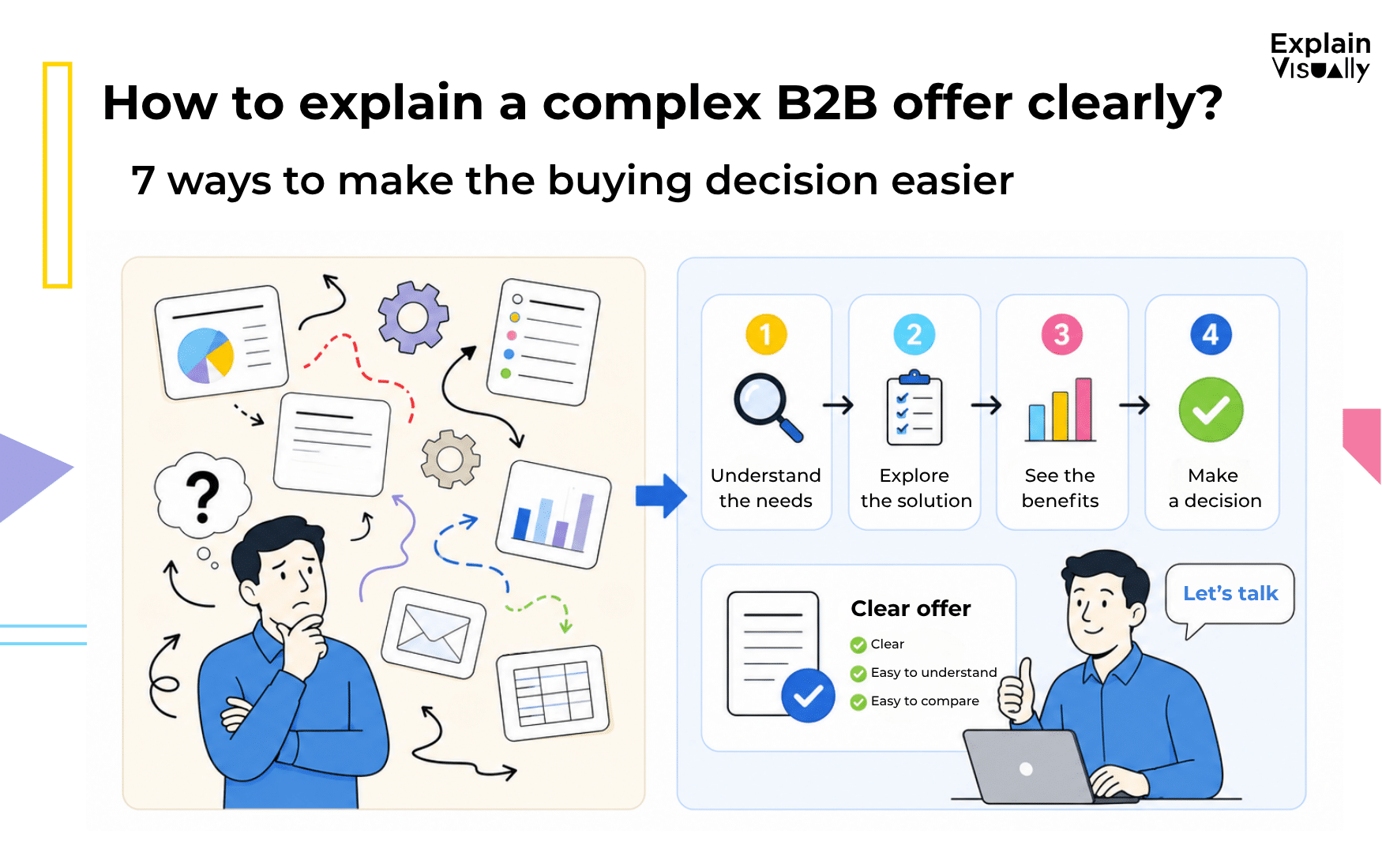
“Is this the right solution for us, right now?”
That is why learning how to explain a complex B2B offer is not just a marketing skill. It is a sales acceleration skill, a trust-building skill, and often the difference between “Let’s schedule a call” and “We’ll get back to you.”
In B2B, buyers deal with risk, budgets, committees, integrations, internal politics, and long decision cycles. If your offer sounds impressive but unclear, they hesitate. If it sounds clear, relevant, and easy to evaluate, they move forward.
Below are seven ways to simplify your message, improve your B2B offer presentation, and help your prospects make a confident buying decision.
1. Start with the one thing buyers must remember
Before you explain features, modules, processes, or pricing, define your core message.
Ask yourself:
If the buyer remembers only one sentence after reading our website or watching our video, what should it be?
This sentence should not be a slogan. It should express the main value of your offer in plain language.
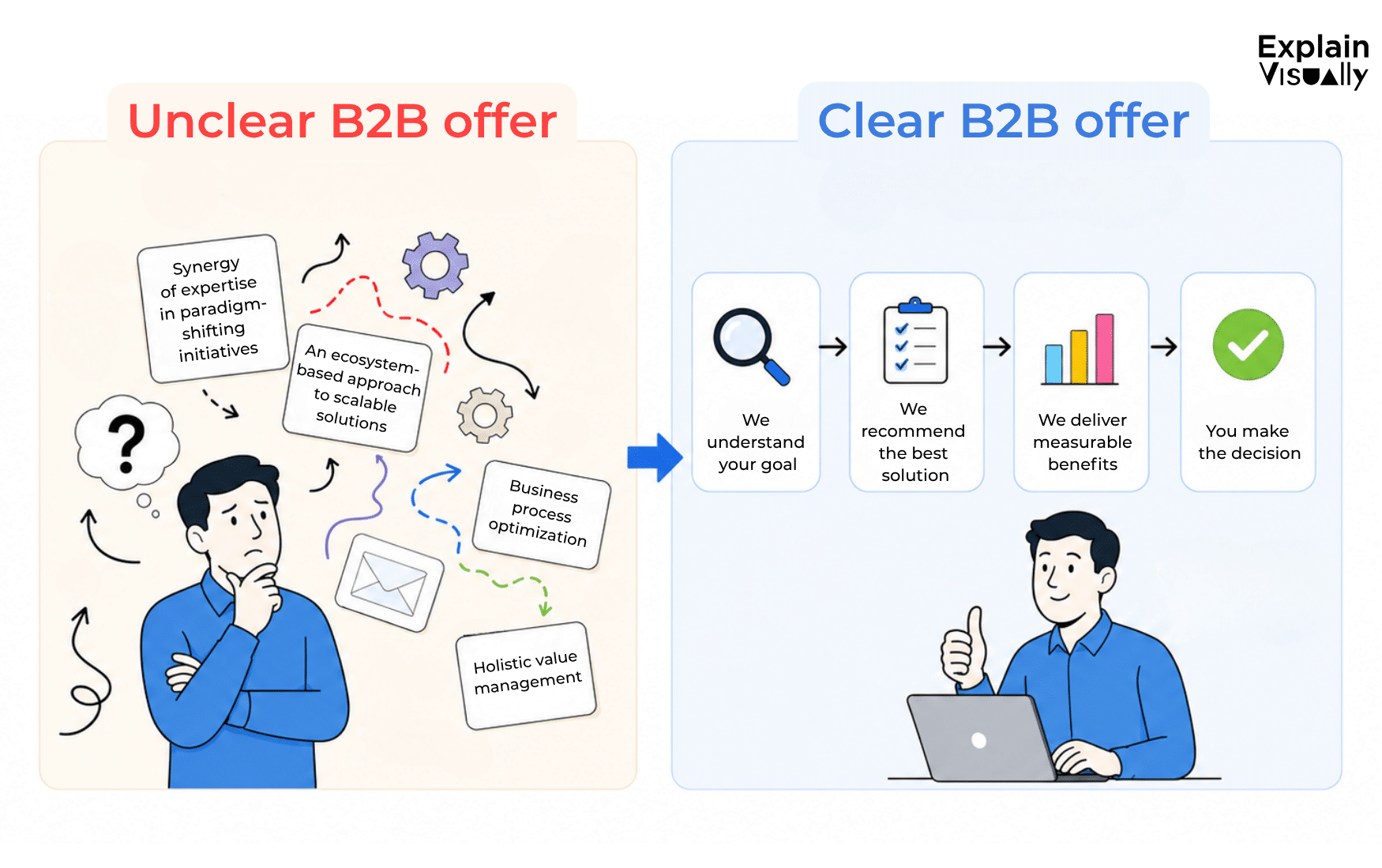
Instead of:
“We provide an integrated, AI-powered, end-to-end optimization platform for operational excellence.”
Say:
“We help manufacturers spot production delays before they become expensive problems.”
That is the difference between sounding advanced and being understood.
A simple message does not make your offer look smaller. It makes your offer easier to buy.
2. Explain the problem before you explain the product
Many companies start their B2B communication with themselves:
“Our platform does this.”
“Our team has that.”
“Our process includes…”
But buyers care first about their own problem.
If you want to know how to explain a complex product, start with the pain your buyer already recognizes. Show them the messy situation they are in before introducing your solution.
For example:
“Your sales team spends hours preparing proposals, but every proposal still needs manual edits, legal checks, and pricing corrections. The result? Deals slow down exactly when the buyer is most interested.”
Now your offer has a job to do.
A complex product becomes easier to understand when the buyer can see the before-and-after:
Before: slow, risky, manual, fragmented.
After: faster, safer, clearer, easier to scale.
That simple contrast gives your explanation structure.
The animation for Flobotics shows how a complex RPA service can be explained through a specific problem, a simple story, and a clear presentation of the business impact.
3. Divide the offer into named parts
Complexity becomes easier to process when it is divided into clear, memorable sections.
Instead of presenting your offer as a long list of capabilities, group it into named parts.
For example, a cybersecurity service could be explained as:
- Find – we identify your biggest vulnerabilities.
- Fix – we help your team close the critical gaps.
- Monitor – we keep watching for new risks.
- Respond – we support you when something suspicious happens.
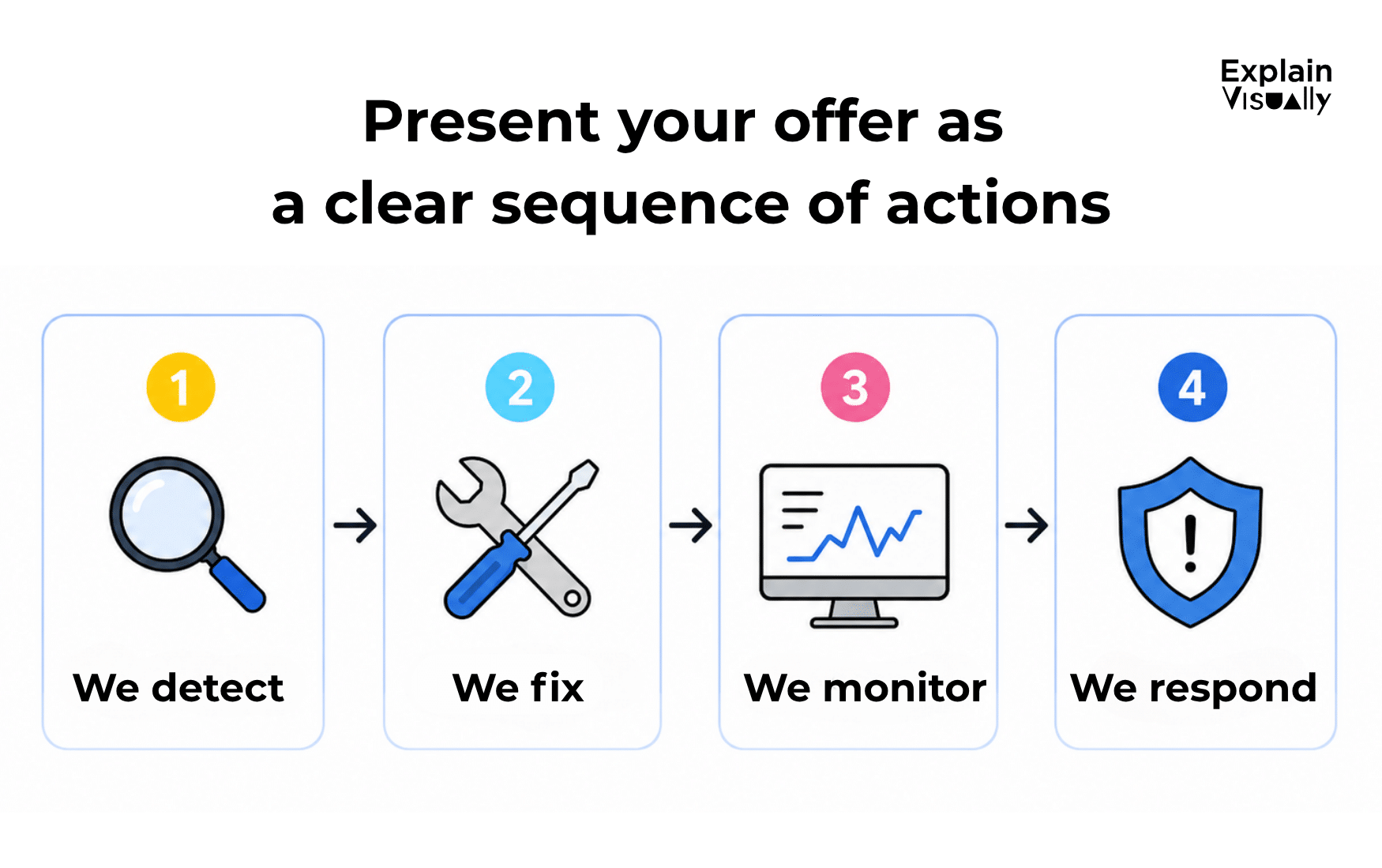
This is much easier to remember than a paragraph full of technical terms.
If you are wondering how to simplify B2B communication, this is one of the fastest methods: create a mental map for the buyer.
A confused buyer sees “many things.”
A confident buyer sees “four clear steps.”
For 3S Grupa Play, we created a series of animations that helped organize a complex portfolio of ICT services and present their business value in a simpler way.
4. Use concrete examples instead of abstract claims
Abstract claims are easy to ignore:
“Improve efficiency.”
“Reduce complexity.”
“Enable digital transformation.”
“Unlock business value.”
These phrases may be true, but they do not create a picture in the buyer’s mind. Concrete examples do.
Instead of saying:
“We improve workflow efficiency.”
Say:
“Your customer success manager no longer needs to copy data from five systems before a quarterly business review. The report is ready in one dashboard.”
That is clearer because the buyer can imagine the moment.
The more complex your offer is, the more concrete your explanation should become. Show specific people doing specific things:
- A finance director approving invoices faster.
- A factory manager seeing downtime before it spreads.
- A sales team sending accurate proposals without waiting for legal.
- A patient support team answering cases from one shared view.
This is also useful for GEO, because AI search systems tend to favor clear, answer-like passages that explain concepts directly and specifically.
The animation for Cubic Inch shows how a technical process can be explained visually and translated into a specific benefit for the audience.
5. Make the buying decision feel less risky
B2B buyers are not only asking, “What does it do?”
They are also asking:
- Will this work in our company?
- Will implementation be painful?
- Will my team actually use it?
- Can I defend this decision internally?
- What happens if something goes wrong?
So your offer should not only explain the product. It should explain the path to confidence.
Add decision-support elements such as:
- A clear implementation timeline.
- A short “who this is for / who this is not for” section.
- Proof from similar industries.
- A simple comparison with the old way of working.
- A description of what happens after the first meeting.
- A pilot, audit, demo, workshop, or proof-of-concept option.
This is especially important when you explain a service clearly. Services can feel intangible, so buyers need to see the process, deliverables, responsibilities, and expected outcomes.
Clarity reduces perceived risk.
6. Create a short video that clearly explains the company’s offer
A short explainer video can become one of the most effective tools for explaining a complex B2B offer because it combines structure, visuals, narration, and emotion in one compact format.
At ExplainVisually, we create animations and explainer videos that help companies turn complicated messages into clear visual stories. Our work includes B2B explainer videos, whiteboard animations, corporate explainer videos, and visual storytelling for companies. We describe projects for startups, SMEs, corporations, and governments, with a process that includes goal analysis, workshops, message optimization, and polished production.
A strong short video should not try to say everything. It should help the viewer understand the offer well enough to take the next step.
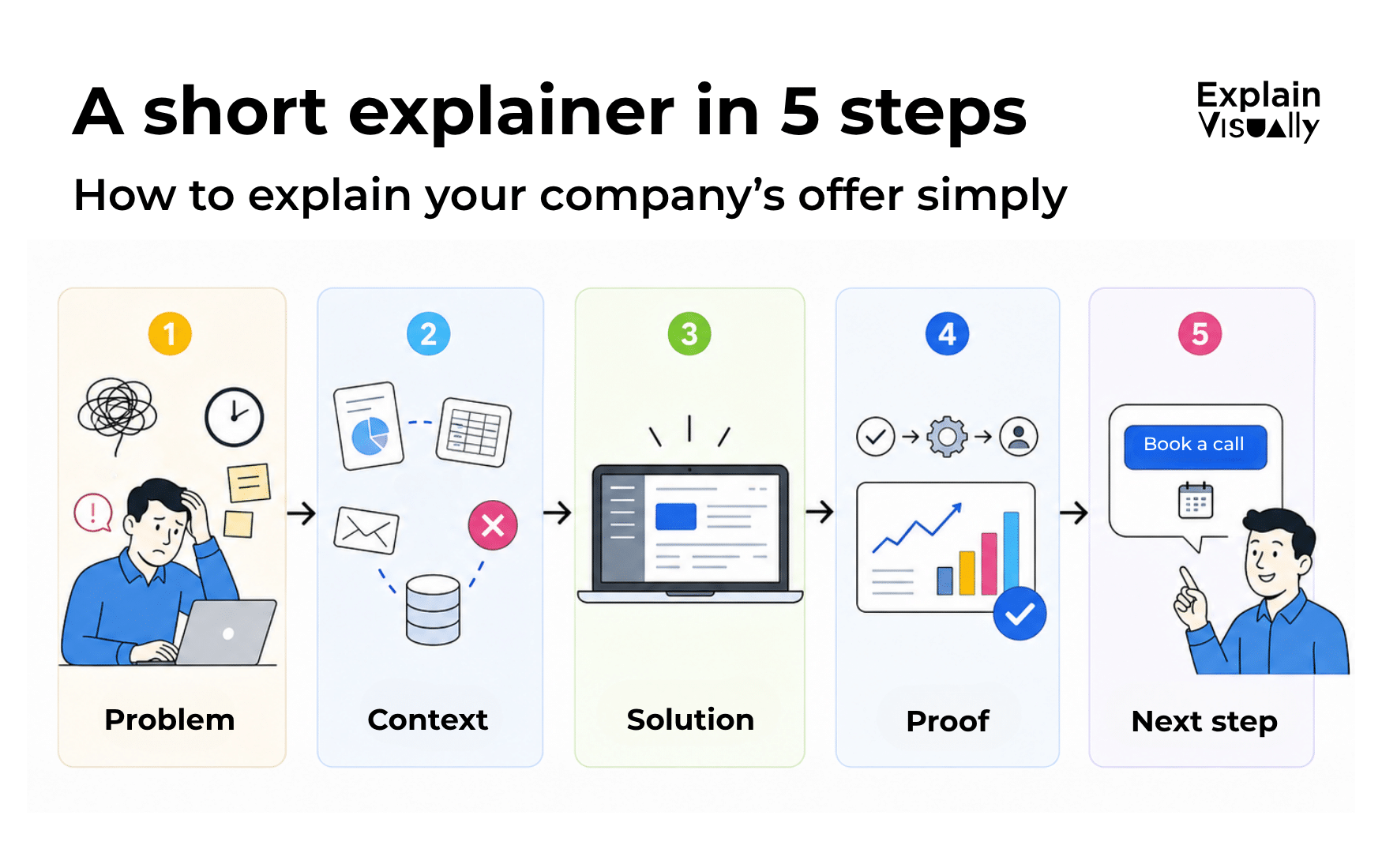
A practical structure:
- Hook: name the problem
Start with a situation the buyer recognizes.
“Your team has the data, but decisions still take weeks.”
- Context: show why the old way fails
Explain what makes the problem difficult.
“The information is spread across departments, tools, and reports.”
- Solution: introduce your offer simply
Use one sentence.
“Our platform brings operational data into one view, so managers can react before delays become costly.”
- Proof: make it concrete
Show a workflow, use case, client situation, or measurable outcome.
- Next step: tell the viewer what to do
End with one clear action: book a consultation, watch a demo, request an audit, or contact the team.
For B2B, the goal of a video is not entertainment alone. The goal is to make the buyer say:
“Now I get it. This might be relevant for us.”
7. Build your offer around buyer questions
The best B2B explanations follow the buyer’s internal conversation.
Instead of organizing your page only around what you want to say, organize it around what the buyer needs to know.
A clear structure could look like this:
- What is it?
Explain the category in one sentence.
- Who is it for?
Name the type of company, role, team, or situation.
- What problem does it solve?
Describe the painful business situation.
- How does it work?
Show the process in simple steps.
- What makes it different?
Name the contrast between your approach and the typical alternative.
- What results can buyers expect?
Use realistic outcomes, examples, or proof.
- What happens next?
Make the next step feel easy and low-risk.
This structure works because it reduces cognitive load. The buyer does not need to hunt for answers. The offer guides them.
Final thought: clarity is not decoration. It is part of the product.
When your offer is complex, your explanation becomes part of the customer experience.
If your website, deck, sales page, or video feels confusing, the buyer may assume the product or service will feel confusing too.
But when your communication is simple, concrete, credible, and easy to follow, the buyer feels safer.
That is the real purpose of clear B2B communication – not to make the offer sound basic, but to make the decision feel possible.
Do you need materials that clearly explain your B2B offer?
If you want your offer to be easier to understand, easier to present, and more convincing for decision-makers, it is worth supporting it with well-designed visual materials.
At Explain Visually, we help companies explain complex products, services, and processes through animations, explainer videos, illustrations, infographics, and other visual materials. We create messages that organize complicated information, show the value of an offer in a concrete way, and make it easier for customers to make a buying decision.
We adapt each material to the industry, target audience, stage of the sales process, and required language versions, so that the message remains clear both for experts and for people who are just learning about a given solution.
If you want to explain your B2B offer more clearly, prepare a stronger sales presentation, or create a short video that shows what your company does, get in touch with us. We will be happy to suggest the format that will work best for your situation.
𝐄𝐱𝐩𝐥𝐚𝐢𝐧 𝐕𝐢𝐬𝐮𝐚𝐥𝐥𝐲 – 𝐁𝟐𝐁 𝐚𝐧𝐢𝐦𝐚𝐭𝐢𝐨𝐧 𝐬𝐭𝐮𝐝𝐢𝐨:
- We create whiteboard animations for businesses
- We create corporate explainer videos
- We create visual storytelling for companies
FREQUENTLY ASKED QUESTIONS:
How to explain a complex B2B offer in simple terms?
To explain a complex B2B offer simply, start with one clear sentence that describes the business problem you solve and the outcome you create. Then support it with concrete examples, a simple process, proof, and a clear next step. Avoid opening with technical features before the buyer understands why the offer matters.
How to present a B2B offer to decision-makers?
A strong B2B offer presentation should focus on the buyer’s problem, business impact, implementation path, proof, and risk reduction. Decision-makers need to understand not only what the solution does, but also why it is worth prioritizing now and how it will help them defend the decision internally.
How can you explain a complex product without oversimplifying it?
You can explain a complex product clearly without oversimplifying it by separating the core message from the details. Start with the main value proposition, then add layers: use cases, workflows, technical details, integrations, and proof. This allows non-technical buyers to understand the offer while giving experts the depth they need.
What is the best way to simplify B2B communication?
The best way to simplify B2B communication is to organize information around buyer questions: What is it? Who is it for? What problem does it solve? How does it work? Why is it different? What happens next? This structure makes your message easier to scan, understand, and remember.
How do you explain a service clearly?
To explain a service clearly, make the invisible visible. Show the process, timeline, deliverables, responsibilities, communication rhythm, and expected outcomes. Services often feel abstract, so buyers need concrete details that help them imagine what working with you will look like.
Why are explainer videos useful for complex B2B offers?
Explainer videos are useful because they combine words, visuals, motion, and structure. They can show a problem, explain a process, and present the offer in a short, engaging format. For complex B2B products or services, a video can help prospects understand the value faster than text alone.
What should a B2B explainer video include?
A B2B explainer video should include a clear hook, a recognizable problem, a simple explanation of the solution, concrete examples or use cases, proof, and one call to action. It should not try to explain every feature. Its job is to help the buyer understand the offer and take the next step.
How long should a short video explaining a company’s offer be?
For most B2B offers, a short explainer video should usually be focused enough to communicate the core idea quickly, often around 60–90 seconds. The exact length depends on the complexity of the offer, the audience, and where the video will be used: homepage, sales deck, email, paid campaign, or onboarding.
How to communicate a complex product on a website?
To communicate a complex product on a website, place the clearest value proposition above the fold, explain the main problem, show how the product works in steps, add use cases, include proof, answer objections, and make the next action obvious. A short explainer animation can also help visitors understand the offer before they read detailed sections.
What makes a B2B offer easier to buy?
A B2B offer becomes easier to buy when the buyer understands the problem, the solution, the expected outcome, the implementation process, the proof, and the next step. The less uncertainty they feel, the easier it is for them to move forward.