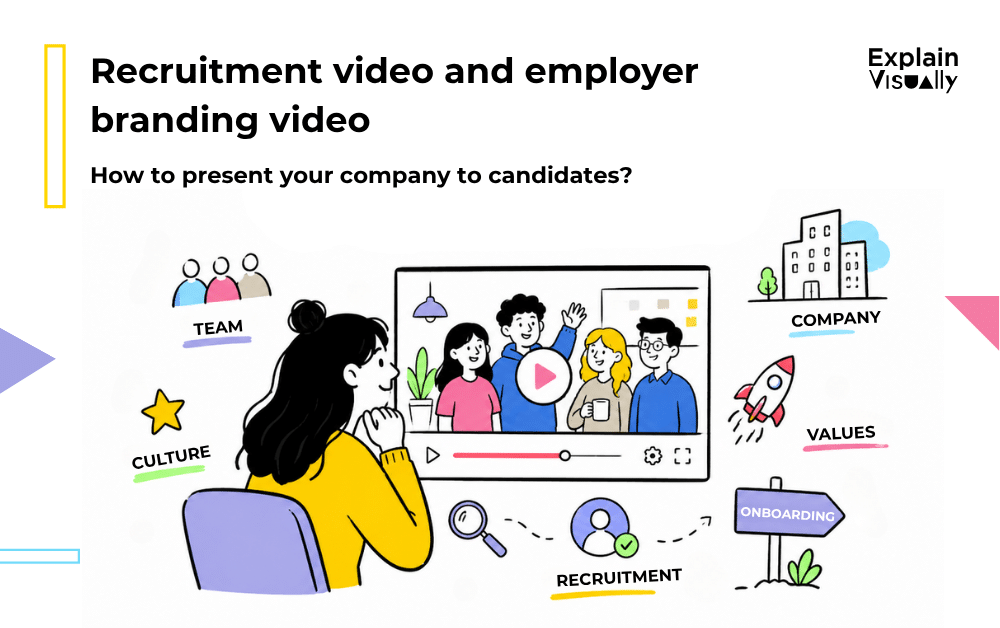
A job ad explains what a person will do. A recruitment video shows what it may feel like to work with you.
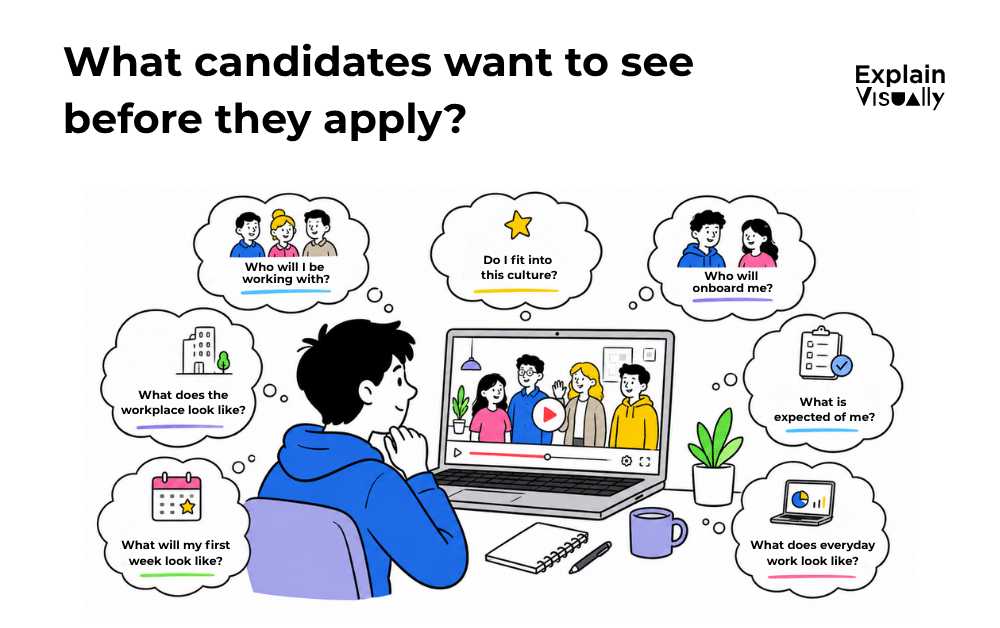
That difference matters. Candidates do not make decisions based only on responsibilities, benefits, or salary ranges. They also try to imagine the people they will meet, the atmosphere they will enter, the pace of work, the workplace, the values, and the everyday situations they may face.
A well-designed recruitment video helps them do exactly that. It turns a job offer into a clearer picture of your company. It can support employer branding, make the recruitment process more human, and help candidates decide whether your organization feels like the right place for them.
What is a recruitment video?
A recruitment video is a short video created to attract candidates and present your company as a workplace. It may focus on one role, one department, one location, or the whole organization.
A good recruitment video for a company does not simply say: “We are a great place to work.” It shows proof. It presents real people, real spaces, real tasks, and real reasons why someone might want to join.
Depending on the goal, a recruitment video can include interviews with employees, scenes from the office or production floor, animated explanations, day-in-the-life sequences, leadership messages, or practical information about the hiring process.
The best version answers the candidate’s silent question: “Can I see myself working here?”
Recruitment video vs. employer branding video
A recruitment video and an employer branding video are closely connected, but they are not always the same.
A recruitment video is usually more direct. It supports hiring for specific roles, teams, or locations. Its goal is to encourage candidates to apply and help them understand the opportunity.
An employer branding video is broader. It builds the image of the company as an employer over time. It may show company values, culture, mission, employee stories, diversity, development opportunities, or the impact of the organization’s work.
In practice, the two formats often overlap. A strong video for candidates can also strengthen employer branding. And a strong employer branding video can make future recruitment campaigns easier, because candidates already have a more concrete image of the company.
An example of such material is an animation we created for PGE, which presents the company’s work standards, benefits, and approach to employees. It is a film at the intersection of HR communication, employer branding, and recruitment – a piece of content that can be valuable both for current employees and for people considering applying to the company.
Start with one clear message
Before you write a script or plan the shoot, define the core message. Not five messages. Not ten values. One sentence.
For example:
“Here, engineers solve practical problems that affect thousands of users.”
“Here, production employees work with modern machines, clear procedures, and a team that supports them from day one.”
“Here, customer service is not a call center script, but a team sport.”
This sentence becomes the filter for the whole video. If a scene does not support it, remove it. If an interview answer sounds nice but does not strengthen the message, shorten it. If a beautiful office shot says nothing about the candidate’s future experience, use it only if it has a purpose.
Simple does not mean shallow. It means focused.
How to create a recruitment video: a practical structure
A clear recruitment video usually needs five parts.
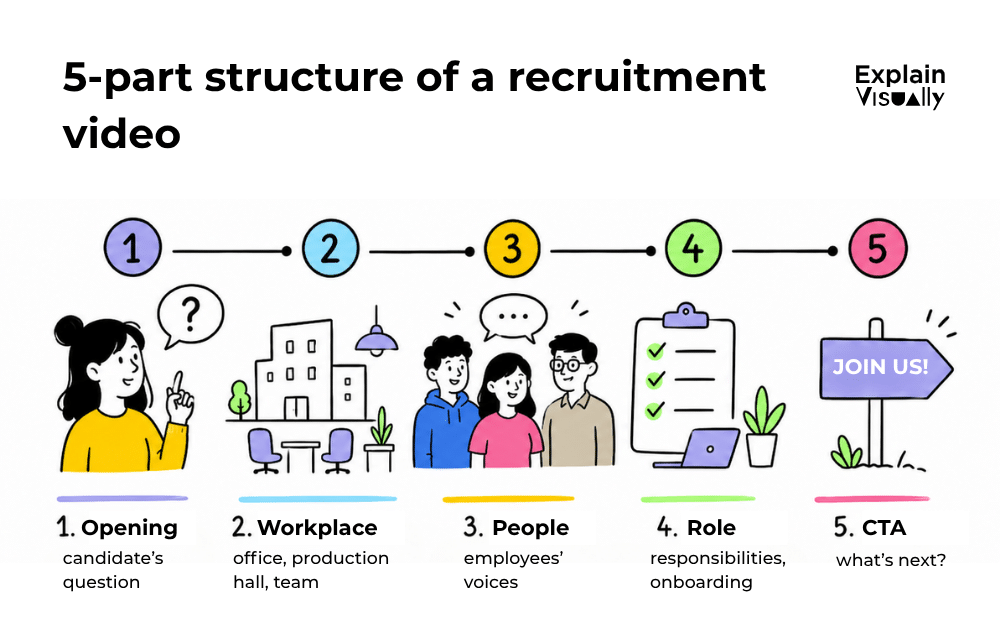
1. Open with what candidates care about
Do not start with a generic sentence like: “Our company was founded in…” unless the history is truly relevant.
Start closer to the candidate’s decision:
“What is it like to join our production team during your first week?”
“How does our sales team work when a client problem appears?”
“What kind of people thrive in our office?”
This creates a useful knowledge gap. The viewer has a reason to keep watching.
2. Show the workplace
For office-based employees, show the spaces where collaboration happens: desks, meeting rooms, common areas, onboarding sessions, workshops, team rituals, or quiet work zones.
For production employees, show the actual environment: machines, safety equipment, shift handovers, supervisors, team briefings, quality checks, locker rooms, canteen areas, and transport or parking if these are important in daily life.
The more concrete the video is, the easier it is for candidates to imagine themselves there.
3. Introduce the team
People trust people more than slogans. Let employees speak in their own words.
Ask questions such as:
“What surprised you after joining?”
“What does a good day at work look like here?”
“What helped you learn the job?”
“What kind of person will feel good in this team?”
This makes the company culture video more believable. Instead of describing culture as “open,” “dynamic,” or “friendly,” you show what those words mean in practice.
4. Explain the role or work model
Candidates want clarity. A recruitment video should not replace a job description, but it can make the role easier to understand.
For office roles, explain the team structure, typical projects, collaboration style, tools, meeting rhythm, and development opportunities.
For production roles, explain the shift system, training process, safety rules, physical requirements, quality standards, and what support new employees receive.
Animation can be especially useful here. It can simplify processes that are difficult to film: onboarding steps, production flow, safety rules, career paths, or how different departments cooperate.
How did Millenium Bank educate its employees on standards of customer service? [Case Study]
A similar mechanism can be used in recruitment and onboarding. In a project for Bank Millennium, we created a series of short animations that helped employees better understand and remember customer service standards. This type of material can show candidates not only “what we do,” but also “how we work on a daily basis.”
5. End with a clear next step
Do not finish with a vague “Join us.” Be specific.
Tell candidates what to do next: visit the careers page, apply through the job portal, contact the recruitment team, watch another video, or read more about the team.
A strong ending may sound like:
“If this looks like the kind of team where you could do your best work, see our open roles and apply.”
How to present company culture without sounding staged
The danger of employer branding is polishing the company until it no longer feels real.
Candidates can sense when a video is too scripted. Perfect smiles, empty slogans, and stock-like office scenes may look professional, but they do not always build trust.
A better approach is to show culture through moments.
Show a mentor explaining something to a new employee. Show a team solving a practical issue. Show how people prepare for a shift. Show what happens before a client presentation. Show the first day, not only the company party.
Culture is not what a company says about itself. Culture is what people repeatedly do.
That is why a recruitment video should include small, specific details: how people greet each other, how feedback is given, how safety is discussed, how managers support the team, and how new employees learn the job.
Recruiting office-based and production employees
Different candidates need different types of proof.
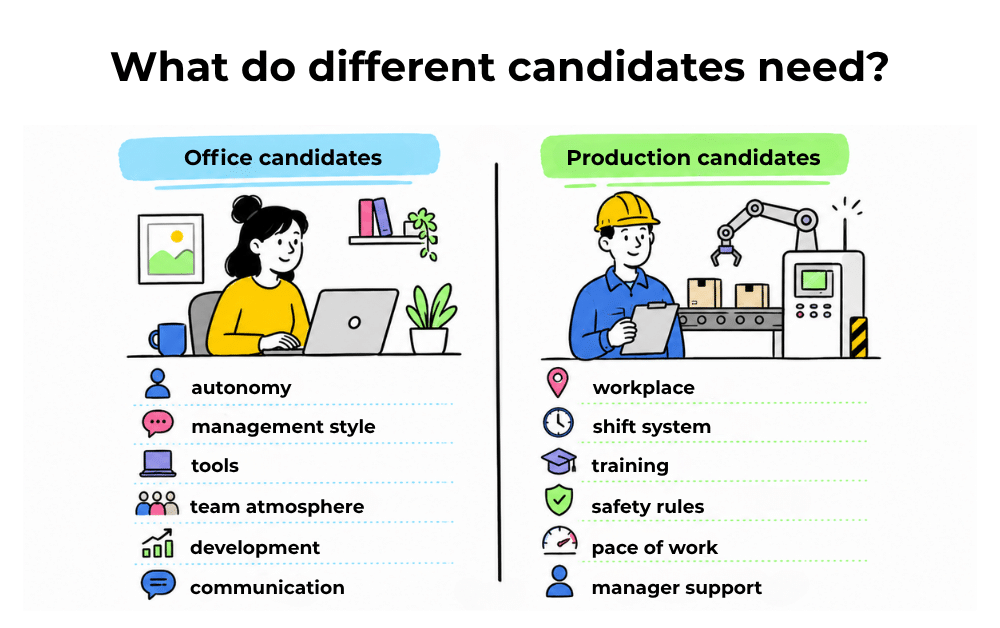
Office-based candidates often want to understand autonomy, team atmosphere, flexibility, leadership style, project ownership, tools, communication habits, and growth opportunities.
Production candidates often need very practical information: what the workplace looks like, how shifts work, what the first days involve, whether training is provided, how safety is handled, what the pace of work is, and who will support them.
A good example of this approach is the animation for Greenyard, in which a broccoli guide takes the viewer around the facility and explains the safety rules. This format can work particularly well when a company wants to present a production environment in a light, clear, and memorable way.
This does not mean you need two completely separate films every time. You can create one main employer branding video and shorter recruitment video versions for different groups.
For example:
- One 90-second company culture video for the careers page.
- One 30-second cut for LinkedIn.
- One practical version for production job portals.
- One team-specific version for office roles.
This makes the content easier to distribute and more relevant to each candidate group.
Where to distribute your recruitment video
A recruitment video should not live in one place only. Use it wherever candidates make decisions.
Careers page – place the video near job offers, team descriptions, or onboarding information. A careers page video helps candidates understand the company before they click “Apply.”
LinkedIn – LinkedIn works well for employer branding video content, employee stories, short culture clips, and recruitment campaign teasers. Use subtitles, because many people watch without sound.
Job portals – on job portals, the video should be direct and practical. Candidates are comparing many offers quickly, so make the message clear in the first few seconds.
Recruitment emails – a video for candidates can also be included in emails from recruiters. It gives applicants a warmer and more visual introduction before the interview.
Onboarding and internal communication – the same material can sometimes support onboarding. A video that explains culture, teams, locations, or procedures may help new employees feel oriented faster.
Why animation can strengthen a recruitment video
Not everything about work is easy to film. Some of the most important elements are invisible: values, workflows, safety rules, development paths, decision-making, benefits, or cooperation between departments.
Animation helps make these abstract topics visible.
In Explain Visually productions, we often use animation and visual storytelling to explain complex products, processes, procedures, and internal communication topics in a simple way. The same approach can support recruitment and employer branding.
For example, animation can show:
- How the recruitment process works step by step.
- What the first week of onboarding looks like.
- How a production line or office workflow is organized.
- How employees can grow inside the company.
- How safety, quality, or customer service standards work in practice.
A recruitment video does not have to be only live action or only animation. Often, the strongest format is a hybrid: real employees and real workplaces combined with animated elements that clarify the message.
We used a similar approach in materials for Carlsberg Supply Company AG, where animations supported onboarding, occupational health and safety training, and communication on screens in production facilities. Instead of presenting general rules, the films showed specific workplace situations: what happened, why it happened, what could be learned from it, and how to avoid a similar problem in the future.
What makes a recruitment video credible?
Credibility comes from specificity.
A candidate will trust “You will spend your first three days with a trainer on the production floor” more than “We offer great onboarding.”
They will trust “Our team has a 15-minute planning meeting every morning” more than “We communicate openly.”
They will trust “Anna joined as a junior specialist and now leads a team of four” more than “We support development.”
The more specific the scene, the stronger the employer brand.
Do you need a recruitment video for your company?
If you want candidates to understand your company faster, remember your offer better, and feel more confident before applying, a recruitment video can help.
It can present your team, workplace, culture, recruitment process, and daily reality in a way that text alone rarely can. It can also support HR teams across the careers page, LinkedIn, job portals, recruitment campaigns, and onboarding.
At Explain Visually, we create animations, explainer videos, promotional videos, instructional materials, infographics, and other visual content that helps companies explain complex topics clearly and attractively.
We can help you design a recruitment video, employer branding video, video for candidates, company culture video, or animated material that supports recruitment and onboarding. We adapt the format to your workplace, target group, language versions, and communication channels.
If you are planning to recruit office-based employees, production workers, or larger groups of candidates and need materials that will help you present your company clearly, get in touch with us. We will be happy to suggest the format that will work best for your employer brand.
- We create whiteboard animations for businesses
- We create corporate explainer videos
- We create visual storytelling for companies
FREQUENTLY ASKED QUESTIONS:
What is a recruitment video?
A recruitment video is a short video that presents a company, team, role, or workplace to potential candidates. Its goal is to help people understand what working at the company looks like and encourage the right candidates to apply.
What should a recruitment video include?
A good recruitment video should include a clear message, real employees, workplace scenes, company culture, practical information about the role or team, and a clear call to action. It should show candidates what they can expect, not just describe the company in general terms.
What is the difference between a recruitment video and an employer branding video?
A recruitment video usually supports a specific hiring goal, such as attracting candidates for a role, team, or location. An employer branding video builds the broader image of the company as an employer and may be used over a longer period across many recruitment campaigns.
How long should a recruitment video be?
Most recruitment videos work best when they are between 60 and 120 seconds. Shorter versions, such as 15- or 30-second cuts, can be useful for LinkedIn, paid campaigns, and job portals. Longer versions may work on a careers page if the content is specific and valuable.
How do you create a recruitment video for a company?
To create a recruitment video for a company, start by defining the core message. Then plan the structure, choose the right employees to feature, collect authentic workplace scenes, write a concise script, film or animate the material, and prepare shorter versions for different channels.
Can animation be used in a recruitment video?
Yes. Animation can explain processes, onboarding steps, safety rules, benefits, career paths, or company structure in a simple and visual way. It can be used as a standalone format or combined with live-action footage and employee interviews.
Where should a company publish a recruitment video?
A company should publish a recruitment video on its careers page, LinkedIn profile, job portals, recruitment landing pages, paid social campaigns, and in recruiter emails. The video can also be reused during onboarding or internal communication.
What makes a company culture video effective?
A company culture video is effective when it shows real behaviors instead of generic slogans. It should present people, work situations, team habits, communication style, leadership approach, and everyday moments that help candidates understand what the culture feels like.
Should production employees and office employees be shown in the same recruitment video?
They can be shown in the same employer branding video if the goal is to present the whole company. However, for specific recruitment campaigns, it is often better to create separate versions for office-based and production candidates, because each group needs different information.
Why is a video for candidates useful in recruitment?
A video for candidates makes the company more concrete, human, and easier to remember. It helps candidates see the workplace, meet the team, understand expectations, and decide whether the role fits them before they apply.